• SECRETS 13

    April 12th, 2023

    34

    Freemasonry. Solomon’s Temple – a new humanity

    There are many elements about Freemasonry, that has led me to believe, its origins reside in the secret teachings of Christ. This strange, non-Jewish western valorization of the Temple of Solomon (something never accorded the Jewish people), can then be explained, as a ritual model used in initiation; for those who would be perfected in early Christianity. It has already been made clear, from the writings of Peter, that such a model was in effect during those early days; when he exhorted the followers of Christ to be living stones, as Christ, and build a spiritual house.

    I have already written, that as with much else about the teachings of Jesus, this concept may have been inspired by the Essene monastic community, striving to embody a spiritual Temple of Solomon; because the earthly temple in Jerusalem had been polluted by the priesthood there, and could no longer be used.

     Considering this connection, it is meaningful, that scholars have commented upon the remarkable similarities, between the practice of Freemasonry and the Essenes. ‘At the first stage, the (Essene) initiate received an apron as a symbol of purity. At the final(third) stage, he took an oath of secrecy to preserve the magical mysteries. He swore by the number four, which was represented by ten dots in the form of a triangle. The parallels with later Masonic traditions of three degrees, lodge apron, secrecy oath, and recognition sign are striking.’1 It is difficult to believe, that somehow the Essenes themselves, were directly or indirectly, responsible for the Western model; particularly as they regarded Gentiles impure and were an insular Jewish group. It is much more feasible to view Freemasonry, as originating in the ritual practices of early Christianity, in the West.

    To further support this supposition, John, the Beloved Disciple, who is also identified with Lazarus – alongside John the Baptist – is a patron of Freemasonry. Harvey L. Ward Jr of the Grand Lodge of Florida in an article on the two Johns, asks: ‘Why have they always been linked to Freemasonry? Surely Masonry as we know it was not extant in the early Christian era, yet there is no period in Masonry where they do not appear.’2

    An early Church authority Tertullian c160-c220, said the disciples of John came to Britain, a view shared by the Eastern Orthodox Church, which maintained missionaries from Ephesus, where John is buried, came there in 42 AD.  So, it is highly likely, in and from that northern isle, that John’s secret teachings – which was a recognized strand of Gnosticism – was the well-spring for Freemasonry, particularly as it was John who had undergone a death and rebirth ritual, a ritual enshrined in Freemasonry.

    The Austrian philosopher Rudolf Steiner 1861-1925, the founder of the Anthroposophical Society, upon establishing his own Order of Egyptian Freemasonry; wrote of a legend concerning this branch of the craft. He recounted, it arose from an amalgamation of the secret teachings of Christ possessed by Mark, and those of Ormus, an Egyptian priest; an initiate of the mysteries of Isis.

    The authors of ’The Hiram Key’ write of a Balkan scholar, Dimitrije Mitrinovic, who in a lecture on ‘Freemasonry and Catholicism’, stated Freemasonry is an expression of Christianity: ’Christ betrayed the secret word of Masonry. . . to the people, and he proclaimed it in Jerusalem, but in saying the Senate word to folk, he was before his time. . . Let Masons receive Christ back into Masonry. . . Masonry has been the expression of Christianity for the last 2000 years.’3 He is not the first person to believe Jesus made available secrets to all (consider the works of Elaine Pagels), rather than allowing them to remain the privilege of the few – but this after all, is what is so remarkable about him.

    Most of this book has been spent, in outlining the ancient legacy, attached to the Davidic kingship Jesus set out to fulfil and transcend; this legacy has also become attached to the origins of Freemasonry.

    One of the oldest documents of the craft is the Cooke MS, dated 1450, which is thought to be an account from an earlier transcript. The Cooke MS relates, that a seventh-generation descendant of Adam the first man, Lamech, had two sons Jubal and Jabal. Jabal is the originator of geometry and masonry, and was the master mason of Cain, and built the first city Enock or Enoch. He was also said to have discovered musical notes, by listening to the metal working hammers of Tubal Cain. Giving masonry antediluvian antecedents, of course mirrors the account of Plato’s Atlanteans, possessing a mastery of building in stone.

    Another tradition links it to the Atlantean colony of Arcadia, and the Cabiri. According to A. H. Seabrook in ‘A Chronology and History of Freemasonry’, wherein different accounts of the craft’s origins are outlined, one of them states: ‘Of the secret associations, presenting many points of resemblance with the Masonic fraternity – the most ancient are the Cabiri mysteries, referable to a period closely approaching the Deluge.’  4

    Nimrod is also considered to be the originator of Freemasonry, instructing and organizing a fraternity of masons, whom he sent to aid the king of Nineveh in building his cities. According to ‘The Encyclopaedia of Freemasonry’ in some forms of the craft, an oath to Nimrod is taken by an indentured apprentice, which is said to be taken in the presence of El Shaddai. Conventional thinking on the matter would find it incongruous to pair a Mesopotamian king – despised within the Hebraic tradition – and the god of Abraham, Isaac and Jacob. But the narrative has already revealed El Shaddai is linked to the Mesopotamian World Mountain, and Nimrod and the lineage of Abraham are part of the same semi-divine race. Whoever designed the oath was aware of the elements that connected their histories. Perhaps awareness of this ancient legacy, was part of the message, the erudite Jesus imparted to his followers.

    I want to next look at the Three Degrees of Freemasonry’s Temple of Solomon, this will reveal its similarity with the spiritual house of Christianity – the blueprint for the perfection of everyone, part of the new humanity Jesus wanted to bring into being – for in Freemasonry the candidate undergoes a symbolic spiritual rebirth.

    The Three Degrees are titled: Entered Apprentice, Fellow Craft, Master Mason. Albert. G. Mackey writes in his ‘The Encyclopaedia of Freemasonry’ ‘The word degree, in its primitive meaning, signifies a step. The degrees of Freemasonry are, then, steps by which the candidate ascends from a lower to higher condition of knowledge.’5 This sense of undertaking a journey is why a Mason is called a ‘travelling man’, journeying to the east for instructions and to the west to plant and increase the knowledge he has gained. The journey is westward, until the Third Degree, when it is taken from the west to the east.

    In the lodge this journey is performed in the practice of circumambulation – moving in a circle around a central object or point – imitating the clockwise movement of the sun. The west is where the sun sets and is associated with the land of the dead and forces of chaos, the east is where the sun rises, having overcome the powers of darkness, reborn with renewed vigour. Such a movement is ancient, and has already been alluded to in the narrative, in connection to solar rituals.

    The journey of the candidate is then, symbolically the disintegration, death of his old being in the west, so that he may be reborn enlightened by a new understanding in the east. This solar importance extends to the two Johns, patrons of Freemasonry, as their birthdays are near the summer and winter solstices. And there is also the consideration that here again is a place of turnings, mirroring all those other places alluded to in the narrative.

    Tracing boards originated in the early days of the Craft, they are symbolic diagrams, drawn to instruct the initiate into the mysteries of the Three Degrees. Originally, they were drawn in chalk on the lodge floor, and at its closing, washed away to prevent the uninitiated from viewing them. In the eighteenth century, these floor drawings were replaced by painted floor cloths, and later painted wooden boards on trestles.

    First Degree

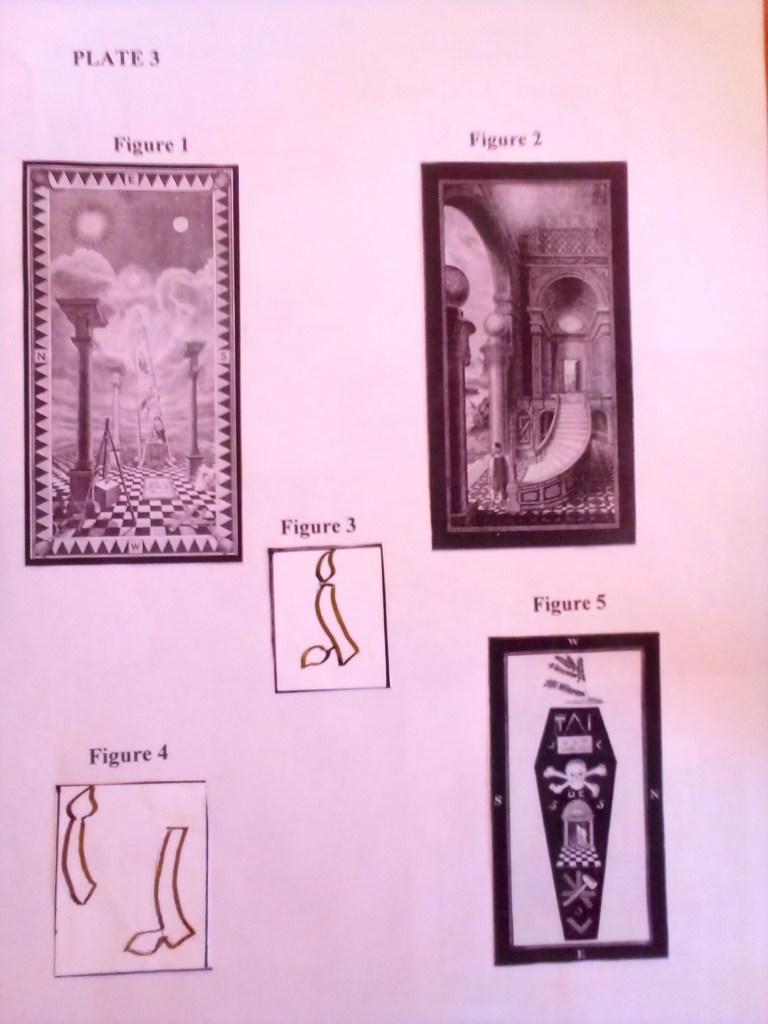
    The First Degree tracing board Plate 3 figure 1  contains these main elements: a rough stone and a dressed cubic stone with a metal clamp dovetailed into the stone, for being raised up by a pulley and set in place; these are called the rough and perfect ashlar (a large square cut stone). There are three pillars, the two to the fore, which often flank each other, are called Strength and Beauty. They are identified with the two pillars set at the entrance to Solomon’s Temple, Jachin and Boaz: Jachin – strength represents the masculine polarity of life and is often depicted with a sun(male) above, Boaz – beauty the feminine polarity is shown with a moon(female) above it. The third pillar, set further back, is called wisdom. The Freemason J. J. Crowther of the American North Raleigh Masonic Lodge, writing upon the Three Degrees, states that the entered apprentice comes to represent the pillar of wisdom.

    On most tracing boards, directly behind this pillar, is Jacob’s ladder; sometimes shown with angels upon it. The final element I want to highlight, is the presence of seven stars, sometimes shown directly above the ladder, and at other times beside a moon or on their own.  

    J. J. Crowther, writing about the two stones makes this comment: ‘The Rough and Perfect Ashlar are precise symbols of the process of initiation. In an Hermetic sense the Rough Ashlar is the prima materia (a formless primeval substance, the original matter of the universe), while the Perfect Ashlar is the Philosopher’s Stone.’6 The Philosopher’s Stone, the goal of alchemy, was a substance that transformed base metals into gold, at the same time transforming the baser qualities of the alchemist’s soul. So, these stones ‘precisely’ reveal, that the base elements of the initiate’s being, will be refined into spiritual gold. Only when this perfected state is realized, will the person/stone be fit to be raised up (by the metal clamp), to a higher level of being.

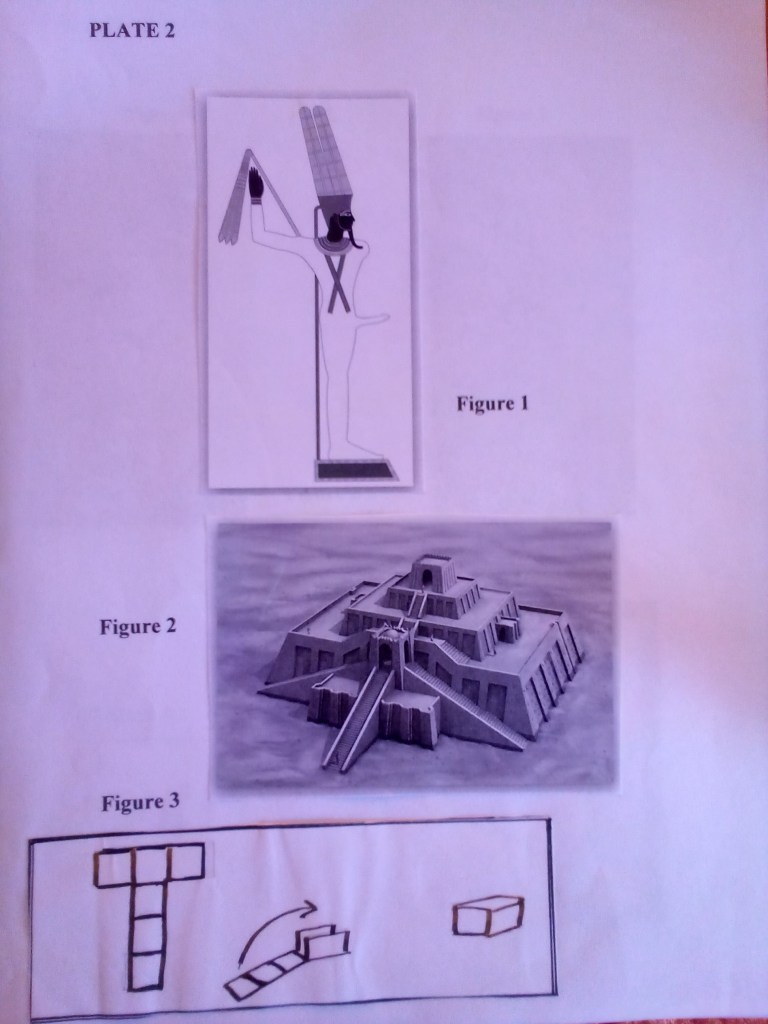
    The First Degree is performed in the north-east corner, which is traditionally where the first stone, the corner stone, is laid before the building is erected. The narrative has already encountered such a stone in relation to Christ, who transformed the unlovely rejected stone, through his T tau suffering as the World Pillar (as the candidate will suffer the annihilation of his baser self), into a precious corner stone. This, I believe, is another indication Freemasonry is based on early Christian initiation ritual, wherein the candidate (copying the actions of his master) lays the foundation stone; of the new spiritual temple of his own being.

    When the candidate has successfully laid the foundation for this new spiritual consciousness – becoming a ’living stone’ as Christ – must be the moment when he represents the pillar of wisdom. This third pillar, in conjunction with Jacob’s ladder, I would say, represents the pillar-stone Jacob erected at Bethel – it is then a navel pillar linking earth to the heavens and the Underworld. The presence of seven stars on the tracing board reflect the seven stars of Ursa Minor or Major and links this pillar to that prime cosmic link – the pole of the pole star.

    The candidate embodying the pillar, means he has transcended an earth-bound consciousness, as represented by the rough ashlar, and is transformed into the perfect stone; with a spiritual cosmic awareness. Before Christ this was the prerogative of kings, after Christ all humanity can experience this mystic journey. Well, perhaps not all, according to Wikipedia ‘The Anglo-American jurisdictions of ‘regular’ Freemasonry follow a set of traditions referred to as the Ancient Landmarks. . . frozen in time by Anderson’s Constitutions and similar works. . . still enshrined in the constitutions of the United Grand Lodge of England and many other Grand Lodges, is a description of the person who may be admitted to Freemasonry ’good and true men, free-born, and of mature and discreet age and sound judgement, no bondmen, no women, no immoral or scandalous men. . . (so a woman is equated with the worst of a man). For this reason, any lodge admitting women is considered irregular by mainstream lodges and Grand Lodges. Masons attending irregular lodges or subscribing to irregular jurisdiction are subject to immediate expulsion. . .  Continental Freemasonry has no such problems. The Grand Orient de France in 2010 allowed the initiation of women.’ 7 Oh well, people may become perfected, but it will take a lot longer to perfect human society. Although having written that, I doubt if there are many, or perhaps any, Masons who are looking for spiritual perfection through the craft – no matter how deep an impression the rituals have upon them – they are seeking perfect social and business connections.

    So, the First Degree, is about the candidate becoming a ‘living stone’, laying the foundation for his ‘spiritual house’.

    Second Degree

    The main elements of the Second Degree tracing board Plate 3 figure 2 are two flanking pillars, one with the globe of the earth at its top, the other with the sphere of the heavens; standing at the base of a winding staircase. The number of steps in the staircase can vary, it may consist of three, then five and then seven steps. Or thirty-six, divided into one, three, five, seven, nine and eleven. At the top the staircase is a corridor, at the end of which, is the open entrance to the middle room of the Temple of Solomon.

    Sometimes positioned over this entrance, is the blazing star of Freemasonry containing the letter G, or it is depicted in the upper area of the design. According to Prof Dr U Gauthamadas, the blazing star with a G inside appeared together, until the Baltimore Convention in 1843. Ironically, at the convention, the blazing star was discarded because it was thought to be too Christian, as it was linked in some accounts with the star of Bethlehem. So, the G was left to hang by itself, in lodges.  

    It is easy to imagine this journeying candidate, arriving at the foot of the winding staircase, the symbolic nature of the pillars flanking it, reveals the way ahead is taken between Earth and Heaven. The winding staircase, like the winding steps of Nimrod’s ziggurat, will bring the traveler one degree closer to the divine – the holy of holies – in the perfecting of his own spiritual temple. The entrance to the middle room of the temple, is depicted either with an open curtain, or with someone stood there, holding it open.

    When I thought about this Degree, it didn’t seem to have the power of the first, which has already shown these mysteries belong in an Earth-Heaven framework. So, it was meaningful to discover, in 1730 in England, the then First Degree was split into two to create the second, so, this entry into the Temple was the culmination of the First Degree.

    The most powerful things connected to the Second Degree are the blazing star and the letter G.

    From the many depictions of this star I have viewed, the majority show it in the form of a pentagram, although it is also shown as a star of David with six points, or in some degrees it is shown with seven or nine points. The authors of ‘The Hiram Key’, in compiling an archive of Masonic writings about the rituals of the craft, including those from its earliest days, found this reference to the blazing star.  ‘When the Pentagram or Blazing Star was to be seen in the east Moses called the Court together to initiate new Princes.’  A blazing star that is referred to as a pentagram can only be a reference to Venus, which has a long association with the pentagram.’8 Venus as the Morning Star, rises before the sun in the east, so it is understandable why the number of points possessed by the blazing star of Freemasonry, should be predominately depicted as five. In fact, it should be five. The narrative has already shown the Morning Star to be a symbol for perfected humanity, and of Christ who leads the way to such perfection; and this association may be the origin of it being regarded as the star of Bethlehem. It is ironic to be reunited with the goddess, in the blazing star of Freemasonry, in a society that bans women.

    But what of the letter G. In the many accounts I read about this G, while stating that it represents God and Geometry – which is subject to much debate – they also go on to mention the G of the Hebrew alphabet Gimel. Well, in Gimel, lies the true mysteries of the G.

    Gimel Plate 3 figure 3 is the third letter of the Hebrew alphabet, composed of Mem and Lamed Plate 3 figure 4, holding within its slender frame several associations. It can represent the Word, the Logos – the principle of divine reason and creative order – and its expression through the human throat. The Lamed part of Gimel meaning ‘to learn’ ‘to understand knowledge’ – composed of an Iod or Yod atop the upright column (that on its own is the letter Vav) – is said to represent the human head supported by the spine. This aspect of Gimel, reminds me of what Rudolf Steiner said about the esoteric meaning of the Masonic square – the instrument used by builders to ensure all corners form right angles – that the horizontal line symbolizes the earth plane, the upright line the human spine – indicating humans are the only creatures to walk in an upright position. So, standing on the square, one is measured as a human being, which confirms one is fit to participate in the mysteries; because one is equipped with the intellect and consciousness required to receive them.

    Gimel also represents an active male energy, and this is expressed in the Yod at the base of the upright column Vav, representing a phallus. In Gimel this male energy is linked to a feminine one, which is found in its relationship to a camel and the planet Venus.

    A camel carries its own life-giving water in its hump, an image symbolic of a pregnant woman and the uterine waters of the womb. This is the one thing, that makes sense, of this pairing of Venus and a camel. Venus as Aphrodite was born out of the foamy sea, she is mistress of the waters of emotions as well as the waters of life, in the cycles of life-death-rebirth.

    Gimel then represents the dichotomy of human nature, with a brain and a mind capable of the highest thinking; and at a lower level, the animal energies male and female utilized for procreation. It represents humankind. Placing this humankind within the pentagram of Venus, translates it into the perfected humanity, Christ wanted to bring into being. The G and the blazing star embody the very essence of Freemasonry and its early Christian roots, separating the G from the heavenly pentagram, shows how much understanding has been lost in the craft.

    The First Degree is conferred in the northeast where the sun rises on the day of greatest light, the second in southeast when the sun rises on the day of greatest darkness, and the third in the east where the sun rises at the vernal equinox – when light and dark are equally balanced – and it is in the east that it unites with the perfect light of Venus or Christ as the Morning Star. These three suns outline the blossoming of the new consciousness, forming in the temple of the candidate.

    Third Degree

    The main elements of the tracing board of the Third Degree Plate 3 figure 5 I wish to highlight, are an acacia tree growing at the top of a coffin, upon the coffin is a human skull atop two crossed thigh bones; below this is depicted a doorway, with a curtain drawn aside to allow entry.

    The travelling man, walking his own place of turnings, having arrived at the middle room in the temple, is now faced with that last step into the Holy of Holies and direct communion with the divine. Before such a communion was accessible only to high priests and kings, but Christ T tau of suffering has rent in two the curtain concealing the Holy of Holies. An event, after his death on the cross, recorded in the Gospels ‘And behold, the veil of the temple was rent in twain from the top to the bottom. . .’ Matthew 28: 51-2 symbolizing these mysteries are now accessible to all.

    The candidate has laid the foundation stone for his new spiritualized self, and now the way to the Holy of Holies is open, and direct communion with the divine. But entering within, sounds the death knell of his previous Earth-bound consciousness, and it is this, which lies within the coffin. This ’death’ of the candidate, is enacted within the course of the Degree, he is ritually struck murderous blows, and then is lowered backwards onto a funeral shroud on the floor, which is then draped around him. From this ‘grave’ the candidate is raised up again, by deacons and the presiding Worshipful Master. This ritual, just as the Blazing Star and the Masonic G, is also linked to the planet Venus, and her movement around the heavens. According to the online Australian Museum of Masonic Library, in a lecture upon ‘Venus and Freemasonry’: ‘When the candidate is raised from his tomb his head rises in a curve towards the East to meet Venus which is also rising above the horizon. The East-West line marks the equinox, the point of equilibrium between the two solstices, when there are twelve hours of light and twelve of darkness. It appears that some rituals of Craft Masonry are based upon astronomy and have a heritage well over five thousand years old. The Worshipful Master directs the candidate’s gaze towards the East, where he can see a five-pointed ‘star’ rising before the sun at dawn. The planet Venus as she moves around the sky touches the path of the sun in five places, just like the Worshipful Master embracing the candidate at just five points when he is raised.’9

    The candidate’s ‘death’ being but a prelude to rebirth, is symbolized by the presence of the acacia tree; growing atop the coffin. The acacia bush or tree, has a long sacred history, for the ancient Egyptians and ancient Greeks it symbolized resurrection and immortality. The ancient Egyptians associated it with the Tree of Life, and it is involved in the resurrection of Osiris. I have already mentioned the tale of Set imprisoning Osiris in a chest, and then dumping it in the Nile. In one account the chest is finally washed ashore at Phoenician Byblos, where a scented acacia tree gradually grew up around it; eventually completely encasing it.  The acacia representing his eventual resurrection.

    According to J. J. Crowther writing on the Three Degrees, in the Middle East there is a tradition, Christ’s crown of thorns was made from the acacia. The symbolism of regeneration, resurrection, immortality connected to the acacia, may arise from its fast growing and resilient nature, and for it existing where there is little water. According to Pliny in his ’Natural History’, if one were to cut the tree down, within three years it would be fully regrown.

    But there is another aspect to the acacia, that I’ve decided to bring into the narrative. There is the possibility, that a distillation of the actual acacia may have been used as a drug, perhaps in early ceremonies of Christian initiation. Such a drug is referred to as entheogen, derived from the Greek entheos ‘full of god’ and genes thai ‘to come into being’, and has a long history of being employed in sacred ceremonies.  It is known the ancient Egyptians used acacia in their religious ceremonies, and it has been discovered the acacia has psychoactive, consciousness altering properties. There is also speculation that they also used the blue lotus, the flower heads most probably soaked in wine or beer. Recent experiments with the draught found it produces a sense of euphoria, with tranquillizing effects. A more concentrated brew, of up to five flower heads, creates a hypnotic sedative state.

    Robert Graves has speculated, that the ambrosia used by pre-Hellenic tribes was the amrita muscaria mushroom, the mushroom of fairy tales with its bright red, white spotted cap; it has a hallucinogenic effect through its active ingredient muscinol. According to Pliny, the Greek priestesses of Apollo, consumed henbane before pronouncing their prophecies.

    In Hebrew culture, according to ‘The Living Torah’ a 1981 translation of the Torah by Rabbi Aryeh Kaplan, cannabis is mentioned in many sacred Hebrew texts, as well as henbane. The English scholar John Allegro 1923-1988, who joined an international team working to translate the Dead Sea Scrolls, became convinced there was evidence that the amrita mushroom had been used in Essene religious rituals; and that the practice was continued into early Christianity. The art historian Erwin Panofsky asserts there are several mushroom-shaped trees in Christian art.

      But returning to the candidate, who has undergone the rituals of the Three Degrees. At the beginning of the travelling man’s journey, he has been measured on the square, and found to be a human being. But now, at the end, he is a different man, having undergone a transformation, the base part of his nature having died; the remaining elements realigned into a higher state. This transformation requires a new form of measurement, which I would say, is represented on the coffin by the skull and crossed bones.

    I believe, they represent a secret form of pentagram, that symbol of a perfected humanity; their five points, mirroring the five points of the star and a human being. The predominant skull representing the powerful new form of consciousness, illuminating the candidate. The human being that was measured on the square and found to be an earth human being, can now be measured as a cosmic being embodying the mystic pentagram, the morning star; this skull is now the matrix of the spiritual temple of the new being, following in the footsteps of Christ  (or for those involved in Egyptian forms of Freemasonry Horus) the Morning Star.

    Attached to the dramatic ritual of the Third Degree, is the story of Hiram Abiff. The nature of the drama, which I will next describe, attached to his name; merely reinforces what the symbolism of the Third Degree has already revealed.  

    Hiram Abiff was a Master Mason and the supervising architect of Solomon’s Temple, knowledgeable in all the secrets of its construction. Three overseers, who did not possess these secrets, coveted them. They decided to waylay Hiram, within the precincts of the unfinished temple, after his noonday worship of the Most High God, and force them from him.

    The first approached him at the southern gate, and threatening violence, demanded the secrets of the temple plan. Hiram refused to divulge the secrets, and incensed the overseer struck him, with a plumb rule, a vicious blow to the right temple.

    Hiram trying to escape, staggered towards the western gate, and was confronted by the second overseer, who upon being refused as the first; struck a blow to Hiram’s left temple with a level.

    Hiram in pain and fearing he was in mortal danger, stumbled towards the eastern gate, where he met the third overseer, who upon being refused as the other two; struck a terrible blow to Hiram’s forehead with a heavy stone hammer or maul. This was the death blow, to an already grievously injured Hiram, who fell dead.

    The three overseers, no longer possessed by the fiery passions of violence, in horror glanced down at his stricken body. In the cold light of reason, they removed the corpse, burying it in a secret grave. They prayed their murderous deed would not be discovered.

    King Solomon, distressed by the sudden disappearance of Hiram, ordered a search. Eventually the searchers discovered his secretly buried body, beneath the sprig of an acacia bush.

    The blows to his left and right temples – the flat areas either side of the head – symbolizes that the ‘temple’ of his thinking has been destroyed. One could view the blows as demolishing the right and left cortex of the brain and the last, smashing the centre of the third eye the esoteric centre of consciousness, connected to the inner eye of the pituitary gland. Its destruction, allows for the resurrection of a new spiritual one, as symbolized by the acacia sprig growing over his unmarked grave.

    Hiram is referred to as the widow’s son, which in relation to these mysteries evokes the ancient Egyptian Horus, who was born from his widowed mother, after her performing a magical rite over the body of his dead father. Tammuz born from the dismembered body of the consort of his mother Ishtar. They embody, as I have explained, solar rejuvenating powers. Hiram Abiff the widow’s son of Freemasonry, embodies the sun as fount of reasoning powers, the higher intellectual faculties of the human mind; he is reborn, filled with this light, enlightened by a new higher consciousness.

    Next, I want to consider how Christ’s cosmic role and the humanity he wanted to usher into being, is reflected in alchemy.

    35

    Human alchemy

    Alchemy is firmly entrenched in the ancient view of life on Earth, being the microcosm, shaped according to the blueprint of the greater macrocosm. This world view, as I have previously outlined, is central to the legacy of cosmic kingship. Before I look at Christ’s role in alchemy, I want to consider the mythic history attached to the art.

    Alchemy bears many names, it is called the Great Work Opus Magnum, the Divine Art, the Royal Art Ars Regia, the Black Art and the Egyptian Art. The Black Art is said to refer to Egypt. The Ancient Egyptians named their country the red and black land, black for the fertile area along the banks of the Nile, and red for the barren desert surrounding it on two sides. And it is supposedly from the black land, that the word alchemy is said to derive, from kemp meaning ’black’ or from hem ‘black land’. Although I believe the ‘black’ referred to, is the Black Rite of Osiris.

    The ancient Egyptian Thoth, god of wisdom and writing, is called the originator of the art. The earliest known alchemical writing, is said to be the third century AD Leyden Papyrus, discovered in 1828, in a tomb in Thebes. The Egyptian art influenced Greek philosophical thinking, and it flourished during the Greco-Roman era, from its centre of influence in Alexandria.

    The Greeks called Thoth, Hermes Trismegistus, ’Thrice Greatest Hermes’, because he was a lawgiver, priest and philosopher. In relation to his Greek name, alchemy is also called the Hermetic art. When Arabs invaded Egypt in the seventh century, the meeting of the two cultures produced its own strand of alchemy; chiefly encapsulated in the works of Zosimos of Panoplis. It eventually flowed into the West, through Moorish Spain, with translations into Latin by such figures as Johannes Hispalensis c1140 and by Philip of Tripoli c1243.

     The main aim of alchemy was the discovery of the philosopher’s stone, which I have previously alluded to, that can turn base metals into gold; and in the process transform the nature of the alchemist, from a degraded to a spiritually refined one. At face value, there is a powerful contradiction in the concept, that such a materialistic pursuit could result in a spiritual flowering. Although a 1741 work on alchemy ‘Livre de Arephius Bibl. Des Philosophes Climiques’ states, any attempt at a literal translation of Hermetic writings, will result in a labyrinthine path of confusion.  

    The Philosophers Stone, in certain preparations involving mercurial water, was said to produce a red powdered sulphur, a ‘red tincture’ that when distilled creates the elixir of life or eternal youth, ‘elixir’ is derived from the Arabic al iksir means ‘miracle substance’.

    In the traditions attached to the origins of alchemy, many point to antediluvian antecedents, and the semi-divine race. Noah was said to have carried the Philosopher’s Stone aboard his ark. In the Palestinian Talmud it is a light source, illuminating the entire vessel. There is also the tradition, that Noah and his great-grandfather Enoch, both knew the secrets of alchemy. And in the 1678 alchemical work ‘Sophia Hydrdita’ Noah built his ark with the aid of the Philosopher’s Stone. It may be because of this precious cargo, that in Rosicrucian and other mystical writings, the ark itself is considered a source of wisdom. The Jesuit Athanasius Kircher 1602-1689 wrote it was greater; and more successful than Solomon’s Temple and the Tower of Babel. An interesting remark, both Solomon’s Temple and the Tower, were means of directly communicating with God, and the Ark was also where God directly spoke to Noah; and one can think it was more successful, because not only was it the equivalent of a floating temple, it also saved the chosen race from annihilation.

    The greatest teaching of alchemy is enshrined in the mythic Tabula Smaragdina, the Emerald Tablet. It first appeared in the ‘Kitab Sirr al-Asar’ probably dating from c800 AD.

    In one tradition it was said to be the stone, that fell from the crown of the angel Lucifer, the most splendid of God’s angels, as he plummeted to earth; upon being ejected from heaven for challenging the supremacy of God. In another account Lucifer was a cherubim in the garden of Eden, dissatisfied by the attention and importance God was bestowing on Adam and Eve, he was then thrown out of paradise; which also involved a fall from a great height, as it lay atop the World Mountain

    Lucifer is the Latin translation of the Greek Phosphorous meaning ‘light-bearer’, which in Hebrew is Helel ben Shahar ‘the shining one’. Lucifer’s name having these radiant meanings is explained, by his being equated with the Morning Star, that incarnation of Venus when it joins with the sun. In this context the stone that fell from his crown, being an emerald, relates to green being the colour sacred to Venus. His story appears to be based upon the astrological nature of Venus, having rose in solar glory as the morning star, once again falls into darkness as the Evening Star.

    In Isaiah 14:12 Lucifer is used as a metaphor for the downfall, from his high station, of a Babylonian king; overthrown by invading Persians. Early Christian theologians incorrectly viewed this fall of Lucifer, as synonymous with the fall of Satan in Revelations. But Lucifer is not Satan the adversary of God – the name Satan itself means ‘adversary’ – who in the Bible is a great dragon thrown down by Prince Michael. Satan is the principle of chaos in the universe.

     In Greek mythology a role similar to Lucifer’s is portrayed by Phaethon, son of the Titan sun god Helios, who I referred to earlier; whose ambition to drive the chariots of his father ended in disaster.  A comparable figure is found in the Babylonian Ethana, who wished to occupy the highest position amongst the gods, atop the world mountain, and was thrown down from heaven for his impudence.

     Lucifer is also identified as one of the fallen angels or Nephilim, in the Book of Enoch – the Hebraic version of the Titans. In the light of this connection, the stone, containing the secrets of alchemy, falling from his crown; must have its origins in the advanced knowledge, the semi-divine race brought to earth.

    As an aside, coming upon Lucifer the Morning Star, contaminated by earth-like ambition, and his fall from heaven, appears to be another expression of the mythology, which connects the beginning of earth life with beings fallen from a higher spiritual state. Adam and Eve thrown out of the garden of Eden, is perceived as a spiritual fall. The fall of the Titans, the divine part of their natures betrayed by material desires. The biblical fall of the Sons of God enticed by earthly pleasures. The Titans, the Mighty Ones, the Watcher lineage of Noah, the Osirian sky family who were called the children of disorder because of the conflict between Osiris, Horus and Set; are condemned for their fallen state, while the divine part was still superior to other mortals – Noah talked directly with God, Atlas linked heaven and earth, Osiris guided the dead to eternal life – and the advanced civilizing knowledge they possessed, still lauded: Noah is the Righteous One, Osiris Wennefer the perfect one.

    The journey of Venus through the heavens, appears to offer the celestial template for this spiritual fall, but thankfully also the way of redemption; Christ and initiates following a spiritual path, rise out of the darkness and embody the shining pentagram of perfected being; while Lucifer already occupying a high spiritual state plunges into darkness, which seems unredeemable. Christ and Lucifer, light and dark, embody the two aspects of the star of Venus.

    But to return to the Emerald Tablet, in other traditions, the Emerald Tablet is Atlantean, or it was found in a hidden cave by one Balinas, clutched in the hands of the preserved body of Hermes Trismegistus; or the antediluvian Seth, the son of Noah, possessed it – perhaps he read the inscription, on the long journey in the ark, by the light of the Philosopher’s Stone.

    The main message of the Emerald Tablet is encapsulated in the maxim: as above, so below as below, so above.  According to the alchemist Albertus Magnus ‘Hermes says ‘the powers of all things above originate in the stars and constellations of the heavens: and that all these powers are poured down into all things below by the circle called Alaur, which is, they said, the first circle of the constellations.’ This descent is ‘noble when the materials receiving these powers are more like things above in their brightness and transparency; ignoble when the materials are confused and foul, so that the heavenly power is, as it were oppressed.  Therefore they say that this is the reason why precious stones more than anything else have wonderful powers.’ 11

    So, inscribed on the green stone fallen from Lucifer’s crown, is the message that alchemy is a cosmic art, or spiritual science: performed within the framework, and manipulation of macrocosmic forces, originating in the stars. This explains how it can embody an earthly part, the material refining of substances into a miraculous gold; and a heavenly one, transforming the debased spiritual being of the practitioner, into refined solar gold. This Earth-Heaven template for the science, of course reveals its ancient roots, embedded in the earliest thinking that transformed the stars into messages about Earth life. It is then understandable, there exists antediluvian traditions around its origins; such as in the tale of Noah and Seth.

    In alchemy the seven metals are intimately connected to the seven planets: gold – sun (interestingly the sun contains 2.5 trillion tons of gold, the ancients understood more than we give them credit for), silver – moon, copper – Venus, iron – Mars, tin – Jupiter, lead – Saturn, quicksilver (liquid metal Mercury) – Mercury. Gold was considered the king of metals, emulating the sun the ruler of life on earth, without its light, there would be no green, fertile and fruitful world.

    The Philosophers Stone, the alchemists strove to create, was itself considered a higher form of gold, it was referred to as ‘living gold’, and a ‘pure fire’. The alchemist George von Welling 1656-1725, in his ‘Opus Mago-cabbalisticum Et Theosophicum’, defines this ‘pure fire’ not as the mundane fire that is used in cooking ovens, but the vital regenerative principle in the light rays, emanating from the sun. This invisible ’pure fire’, he maintains, propagates into being the seed-like forms of all things connected to the earth, that are lying dormant in its middle. This pure fire of the alchemists is then, the vital principle of life itself.

     In the first stage of alchemy, the prima materia the material in the retort undergoes a refining and putrefaction process. In the second stage the matter is fixed, symbolized by the swan, transformed from putrefaction into a lunar tincture, a white elixir. In pharmacological terms, a tincture means an alcohol, or alcohol and water, infused with animal, vegetable or chemical ingredients. In the third stage, a symbolic royal wedding of the sun and moon, gives birth to the pelican or phoenix, producing a solar tincture that can transform base metals into gold, and from its red powdered sulphur, distilled in mercurial water, the elixir of life. The phoenix, representing the pure raw regenerating energy of the sun, is now harnessed in a portable retort.

    This pure fire, which becomes fixed in the substance of the Philosophers Stone, explains its ability to purify base metals, transforming their molecular structure with the vital solar imprint of gold. Its regenerating solar nature, also explains a mercurial elixir of life obtained from the stone, transforming cellular decay and aging into eternal youth. Creating it, burns away the baser elements of the alchemist’s own nature, in alchemy the fallen state of humanity was called the black sun’s fire; well now this dark fire in the alchemist’s being is replaced by a shining spiritual beacon; not only that, he is master of life itself, and like the sun can rule over the realms of nature.

      The Christ that finds expression in alchemy, lost to mainstream Christianity, is the cosmic one. This Christ is evident in the first Rosicrucian manifesto, a public declaration, purported to originate in a secret brotherhood of alchemists and initiates. In 1614, they published anonymously in Kassel Germany, the ‘Fama Fraternitatis Rosae Crucis’: ‘The Fama begins by trumpeting God’s recent revelation to men of the perfect knowledge of Jesus Christ and nature so that they may renew and perfect all arts. In this way, man may understand his own nobleness and worth, and why he is called Microcosmic, and how far his knowledge extends into nature.’ 12 This microcosmic humanity it reflected in a Rosicrucian drawing, in which a human being is depicted as composed of three worlds – mirroring the Earth-Underworld-Heaven template of the macrocosm.

    In ‘Uraltes Chymishces Werk’ by A. Eleazar 1760, the image of a snake entwined around a tau cross, is identified as Nehushtan, the one erected by Moses. I referred to this snake earlier, which healed the snake bitten Israelites, when they were wandering in the wilderness. It is the one Christ identified himself with, the text refers to this snake, as the mercurial elixir of the crucified Christ – mercurial elixir is another name for the drinkable gold elixir of life, or eternal youth. In this alchemical tract Christ’s solar, regenerative powers (which the alchemists probably regarded as the purest of solar pure fire) represented by the serpent, which he said would bring eternal life, has become equated with the elixir of eternal youth.  

    A plate in Alexander’s Roob’s ’The Hermetic Museum. Alchemy and Mysticism’ depicts, from the ‘Hermetische Schriffen’ 1786, the fifteenth century monk Vincent Keffslkhiier or Ktheoffshy, who belonged to a Danzig monastic Order. The monk is kneeling before a Christ crucified upon a tree, the mass of foliage above his head shaped into seven triangular-shaped points. A jet of fluid is issuing from Christ’s side and it is being captured in a chalice, held by the kneeling monk. The accompanying text identifies the fluid as the tinctured blood of mercurial Christ who has been crucified on the tree of seven metals – hence the seven points. The ’tinctured blood’ or ‘red tincture’, is of course a reference to the substance produced by the Philosophers Stone, which when mixed with a mercurial fluid and distilled, produces the elixir of life. The alchemists, as I have written, also referred to this transformation as the pelican.

    The pelican, preserving fish in a great pouch-like crop under its beak, regurgitates the fish to feed its young, leaving a red streak of fish blood down its breast. This bloodied bird, who appeared to be using its own life’s blood to sustain its young, became a symbol in Christianity for Christ shedding his blood to redeem humanity. In the case of the cosmic Christ, his ‘blood’ is a vital solar product, at Golgotha regenerating the consciousness of first Adamic humanity; for the alchemists it was symbolic of the pure solar fire, that had a physical and spiritual working.

    In the background of the plate depicting the monk Vincent and the alchemical Christ, is a group of solid-looking, cylindrical ovens, one large and three small. It may be in reference to these ovens that Alexander Roob has added by the side of the plate, a quotation from ‘Vom Hylealischen Chaos’ by H. Khurath 1708, dealing with the practical task of cooking the alchemical mixture, stressing the alchemist should not be dismayed, but sweat gladly, for the benefits of the labour will be worth it.

    In what type of oven, does one cook the red tincture of the crucified Christ? It would have to be one based on a cosmic model, which is strikingly obvious in a sixteenth century representation of an alchemist’s triple oven, in the ‘Prehosa Margarete’ by Janus Lacinius 1577-1583. In a plate from this work, a triple oven is depicted as three walls enclosing a central space where a red woman is perched in a fruit laden tree, growing from a raging fire. The commentary on the plate, states that the two figures standing before this triple-walled structure, represent sulphur and mercury – viewed as the base elements of matter – which is worked on in the three phases of decay and refinement, until the last stage is reached in the central courtyard. This last stage produces the elixir, drinkable gold of eternal youth.

    This symbolic triple oven forcefully reminded me of Plato’s description of Atlantis, and to emphasize this connection, the woman sat in the tree offering immortal life, evokes the apple tree of immortality in the Garden of Hesperides, guarded by the daughters of Atlas. For me this oven, is an expression of the ancient legacy this book has outlined, manifesting in alchemy alongside the secret teachings of Christ.  This oven in the ‘Prehose Margarete’ is then a cosmic oven, the cooking of physical elements in a material oven based on this cosmic model, was doubtless performed at certain sidereal and solar alignments.

    This transformation of the raw elements of physical existence, is also embodied in the Black Rite, found in Hermetic writings. It is identified with the magical act performed by Isis, as previously related, when she attached an artificial phallus to the reassembled pieces of Osiris’ dismembered body, and thereby created new life in the being of their son Horus. This is the miracle of the Black Rite, to produce life out of dead matter, in fact long dead matter in the case of Osiris. This regeneration, as I have shown, was a solar one, the new born sun bringing back to life the decayed, dead matter of the earth and his magically acquiring immortal life, a deathless state.

    As I remarked earlier, I believe the Egyptian ‘black’, the origin for the word alchemy, refers to this black magical rite.  Life (Horus), in the midst of death, embodied in Osiris, is connected to his being as powerful a solar regenerative symbol as Christ. The rebirth of the dead Osiris into eternal life is represented by the phoenix (solar energy) in all its glory, flaming into being over his tomb of matter. This is why the process connected to the production of the elixir of life, is also referred to as the phoenix, for Osiris and his successor Christ both embody the same solar powers. They lie behind alchemy being called the royal art Ars Regia – because of course, both Osiris and Christ were kings.

     The allure of an elixir of eternal youth – mortal flesh cheating the cycle of decay in a perpetual summer of existence – must have inspired many to become an alchemist. When in China, a monk was thought to possess this secret, the mighty and pitiless Genghis Khan, pleaded with him in a letter to take pity on him, and grant him this knowledge.  China’s first emperor Qin Shihung instigated a nationwide search for the elixir of life, which was said to have been discovered in the central province of Hunan. Chinese alchemists had always accepted, that the work could produce a physical elixir of long life. When the alchemist Ko Hung was asked about how possible an elixir of life was, he replied that the deaf cannot hear stormy weather or music, or the blind see the splendour of the sun and yet these things existed. Stalin funded a research unit in the Ukrainian Academy of Science, to enable Professor Alexander Bogomolet to work on the question of longevity. The Professor had designed a serum composed of equine blood, human spleen cells and bone marrow from healthy young accident victims, in his search for the secret of long life.

    The Black Rite’s goal of creating life out of dead matter, is reflected in the opinion of the learned Arab alchemist Jabir ibn Huyyum c721-c815 AD, known mainly by his Latinised name Geber, that the ultimate goal of alchemy was Taksim – the production of artificial life. His ‘Book of Stones’ includes recipes for the manufacture of scorpions and snakes, and miniature humans, called homunculus.

    Homunculus are also referred to in the writings of the alchemist Zosimos, in which he encounters them in several visions. In 1616, the Rosicrucian treatise ’The Chemical Wedding of Christian Rosenkreutz’ refers to the creation of two such miniature humans.

    The Swiss physician Paracelsus 1493-1541 describes how to create such a being in his ‘Denatura rerum’ ‘That the sperm of a man be putrefied by itself in a sealed cucurbit for forty days with the highest degree of putrification in a horse’s womb, or at least so long that it comes to life and moves itself, and stirs, which is easily observed. After this time, it will look somewhat like a man, but transparent, without a body. If, after this, it is fed wisely with the Arcanum (mystery) of human blood, and be nourished for up to forty weeks, and be kept in the even heat of the horse’s womb, a living human child grows there from, with all its members like another child, which is born of woman, but much smaller.’13

    In 1775 Count Johann Ferdinand von Kufstein working with a Abbé Geroni, said they had created ten homunculi, that had the ability to foretell the future. They were reportedly kept for a time, in glass containers in a Masonic lodge in Vienna, of which the Count was a member; and seen by several people, including those of social standing.

    In 1836 Andrew Crosse, conducted experiments with electricity on siliceous salts, discovered to his intense surprise, living forms, with motion of their own, which he termed ‘Acari’. The renowned Michael Faraday1791-1867, who discovered electromagnetic induction, and in demonstrating electromagnetic rotation, provided the key to the electric dynamo and motor; produced the same living beings through his own experiments.

    In the 1930s, a British biochemist Morley Martin, was conducting experiments with rock, from the earliest geological period of the earth. He heated it to ash, added various chemicals, and discovered the presence of living prehistoric protoplasm in his samples. He witnessed the protoplasm forming into globules of matter, which eventually produced vertebrae, head, eyes, teeth and claws – transformations observed by a number of witnesses. He further subjected these basic life forms to x-ray bombardment, which he claimed produced a race of small fish. These results, if true, give a completely different view of how life is propagated, and the nature of life itself, as to that accepted now.

    This ancient model is similar to the supramundane (transcending or superior to the physical) morphic (from the Greek morphê meaning ‘form’) fields, the biologist Rupert Sheldrake b1942, has concluded, after years of extensive research, are responsible for the shapes things take. DNA, and their working subunits genes, chemical information centres with instructions governing the development, and nature of cellular construction; do not account, he maintains, for the different shapes things take. For instance, the Hox developmental switch gene that is very similar in fruit flies, fish, and mammals, nevertheless does not produce for instance, human beings resembling fruit flies.

    He considers morphic fields, which are spatial, temporal higher vibratory patterns – a natural memory bank – are responsible for the ultimate form the living system embodies. He also views them as collective in nature, uniting a whole species, lying behind the phenomenon of skills acquired by trained laboratory rats, also being exhibited by untrained ones in the same facility.

    The difference between Rupert Sheldrake’s view and the ancient one, is that he interprets this template as created by the repetitive events of continuously forming living systems, that has imprinted this supramundane blueprint – rather than viewing it as the work of the creative intelligence behind the manifested universe.

    Remaining with the ancient microcosmic-macrocosmic template, and considering it in relation to planet earth, how real are the effects of activating or just maintaining the navel places of the earth?

    36

    Planetary alchemy

    Researching the World Pillar for this book, I was amazed at the uniformity of thinking world-wide, from such diverse cultures as found in Mexico and Mesopotamia; regarding the existence of a cosmic link, that united the three realms of Earth-Underworld-Heaven.

    The Mayan civilization – accomplished astronomers and astrologists as the Mesopotamians – occupied south-eastern parts of Mexico, Guatemala, Belize and parts of Honduras, establishing by 500 BC cities with monumental architecture, including stepped pyramids. They believed a World Tree, with its roots in their underworld, Xibalba or Meltansituated under the earth, united the Earth and the Heaven. Their Underworld, mirroring the Hebrew one, was a place of primeval waters and many rivers.  It could be entered by underground caverns, called cenotes, or underground pools. There was also an entrance located in the heavens, along the road of the Milky Way, like the Greek Corona Borealis.

    Their stepped pyramids had temples dedicated to different gods situated on the top, and there is also evidence they situated their pyramids over sites, that were regarded as entrances to the Underworld – mirroring Mesopotamian ziggurats.  The great stepped pyramid of Kukulkan, known as El Castillo, towering over the Mayan city of Chichen Itza, in the northern Yucatan peninsula of Mexico; was built over an underground cavern or cenote, and has a river running through it. Beneath the Mayan Temple of Inscriptions at Palenque in south-eastern Mexico, lies the tomb of the great ruler Pacal. Under this tomb, archaeologists have discovered a water tunnel, which they believe was constructed to facilitate the passage of the spirit of Pacal, to the Underworld. Upon the lid of his sarcophagus, he is depicted lying beneath the World Tree, this may represent either his descent into the Underworld; or his resurrection and emergence from that dark domain, in ascent to the paradise world of the gods above.

    Is this planet wide microcosm-macrocosm understanding, shared by peoples so diverse, an indication that they were all tapping into the same reality about human life and the earth, that present mainstream thinking fails to recognize?

    Just as the human navel lies at the centre of the enteric nervous system – which is known as the body’s second brain, with a complex neural network, embedded in the oesophagus, stomach and large and small intestines – so did the ancients perceive an Earth navel as a central node at the heart of an elaborate energy network. This network was three-fold in nature, mirroring the template at the heart of these mysteries – Earth-Underworld-Heaven. In this thinking the Earth, as much as a human being, is a living reflection of the macrocosm.

    The British archaeologist Alfred Watkins 1855-1935, recognized there existed a number of ancient straight tracks, across the British landscape, which linked different prehistoric sites and natural features such as: burial mounds, barrows, cairns (man-made mounds of rough stones), cromlechs or dolmens (megalithic tombs with a large flat stone laid on upright ones), standing stones, stone circles and churches built over old sacred sites. They also connected sites where water was found: ponds, springs, wells, fords, marshes, moats. These ‘old straight tracks’ or ‘archaic tracks’ he termed ‘ley lines’ from the Saxon lea meaning ‘open space’.

    The traditions attendant on this network – which connects many prehistoric burial grounds – refer to them as ‘spirit lines’ and ‘death roads’, straight paths for the spirits of the dead to take to the Underworld, like the underground water path created for the passage of the spirit of the Mayan Pacal. The ley lines clearly then, have a spiritual dimension.

    There is also much evidence that the sites, which are connected in this way, are astrologically aligned. John North in his book ‘Stonehenge Neolithic Man and the Cosmos’ details his research into the long barrows of southern England, that were prominently astrologically aligned to the constellation Cygnus the Swan, writes: ‘one of the strongest arguments for the idea that the heavens occupied a central place in Neolithic and Bronze Age religion is the very scale of the architectural enterprise into which astrological alignments were incorporated. This is not only a question of architectural scale, but of the attention given to geometrical and astronomical detail in the planning. Those responsible for these things must have been highly honoured members of society, if only by virtue of their ability to pronounce on the patterns of return of the sun and moon to their extreme positions. . .’ 18   Perhaps those responsible owned something like the Nebra sky disc, dating to the second millennium BC, found near Nebra in Saxony-Anhalt Germany at the site of a hilltop prehistoric enclosure; surrounded by nearly a thousand barrows in the nearby Ziegelroda Forest. The disc is made of bronze, with a blue-green patina, inset with gold symbols depicting the full and crescent moon. and stars, including a cluster that is thought to be the Pleiades; with two arcs at the side marking the angle of the solstices. There is one arc indented with multiple lines, whose meaning has yet to be deciphered.

    They also may have been aided, in their survey of the heavens, by an ancient form of telescope. The writer and academic Robert Temple in his book ‘The Crystal Sun’ outlines, many examples of the ancient science of optics, including the production of sophisticated lenses, an ancient science remarked upon since 1796. The earliest use of magnifying lenses in a telescope is said to be 1608, although in Robert Temple’s book there is a plate of a fourth or fifth century BC vase, on which a figure is looking through a telescope-like tube. The ancient Greek philosopher Aristotle 384-322 BC referred to a ‘tube’ that assisted sight, and similar tubes are referred to in the writings of the Roman historian and geographer Strabo c63BC-23. The Layard lens, excavated from the ruins of the ancient Assyrian city of Nimrud, by a British expedition led by Austen Henry Laylard, was found with other artefacts dating from the reign of Sargon II, who ruled between 722-705 BC. The lens is of rock crystal, with a flat base and a convex face. Ancient lens has been found at many other ancient sites, including Egypt, Mycenae, Rhodes, Ephesus, Troy, Crete, Scandinavia, Germany and Britain.

    The Australian Aborigine people call their sacred lines ‘dream paths’ or ‘song lines’, they believed creator gods shaped the network, that linked important natural features such as hills, streams, rocks.  At certain times this network was said to become a conduit for energy, that fertilized the earth, and revitalized animal and plant life.  In Germany they are called heilige linien ‘holy lines’, the Welsh and Chinese refer to them as ‘dragon lines’, the Irish ‘fairy paths.’ The Amerindians say their shamans used this energy network to contact the spirit world.

    The Inca civilization, was established in the Cuzco valley in Peru, from c1200 AD. At the time of the Spanish invasion in the sixteenth century, they had established an empire covering Peru, Ecuador, much of Bolivia, parts of Argentina and Chile. They too constructed a sacred landscape of straight tracks called ceques, that connected sacred wak’as or huacas: which could be a cultic object, statue of a god, stone, or stone outcrop, cave, water sources, and holy mountains. The tracks were defined by the huacas they connected, and so sometimes deviated from a straight route. Ritual ceremonies at a huacas sites, including the sacrifice of children who had been sanctified as children of the sun at the capital Cuzco, was a prime activity of the communities where they existed.

    The huacas were believed to possess supernatural power, and could facilitate communication between other realms, sites connected with underground water were considered entry points into the Underworld. They believed the mountains were their ancestors, who were gods, that could control water, the weather and the fertility of the earth. There is also evidence, just as with the British network, that the huacas were astrologically aligned, pillars erected on hill tops were used to mark significant solar activity.

    Chinese lung mei dragon paths, which they believed spread all over the world, were viewed as currents flowing through the earth, composed of male yang and female yin forces – any imbalance in these forces was dangerous, and injurious to human health and property. Dragons, to the Chinese, represent potent powers that can control the weather and water, particularly moving bodies such as waterfalls, rivers and the oceans. Again, there can be seen the importance of water, in connection to these lines.

    The dragon paths were marked by mountains, hills, stones, stone circles, mounds were erected, and the landscape altered if it was thought to be detrimental to the positive flow of the dragon energy, or buildings were deliberately sited according to the path’s flow.  Seasonal rituals were performed along the paths, corresponding with certain astrological events.

    These telluric dragon paths, in the wisdom of the Chinese, are mirrored in their conception of the energetice nature of the human body, in the flow of qi energy, through channels called meridians. As with earth energies, the flow of qican become inhibited, thereby causing a build-up of energy harmful to health. Just as the landscape was altered to facilitate a positive current, so are the needles of acupuncture inserted at various meridian points, to facilitate a healthy flow of bodily energy. It has been demonstrated scientifically, that this form of medicine effects the flow of electromagnetic energy through the nervous system, which is now thought to stimulate the release of chemicals in muscles, spinal cord and brain; changing how pain is experienced, releasing hormones to regulate the body’s internal workings.

    In the Indian esoteric tradition, a similar energy system, part of a subtle body interpenetrating the physical, with channels called nadis carrying prana meaning ‘breathe, life energy’ throughout the subtle body. The nadis are connected to chakras meaning ‘wheel, circle’ vortical matrixes that draw in prana from its energetic environment, absorbing and disseminating this prana energy, throughout the subtle and physical bodies.

    These energy systems of the body, like the Earth’s, the chakras mirroring navel sites, clearly demonstrate their origins in the same ancient microcosmic template – reflecting a macrocosmic one – that is manifested in the planet and living things. As above so below, as below so above. Viewing the interconnectedness of all things in this blueprint, one can see the navel sites and ley lines have spiritual, human, earthly and cosmic dimensions.

    I next want to consider the importance of water, within this three-fold planetary alchemy, for viewing the ancient sites connecting this energetic system, they are predominately associated with it; underground and over ground.

    The Chinese Dragon Paths are clearly about natural Earth energies, and this same thinking is held to be behind the cup and spiral markings, on various prehistoric standing stones in Britain. The cup represents a vortex flow with the energy strongest at the centre, and the movement of water is naturally vorticular, the spiral is thought to represent sweet water – which is a synonym for ‘fresh water’.

    The Foulford Inn Stone in Scotland, is aligned with two cupped marked standing stones, and a straight ley line, that runs through a man­-made cave of massive boulders, and over a nearby body of water. The name Foulford can also be translated as ‘dirty ford’ – a ford means a shallow place in a river or a stream which allows passage over it. Was this place considered ‘dirty’ or ‘foul’, because of the conjunction of Earth energies, that was producing a negative effect; in underground and over ground water in the vicinity? Was the stone ‘cave’ artificially created (just as the Chinese would alter their landscape), to somehow ‘balance’ the energies and make the water ‘sweet’?  

    There is one way of considering these ancient telluric energies – intimately connected with over and underground water, and aligned to the influences of the sun, moon, planets and stars of the cosmos – that would make them understandable and valid scientifically, this is by viewing them as electromagnetic fields emanating from the earth, interacting with the electromagnetic activity of the greater universe. Before I go any further, this begs the question how did these ancient people know this? Perhaps it is the legacy of the advanced civilization that existed before the Flood. Perhaps they had an innate, very profound understanding of natural energies, which this present age with a toxic technology, that fails to work with nature, has lost.

    This conundrum reminds me of the perplexity of the anthropologist Jeremy Narby, that is outlined in his book ‘The Cosmic Serpent – DNA and the Origins of Knowledge’. He was researching how Peruvian Indians, without the benefit of microscopes or modern laboratories, had an astonishing understanding of plant chemistry. This knowledge was evident, in their creating the hallucinogen ayahuasqueros potion, for inducing mystical altered states of consciousness. The potion is a combination of plants, which ensures when it is consumed, that its hallucinogenic ingredient dimethyltryptamine, is not inhibited by the stomach enzyme monoamine. The regular consumption of ayahuasqueros, decreases the presence of the serotonin in the brain, and as if the shamans knew this, they had a diet mainly consisting of fish and bananas – both rich in serotonin. When Jeremy Narby asked how they possessed this knowledge, they told him the plants had told them. So perhaps the Earth told the ancients, who recognized the intimate interconnections between humans and the Earth, about the electromagnetic forces that shape us and our world – we have stopped listening.

    The human body is electric, with complex magnetic fields radiating out from it, generated by the chemical interactions of neurons in nerve cells; sending out signals in waves of electrical activity. For instance, those interacting with the copper present in bones, holding apatite crystals and collagen together.

    The earth is encased in an electromagnetic field – varying according to the phases of the moon – created by its spinning iron nickel core, and the charged gas of the ionosphere. The earth is a negatively charged body, in contrast to the ionosphere which is positively charged – this produces an electromagnetic field of hundreds of thousands of volts (electromotive force), creating energy currents in the ionosphere and telluric ones within the earth.

    This great electromagnetic tapestry of dynamic forces, is further interwoven with the continually flow of charged particles from the sun, giving off positive protons and negative electrons; which dramatically increases during sunspot activity. This is mixed with the charged particles of interstellar space, the electromagnetic fields of the planets in our solar system – out of which Jupiter has the largest magnetic field enfolding it – and gamma rays from the heart of the galaxy.

    The electrical human being is highly sensitive to these fields. ECT (electroconvulsive therapy) used upon patients with severe depression, is said to make new neural connections, and its questionable use has been shown to create new patterns of behaviour. Very low electrical fields are known to alter the function of the pineal gland, or the production of melatonin secreted by the pituitary gland. Electromagnetic fields influence the growth of embryos, experiments with chicken embryos, placed within magnetic fields of varying strengths, resulted in the highest producing severe defects of the central nervous system. Plants placed in artificial electromagnetic fields, resulted in higher growth, and in one experiment with geraniums they grew to the unusual height of four and a half feet; and continued to flourish outside their normal seasonal cycle.

    Flowing water creates an electromagnetic field, and the researches of Professor Gerald. H. Pollack has revealed water absorbs radiant electromagnetic energy, in the form of non-thermal photons. The photons latch onto the electromagnetic oxygen molecules in water, creating positively charged hydronium ions.

    Water is then alive with energy, which was the conclusion of the Austrian Viktor Schauberger 1885-1958, who through his employment as a forester on an estate belonging to a nobleman, had ample opportunity to study the nature and dynamics of water. He concluded it was not only alive, but that it was self-regulating. He noticed that when a stone edifice was demolished over a mountain spring, the spring dried up; when another structure was erected the spring began to flow again, this helped him realize that water loves shade and cold.

    Water’s natural movement is vorticular, and he saw this mirrored in the meandering course of rivers and streams. He noted that when water courses were artificially straightened, the water became unmanageable, overflowing its banks and the water itself became sullied with debris.  

    According to Martin Chaplin writing online about water structure and magnetism, water molecules are highly sensitive to electromagnetic fields, even low frequencies can have a significant and lasting impact; and depending on the strength of the field it can affect water’s dynamic viscosity. The dipolar (equal and oppositely charged or magnetized poles) nature of water molecules, allows them to become partially aligned to electromagnetic fields, which can affect water flow. The alignment can alter hydrogen bonding in water molecules, breaking, bending, or lengthening them, which has long term effects. Minerals present in soil can also alter water molecules, for instance the presence of structured water found on complex silicate deposits. The increased mobility of salts in water, within a strong electromagnetic field, can also affect hydrogen bonding and the solubility of gases in seawater.

    Water, essential to life on earth, is then a changeable medium, influenced by changing electromagnetic fields, and in the case of all-important ground water derived from rainwater, and feeding lakes, rivers, streams, ponds, marshes; other factors come into play. Animal waste seeping into the ground may contaminate it, naturally occurring arsenic in rock strata may seep into it, or harmful radon gas, which is released when uranium 238 starts to decay. Or groundwater may be polluted in such a way, that it provides an oversupply of minerals to plant, animal and aquatic life, which is toxic; and toxic to humans when it enters their food chain.

    So, water is not just water, take for instance the ‘foul’ or ‘dirty’ ford in Scotland, was there a flow of groundwater under some form of electromagnetic stress or natural contaminant there, that had caused it to lose its ‘sweetness’. Was the artificial cave of sedimentary rock – which is not permeable and therefore incapable of water storage unless it is fractured – constructed to inhibit or divert the flow of this water?

    There is an ancient tale of ‘foul’ water connected to the important navel site at Delphi in Greece, which lies on the lower southern slopes of Mount Parnassus; above the valley of Phoucis and the Gulf of Corinth. Delphi derives from delphys the same root word as ‘womb’, and with other evidence, points to it originally being a site dedicated to Gaia the Earth. There is also evidence that Poseidon was worshipped there, before it was devoted to the sun god Apollo.

    The Castalian spring flows towards the temple, serving the two fountains, whose preserved remains are still to be seen, one archaic (the seventh to sixth centuries BC), the other of Roman construction. Before reaching the temple, the spring disappears underground and is said to flow beneath an underground chasm, over which the priestess called Pythia, Sibyl or Oracle, perched on a tripod (three-legged stool), would pronounce prophecies in answer to the questions of supplicants. Sweet vapours were said to rise from the chasm, which the Roman poet Plutarch, at one time a priest at the site, attributed to Pythia’s ability to enter a mystic trance. This may have been naturally occurring ethylene (found in natural gas, coal gas and crude oil); or other hydrocarbons such as ethane (a constitute of petroleum and natural gas); which is known to produce a trance state, sometimes a violent one.

    The mythology of the site, attributes the vapours to the decomposing corpse of the monstrous dragon Python, slain by the sun god Apollo. Python, the name derived from the Greek verb ‘to rot’, was said to have been born from the slime left by the Flood, and ordered by Gaia, Mother Earth, to guard the omphalos stone at Delphi. Homeric hymns and ancient Greek art depicts the Python as an Ekhidna, a half woman half serpent drakaina dragon, who was the consort of Typhon. Typhon a monstrous winged storm giant, with two serpents for legs and writhing serpents for fingers, assaulted the heavenly abode of the gods; and for his pains was thrown down into a pit in the depths of Tartarus.

    The Roman poet Publius Papinius Statius c45-c96 AD, writes of Python: ‘The god (Apollon or Apollo) had smitten the dark and sinuous coiling monster, the earth-born Python, who cast about Delphos (Delphi) his sevenfold grisly circles and with his scales ground the ancient oaks to powder, even while sprawling by Castalia’s fountain he gapes with three-tongued mouth athirst to feed his deadly vemon’19

    The Homeric Hymn to Apollo, calls the Castelia spring ‘sweet flowing’, and that the bloated Python was a bloody plague upon humans and beasts. Ovid in his ‘Metamorphoses’ writes of poison seeping from the black wounds caused by Apollo’s arrows. Strabo writes when Apollo killed the Python, the people who lived around Mount Parnassus, shouted with joy ‘Hei Paian’ and gave birth to the song called Paean. Although some say Apollo himself composed it, and it is also considered to be one of his names. Others say it is the name of the physician of the gods, for the word is thought to have ancient roots in  ‘healer’ and ‘song’ – paean that knows the remedy for all things. Apollo, god of song, healing and every pleasure that is not mangled by fear or pain, perfect Apollo, as perfect as his name Paean.

    From these accounts it is possible to view the Python as a personification of negative earth energies – just as her consort is of negative extreme weather patterns, that threatens Earthly and Heavenly order – feeding on the sweet water of the Castelian spring, and turning it into poison; a bloody plague.

    The life generating sun god Apollo, destroying the black Earth energies, brings a healthy natural balance back to the site, a new life-giving harmonic flowing through the landscape. This, I believe, is why as Plutarch commented, engravings of the letter E could be found everywhere at the site. E is the fifth letter of the alphabet and signifies the number 5. 5 has a special property, when added to itself, it produces alternately itself or ten, and so on forever. The ancients thought this number by its very nature cannot produce anything imperfect, it is composed of similar components throughout; and in this was thought to reflect the ordering intelligence behind the universe – this perfect number reflecting the perfect mind of god.

    The omphalos stone at Delphi, according to Pausanias 2nd century AD Greek geographer and historian, had two golden eagles crowning it, and was enveloped in a woven woollen net – thought to imitate a woven snake basket – and decorated with precious jewels in the shape of mermaids. It was mounted on bronze tripods, supported by statues of three dancers.

    The two eagles, refers to the ones Zeus was said to have released at different ends of the earth, and where they finally met in flight, the place was deemed the centre of the world.

    And what is the significance of the mermaid-shaped jewels adorning it? The first mermaid is the northern Syrian Atargatis (whom the Greeks called Derketo), goddess of fertility, marine life and protectors of cities – in her mythology she is identified with Venus or Aphrodite – and was worshipped by the Phoenicians. She was said to have loved a mortal man, and becoming pregnant with his child, in shame jumped into a lake; where upon her body transformed into that of a fish, while her head remained human. In another account an egg fell from heaven into the Euphrates, which was then rolled onto land by two fish, rewarded for this deed they were transformed into the constellation Pisces. Doves then settled upon the egg and incubating it, it finally hatches and the goddess Atargatis emerges. These two fish are honoured in the same way in Ovid’s ’Metamorphoses’, except they carry Venus and her child, after she has jumped into the Euphrates, to escape the storm giant Typhon.

    The mythology of the first mermaid, is clearly concerned with water and its life-giving qualities. The egg, the celestial template behind life, is first incubated in the medium of water, just as a human embryo is incubated in uterine waters, before it emerges on earth. The mermaid in this respect, can be viewed as a symbol of balanced life giving aqua, which has one such sweet source at Delphi; cleansed of toxic chaotic elements, personified by the Python.

    The dancers in a circle (mimicking the vorticular motion of water and life itself) upholding the omphalos stone, and the healing song said to have been created when Apollo killed the Python, both represent the dynamics of very real Earth energies. The song Paean, introducing a new healthy harmonic, in the electromagnetic energy field at the navel site.

     Cosmic kingship was said to promote fertility of the earth, and I now wonder, if ancient thinking about this effect, was based on an understanding of how the earth’s electromagnetic fields, are influenced by the greater universe. I’ve already outlined, how an imbalance in the field, can produce harmful effects, so, the cosmic king ordering the earth in a right working with the cosmos, was thought to maintain a balanced energy matrix within the land.

    Writing of human beings existing in and affected by their cosmic environment, led me to also to wonder if the importance the ancients accorded astrology, was because it charted a very real effect on human beings. Michel Gauquelin 1928-1991 the French researcher and science writer who graduated in statistics and psychology at the Sorbonne, had the same thought from an early age. He went on to compile a massive database, of the times and birth details of individuals who had achieved fame in their own discipline. He discovered that successful people had the Moon, Venus, Mars, Jupiter or Saturn, either rising or culminating at birth. The planets determined the discipline they eventually excelled in: Mars or Saturn rising or pass the zenith for doctors, Saturn rising and setting for great scientists, Moon, Mars for those excelling in sports, Mars for military men; Moon, Jupiter for politicians, Jupiter rising or setting for actors, Mars, Saturn for painters, great writers when there is a rising or culminating Moon.

    The astrophysist Dr Percy Seymour has put forward the theory, that the basis of this result rests in the differing electromagnetic dynamics, the planets exert on their electric environment, for instance, is the reversal of the sun’s magnetic field every eleven years, caused by the combined energy field generated by Jupiter, Saturn, Uranus and Neptune? He then theorizes that this unique electromagnetic field, resonating with the developing electric nervous system of the unborn, shaped further by its genetic make-up, creates a framework for its future disposition.

    Considering this interconnected, multi-dimensional energy network – spiritual, Earthly and human – as real, with a very real impact on how we live our lives, would explain the experiences of the author Andrew Collins in the 1980’s and 90’s, chronicled in his books ’The Black Alchemist’ and ‘The Second Coming’. I came across ’The Black Alchemist’ in 2017 by chance on my kindle, it sounded interesting, and so intrigued I bought it. I then decided to buy a second-hand copy of ’The Second Coming’, because it was following the same strands of events highlighted in the first book.

    So, I found myself reading ‘The Second Coming’, while I was concerned with writing this work, the significance of this, didn’t strike me straight away. I had no real interest in ley lines and the system they incorporated up to that point, and the fact I was reading a book which tied in with what I was writing; only hit me when I saw the photograph of a ‘goat’s’ head dagger reproduced in the book. The author called it thus, because the head at its top, had been interpreted as belonging to a goat. It was then I realized how meaningful it was to be reading the book, for I could see, in conjunction with the rest of the symbolic nature of the dagger’s shaft, that the head didn’t belong to a goat. The dagger was, in fact, a symbolic World Tree, and because of this ‘coincidence’ I decided to include the matter here.

    Andrew Collins and a psychic friend Bernard – guided by the friend’s paranormal insights – were on a quest to recover an ancient artefact called the Stave of Nizar. The quest led them to the tiny parish church of Lullingham in East Sussex. When they arrived, Bernard sensed that someone had polluted the site, by practicing black magical rites there. They later discovered, a man they came to refer to as the Black Alchemist, was responsible for the black working.  Following his intuition, Bernard was guided to unearth a spearhead in the churchyard, incised with magical characters; that had been left there as fixing marker, to seal the intentions of the black magical rite.

    Following the Black Alchemist activities, they discovered he was performing similar rites at important sites on the ley line energy matrix of Britain: at St Catherine’ Hill near Winchester, Woodhenge in Wiltshire, Ide Hill in Kent; and at energy centres, on a major network of ley lines, converging on Winchester.

     Andrew Collins and the psychic group around him, continually tried to thwart these activities; and removed a number of black art markers from other sites. The ‘goat’s head’ dagger was retrieved, embedded in the earth, at the base of a cross in the graveyard attached to St Mary’s church on Ide Hill, located on the North Downs of Kent. The psychic Helen, who discovered the location of the dagger, sensed that it had first been left in the church for two days, and the intention was to leave it buried in the earth for a further eight; before it was removed and used at other sites.

    The dagger is made of brass and thought to be a Jacobean paper knife.  The pommel is an arching neck of an animal, with a long tongue protruding from a long beak-like mouth, that runs down and unites with the shaft of dagger. The animal head has a row of scale-like shapes, radiating out from the base of the head. The shaft of the dagger is shaped as a tree trunk, and entwined around it is a snake, with a ball or sphere in its mouth. At the centre of the dagger’s guard protrudes a penis-like shape, and the blade itself is decorated with a sylvan scene – which made me think of Arcadia – where one human figure is stroking a lamb, and two others are united against a backdrop of abundant vegetation.  

    All this symbolism, attached to the dagger, identifies it as a symbolic World Tree. The head of the pommel, has the characteristic of a dragon not a goat, goats do not have long beak-like mouths or scales. This is the head of Draco the Dragon, guarding the World Pillar-Tree, with snake Ladon curled around it. The ball or sphere in Ladon’s mouth. then carries solar meaning:

    representative of the sun, or the solar fruit of the tree of the Hesperides. The penis-like shape represents this Earth-Heaven link, fertilizing the earth, and bringing a harmony of being for humans and animals.

    It would be interesting to know who designed this dagger, and if its real purpose was to be used as a paper knife. The fact that such an artefact, embodying the powerful symbolism of the World Pillar-Tree was employed by a master of the black arts; to pervert the very energy system of which the World Pillar-Tree is a crucial part, substantiates further Andrew Collins’ belief; that it is the Black Alchemist’s ultimate intention, to pervert and control this multi-dimensional energy network.

    I think, his not knowing what the dagger represents, helps to support the veracity of the events he described. It would be easy to think it was a plant at a site, if it was then shown to substantiate what he maintained was genuine events. His not knowing its great significance in that respect, points to it being a genuine find; and makes the whole thing much more worrying.

    The psychics working with Andrew Collins, also produced information, which indicated powerful multi-national companies, had started to fund the activities of the Black Alchemist. For someone to put money behind such an activity, indicates they must recognize the very real nature of this cosmic connection, and how it influences life on Earth. Perhaps it is time for the rest of humanity to become equally aware.

    NOTES

    All biblical quotes are from the KJV.

    PART ONE

    1 Plato’s Critias translation Benjamin Jowett P.55 PD

    2 Pseudo-Apollodorus translation J.G. Frazer. William Heinemann 1921 2.5ill PD

    3 Faber and Faber 1997 P.250

    4 The Quest for Theseus. Pall Mall Press 1970 P.115

    5 Translation John Sandys. William Heinemann 1915 PD

    6 Online paper. Evidence of Minoan Astronomy and Calendrical Practices. Helsinki

     University Observatory P.12. P.4

    7 Online The Mountain Master seal from Knossos – a reevaluation. Presented Triennial

     Conference New Zealand Classics Department at University of Auckland

    8 Translation John Sandys. William Heinemann 1915 10:16-36

    9 Greek Myths. Robert Graves 1955 P. 74

    10 ibid P.18

    11 Translation A.T. Murray. William Heinemann 1924 18:560

    12 Star names, their lore and meaning. Richard. H. Allen 1889 PD

    13 Online Hamlet’s Mill Giorgio Santillana. Hertha von Dechend

    14 Online Theopanes Nonnus. Dionysiaca. 8.73 ff

    15 ibid 18:149

    16 Greek Myths. Robert Graves P.304

    PART TWO

    1 The Odes of Pindar. Translation John Sandys. William Heineman 1915 PD

    2 Internet Classics online Plato’s Phaedo. Translation Benjamin Jowett. P.49 PD

    3 White Goddess P.128

    4 Idylls, Epigrams and Epitaphs. Translation Charles Stewart Calverley.

     www.digireads.com 2011 P.41

    5 Online The Origins of Daphnis. Proceedings of the Virgil Society 1993. P.105

    6 translation Guy Lee. Penguin 1980 P.105

    7 ibid P.103

    8 ibid P.65

    9 ibid P.65

    10 ibid P.65

    11 ibid P.65

    12 ibid P.67

    13 Online translation Ellen Bradshaw Aitken, Jennifer Berenson MacClean. Centre for

     Hellenic Studies. Harvard University.

    14 ibid

    15 www.sacred-texts.com/biblboe

    16 P.97. 1803 in collection Oxford University Press

    17 Ebook The Illiad 3 Editions. Location 8257

    18 Troy c1700-1250 BC Osprey Publishing. 2004. P.4

    19 ibid P.23

    20 Ebook. The Iliad 3 Editions. Location 4041

    21 Dissertation on the mysteries of the Cabiri. P.358

    22 Troy c1700-1250. P.23

    23 Greek Myths. Penguin P.381

    24 Translation M. A. Ridley. Edmund Ward 1944.

    25 The White Goddess. Robert Graves. P.175

    26 Online The death of King Arthur and the legend of his survival in Sir Thomas Malory’s

     Le Morte D’Arthur and other late medieval texts of the fifteenth century. John Kenneth

     Brookes Withrington. Thesis for a D.Phil. submitted Centre for Medieval Studies.

     University York. March 1991. P.65

    27 ibid P.73

    28 ibid P.76 P.78

    29 Online translation Aaron Thompson revisions J. A. Giles. Imparenthesis Publications.

     Medieval Latin Series. Cambridge Ontario. 1999. P.138

    30 Project Gutenberg. Book XIV Chapter 2 PD

    31 John Kenneth Brookes Withrington. P.97

    32 Vita Merlinus index sacred-texts. com

    33 John Kenneth Brookes Withrington. P.74

    34 Project Guttenberg. Ed. A.W. Pollard. New York 1903. Vol. 2 Chapter VII

    35 White Goddess P.45

    36 Online Harper Collins. 1998. P.62

    37 Online Gods of the Egyptians. Methuen. 1904. P.126. PD

    38 Brill Publishers 1982. P.16

    39 The Pyramid Texts. Translation P. O. Faulkner. Oxford University Press 1969 P.46-7

    40 The Gods of the Egyptians. P.164

    41 Thorsons 1998 P.62

    42 Paradise found: the cradle of the human race at the north pole. William. F. Warren 1885

     P.126 PD

    43 Online The migration of symbols. Goblet d’Alviella. 1894  www.sacred

    -texts.com P.157

    44 ibid P.157

    45 Online Kingship of the gods. Henri Frankfort. University Chicago Press. 1948 P.296

    46 ibid P.237

    47 Online Ancient History Encyclopedia www.ancient.eu/amorite

    48 The ark of the covenant. Roderick Grierson and Stuart Munro-Hay. Weidenfeld and

         Nicolson 1999 P.152

    49 ibid P.157

    50 Online Canaanite myth and Hebrew epic. Frank Moore Croft. Publication Harvard

     University Press P.99

    51 Online paper Name changes in the Bible. Thomas F. McDaniel

    52 Online Lectures on the religion of the Semites. William Robertson Smith. Edited David.

     J. A. Clines and Philip. K. Davies. Sheffield Academic Press 1995 P. 109

    53 ibid P.110-11

    54 Online Vetus Testamentum. International organization for the study of the Old

     Testament vol XX July 1970 No:3 E. J. Brill Leiden P.317

    55 ibid P.67 P.244

    56 Penguin 1980 P.57 P.59

    57 Online John, Jesus and the New Temple. Criswell College Dallas. Theological review

     P.109

    58 Online International weekly journal of science. Article Katherine Sanderson

    59 www.gnosis.org/library/gs

    60 The lost Jesus scroll. P.10

    61 www.gnosis.org/library/hyp_refut8.htm

    62 The White Goddess. P.77

    63 ibid P.176

    64 Online self.gutenberg.org/articles/Peri_Pascha P.7

    65 Online Golgotha and the Holy Sepulchre. C. W. Wilson 1906. Forbidden Books 2016

     P.7

    66 ibid P.115

    67 Wikipedia The Crucifixion of Jesus

    68 Online The Trial and Crucifixion of Jesus. David. W. Chapman Eckhart. J. Schrubel.

     Mohr Siebeck 2015

    69 Online Tyndale Bulletin 62.2 2011 P.285

    70 The Trial and Crucifixion Jesus

    PART THREE

    1 Online Restoring the temple of vision: Cabbalistic Freemasonry and Stuart culture.

     Martha Keith Schuchard. Brill Publishers 2002 P.19

    2 Online Pietre-Stones Review of Freemasonry. John the Baptist and St John are the

     patrons of Freemasonry

    3 Christopher Knight and Robert Lomas. Century Books 1996 P.20

    4 Online published 1933 A. P. Old. Editor York Rite Trestle Board.

    5 Online google digital copy published 1873 PD

    6  a www.jjcrowther743.com/three degrees.html

    7 Wikipedia Freemasonry and Women

    8 Christopher Knight and Robert Lomas P.54

    9 Online mofmasoniclibrary

    10 Bracken Books 1988 P.246

    11The alchemy website. Levity.com ‘Emerald Tablet of Hermes’

    12 Online Nicolas Goodrick Clarke The Western Esoteric Traditions. Oxford University   

         Press. 2008 P.108

    13 Online Natural particulars: nature and the disciplines in Renaisssance Europe. Anthony

         Grafton MIT Press 2008 P.328-29

    14 Online Natural particulars

    15 Harper Collins P.519 1996

    16 www.sacred-texts.com The Thebaid a Latin epic in twelve books. Publius Papiniu  Statius
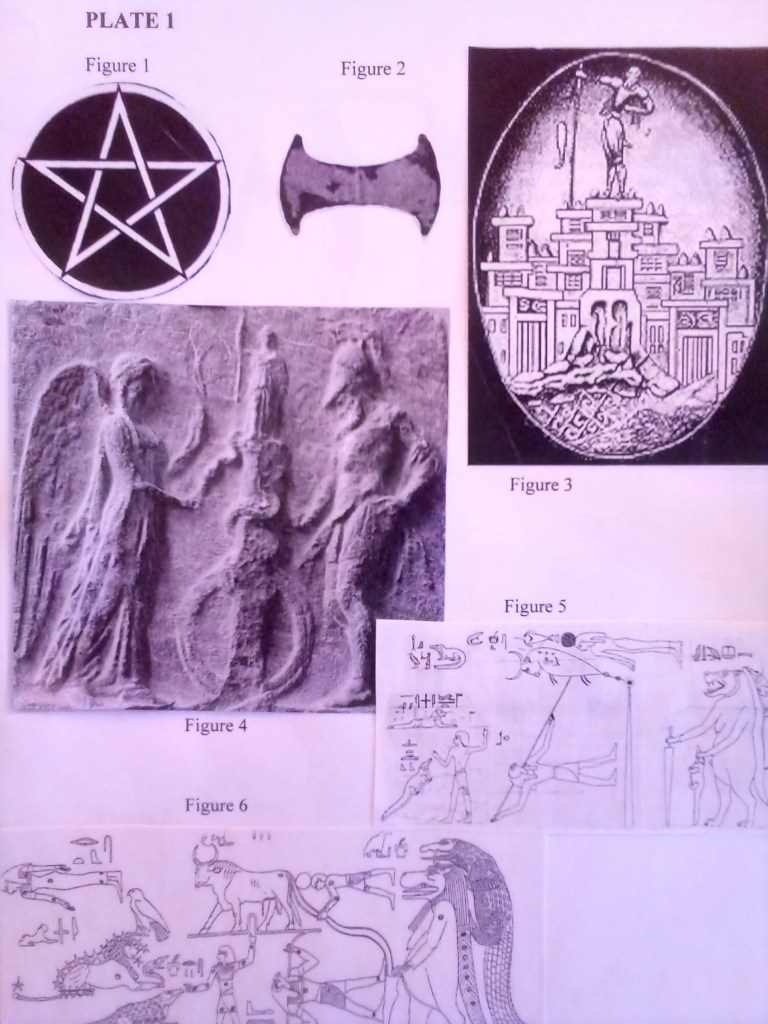
    cDt
  • SECRETS 12

    April 3rd, 2023

    31

    The rejected stone, the Shepherd the door, and the Harrowing of Hell

    The prophecies about the coming Jewish Messiah, spoke of his death and resurrection‘. . . he was cut off from the land of the living. . . he was assigned a grave with the wicked. . .Yet it pleased the Lord to bruise him; he hath put him to grief; when thou shalt make his soul an offering for sin, he shall see his seed, he shall prolong his days. . .’ Isaiah 53:8-11.

     There is this account in Psalms:

    ‘I shall not die, but live,

    And declare the works of the Lord,

    The Lord has chastened me sore;

    But he hath not given me over unto death,

    Open to me the gates of righteousness;

    I will go into them. . .

    Into which the righteous shall enter. . .

    The stone which the builders refused

    Is become the head stone of the corner,’ 118:17-23  

    In masonry, the cornerstone, also called the foundation stone, is highly important, for all other stones are laid in reference to it; and it will determine the position of the whole edifice. According to Wikipedia, in the ancient world, the importance of this stone was shown by animal sacrifices being made at its setting, and the blood then smeared over it; or offerings of grain, oil or wine being placed upon it. The significance of the cornerstone is still recognized in modern times, mainly at the construction of important buildings, when there is a ceremonial setting of the stone, usually by an important (often considered important by the wrong people, for all the wrong reasons) person laying their hand upon the stone or spreading a little mortar with a special trowel.  

    The Messiah’s overcoming death in his resurrection, results in the opening of the gates of righteousness. Relating the stone to this, would mean the rejected stone symbolic of his death, has been transformed by his resurrection into the precious foundation stone of the gate. If this stone was imagined in the shape of a cube, then it does indeed hold in its make-up the symbolism of a gateway, suffering, death and resurrection.

    If you unfold a cube it takes on the form of a tau cross Plate 2 figure 3. The Greek Tau is associated with the letter Theta or T, it was an emblem of death. Robert Graves writes: ‘Men weep, and bewail their lot, and curse Cadmus (the Greek inventor of the alphabet) with many curses for introducing Tau into the family of letters; they say it is his shape that they imitated, when they set up the erections on which men are crucified…Now with all these crimes upon him, does he not deserve death, nay, many deaths? . . . And in the Gnostic Gospel of Thomas. . . the same theme recurs in a dispute between Jesus and his schoolmaster about the letter T. The schoolmaster strikes Jesus on the head and prophesies the crucifixion.’ 64

    In biblical times the tau cross was associated with Tammuz, upon his annual death his mourners marked their foreheads with this cross. A death, of course, that was then translated into rebirth as the sun child.

    Tau is the final letter of the Hebrew alphabet and esoterically, it is said to represent a gate or opening that is symbolic of death, viewing the Hebrew letter, it does look like a portal resembling the letter n.

    The stone and gate of the Jewish Messiah, lies behind Jesus calling himself the door. I mentioned earlier, when Jesus said this, in preaching to those following him, they hadn’t a clue what he was talking about. He called himself the door, in connection with calling himself the Shepherd, and those who would follow him his sheep. ‘Most assuredly, I say to you, I am the door of the sheep. . . I am the door. If anyone enters by me he will be saved. . .I am the good Shepherd. The good Shepherd gives his life for the sheep. . .My sheep hear my voice, and I know them, and they follow me: and I give unto them eternal life. . .’ John 10:7-18.

    He the door which will lead to eternal life, mirrors the gate in Psalms created by the Messiah’s overcoming death. His linking his role of the door, to the Shepherd king of Israel, relates also to the Messiah, who was to be a kingly Davidic one. The king the Shepherd is also, it will be remembered, the stone of Jacob; a World Pillar, that will be in alignment with that celestial door to immortality, the Corona Borealis stargate, which I’m sure the Naaseni understood, when they called him the True Gate.

    Jesus connecting himself to a kingly stone, his tau of sacrifice, and a door to eternal life, was evoking the gate created by overcoming death and the stone of the kingly Messiah in Psalms, he was asserting to anyone who had the understanding, that he indeed was the coming Messiah.

    As I already related, the temple priesthood, perhaps lacking his initiate training, or his amazing intellect and erudition, and original rethinking of ancient truths – this is the man who as a child could talk on a par with the learned in the temple – failed to understand what he was talking about.

    From evidence in the Bible, it would have been highly dangerous for him to openly declare himself the awaited Messiah, the priesthood found his teachings blasphemous and offensive in the extreme, as did other Jews. They also feared the power of his presence, erudition, and preaching; that was attracting more and more followers, and wanted him dead. It was a danger Jesus constantly faced, for instance, when he wanted to journey into Judea to be by the side of Lazarus, his disciples cautioned him against it: ‘Master, the Jews of late sought to stone thee; and goest thou hither again?’ St John 11:8-9. There are chances he would have been stoned to death on the spot (there are other incidents of such mob justice), if he had openly proclaimed himself.  

    Being the living door to eternal life, he also became the gateway for the dead, who existed since the beginning of the world, to be awakened to their own immortality (the narrative is in Titan country, the dead are always there).  ‘. . . when the dead will hear the voice of the Son of God, and those who hear will live. For as the Father has life in Himself, so He has granted the Son to have life in Himself, and has given him authority to execute judgement also, because he is the Son of man.’ John 5: 25-27.

    This also accords with the Jewish prophecies of the Messiah ‘Thy dead men shall live, together with my dead body shall they arise. Awake and sing, ye that dwell in dust; for thy dew is as the dew of herbs, and the earth shall cast out the dead.’ Isaiah 27:19-20.

    This was the role of every cosmic king before him, but of course, he transcended the role and gave all the dead access to the door, no special treatment for the elite in Hyperborea. All the feeble, ghostly shades, lingering in the gloomy, subterranean vaults of Sheol and the Mesopotamian Underworld. The better off dead in the Greek Hades, who because they are worshipped by and still communicate with the living have not faded into gloomy wraiths, those in the Asphodel Fields, the initiates in the Elysium Fields. The immortal kings, heroes and poets in Hyperborea are in for a shock, the streets of the sidereal castle will soon be teeming with the souls of lesser mortals. In one amazing swoop he made all souls equal in death, proclaiming the immortality of the human soul anew to a New Age.

    This aspect of his role is found in the popular early Christian belief, of his Harrowing of Hell, although it is noticeably absent from the deliberations of the Council of Nicea. It had greater prominent in the Eastern Orthodox Christian Church, that commemorates the event as part of the Easter service to this day.

    ‘Harrowing’ is derived from the Middle English verb harry, meaning ‘to despoil or persistently carry out attacks’. Hell, in this case is thought to mean Hades, for part of his task was to release the righteous men and women of the Old Testament who resided there. But as every good Greek Christian would know, hell or Tartarus was a suburb of that Underworld realm, so Christ could have paid both places a visit at one go.

    This feat was accomplished between his crucifixion and resurrection and is alluded to in all the Gospels ‘. . . so shall the Son of man be three days and three nights in the heart of the earth.’ Matthew 12: 40-41. Sheol, the Jewish underworld, as I have explained, was in the centre of the earth.  ‘. . .He was put to death in the body but made alive by the Spirit, through whom he went and preached to the spirits in prison who disobeyed long.’ Peter 3 18-20.

    The main body of evidence is found in works, not accepted into the body of the New Testament by the Roman Church. In the Apocryphal of Bartholomew, Christ is said to have vanished from the cross, and gone to Hades, bringing out Adam and all those with him. It is found in the Acts of Pilate, the Gospel of Nicodemus, the Acts of Peter and Paul. The Harrowing of Hell was taught by theologians of the early Church including Tertullian, Hippolytus and Origen. Melito of Sardis died c180 in his ‘Peri Pascha’, wrote these words about it:

    ‘It is I’ says Christ

    I am he who destroys death

    and triumphs over the enemy,

    and crushes Hades,

    and binds the strong man,

    and bears humanity off to the heavenly heights.’ Pasha 10264

    In many depictions of the Harrowing of Hell, particularly from the Eastern Church, Christ descending into the realm of the dead, is shown standing on an equal-armed cross, made from the doors of the underground realm, that he had torn down; exposing its inhabitants eager to clamber out. In mainly western depictions, the cross adorns a halo over his head.

    The equal-armed cross, as I previously mentioned, is an ancient solar symbol, which relates to the cross-beams of heaven marking the waxing and waning powers of the sun; and a cross in a circle represents a sun wheel. The presence of such a cross in relation to Christ, must represent his solar powers (also a vital part of early belief), the regenerating light shining in the darkness of death Alban Arthuruon.

    I next want to consider the traditions about Christ’s cross and its location, which will reveal their origins in his World Pillar role.

    32

    True cross and Golgotha

    The ‘Legenda Aurea’ ‘The Golden Legend’ by Jacques de Voraigne printed in 1517 (originating in the thirteenth century), a compilation of legends and myths about various Christian saints (a bestseller of its time), included a ‘Vita Christi’ ‘Life of Christ’; in which there was this tradition about the cross on which he was crucified.

    Adam near to death, instructed his son Seth, to go to the Garden of Eden, and ask for a balsam (an aromatic medicinal resin exuded by various trees) to prevent his demise. Seth eventually arrives in the garden and the Cherub, guarding it, can offer no reprieve from death’s dark shadow, instead giving him three seeds from the Tree of Life to place in the mouth of his father’s corpse, and then bury him.

    Seth follows the Cherub’s instructions, and eventually three trees grew up from his grave, that gradually intertwining became one. It was beneath this tree that David sat and sang of his sorrows, and his son Solomon eventually cut it down, to be incorporated as the main pillar in his temple. But the wood, magically changing size during several attempts, to Solomon’s rage, was finally rejected.

    It lay neglected for a while, until it was used for a bridge over a stream, and when the Queen of Sheba passed over it, she recognized its true qualities, removing it from its place. But Solomon buried it, near the pool of Bethsheba. During the time of Christ, the waters of the pool spreading, dislodged the wood and it rose to the surface, eventually being used to make the cross upon which Christ suffered.

    This tale obviously originates in Christ’s role as the Son of Man, the Second Adam. The wood being from the dead body of Adam and the Tree of Life, represents that in the death of the first man, representative of the whole Adamic race, lies the seeds of their resurrection, transformation as the second; made possible by the suffering role of Christ. His suffering represented by the wood being rejected, as he was rejected as the stone.

    This creation of a new humanity, lies behind the belief in early Christianity, that Adam’s skull was buried at the place where Christ was crucified, called Golgotha. A Christian theologian and bishop, Basil of Caesarea 329-379 AD, said that there was an unwritten tradition about this belief in the early Church; which most probably means it arose from the secret teachings.

    Golgotha, from the Aramaic gagûltā is derived from the Hebrew word for skull, and so it became known as the place of the skull ‘And they bring him (Christ) unto a place called Golgotha; that is to say, a place of a skull. . .’ Mark 15:22.

    In one tradition, the blood dripping down from the crucified Christ, seeped into the earth below, and bathed Adam’s skull. Blood from the time of Moses, was called the life of a person ‘For the life of the flesh is in the blood…’ Leviticus 17:11, so here we have the life of Christ transforming the consciousness, symbolized by the skull, of the old Adamic humanity. I also find it meaningful that the skull is cave-like.

    Christ’s role as World Pillar, lies behind the belief that Golgotha, was at the centre, the navel, of the earth. ‘An unusual part of the legend. . . (is) that the tomb of Adam was in the centre or navel of the earth; and this position is assigned to Golgotha by writers who do not connect that place to Adam. Thus Cyril of Jerusalem calls it ‘the very centre of the earth’ Didymus Alexandrinus (AD 309-394), ‘the centre of the universe’; Victorinus of Poitiers ‘like the middle of the whole earth’ Sophronius (circa AD 564-637) ‘the navel of the earth’; and Andreas Cretensis (Archbishop of Crete, AD 675) ‘the middle of the earth’.65

    I think calling the site where Christ was crucified, the place of the skull, is a symbolic reference, rather than descriptive of an actual location. This fact, would account for the difficulty encountered by those trying to identify it; the actual location is still in dispute. The descriptions in the New Testament of where it was situated aren’t very helpful: it was outside a city gate, but doesn’t say which one, near a frequented road because people passing by mocked him. Simon the Cyrenian, a traveler on the road, was forced to help Jesus carry the burden of his cross; the site was in a garden where nearby a rock hewn tomb belonging to Joseph of Arimathea was situated, in which they laid Christ’s dead body. 

     In attempting to locate this place, the place of a skull, it was speculated this one skull, referred to the bleached skulls of previous victims of crucifixion, littering an established execution spot. Or the place was where a skull-shaped rock was found.

    This uncertainty about the location continued, until 325 when Helena, the mother of the emperor Constantine, came on the scene, and made a determined attempt to find it. In one account having reason to believe a Jew named Judas knew of the site, she denied him water until driven by the torments of thirst, he identified the site as a small hill (even though no mention of a hill was made in the Bible) outside Jerusalem – where a temple of Aphrodite had been built by the emperor Hadrian. In another account Judas, under divine inspiration, showed the searchers the spot, which other Jews had concealed with stones, was highly praised by Helena and became a Christian convert and later a saint.

     She then discovered the tomb of Christ on the site, and the cross upon which he was crucified. Obviously, a resourceful woman. Well, she unearthed three crosses (of course, Christ was said to be crucified in the company of two others) but ascertained the real one by bringing them to the sickbed of a dying woman, getting her to touch each cross in turn; when she touched the true cross, she recovered her health.

    So, Golgotha had been found, but as C. W. Wilson remarks in ‘Golgotha and the Holy Sepulchre’ ‘. . . there is no indication in the Bible that Golgotha was skull-like in form, or that Christ was crucified on a hill. . . that no Greek writer uses the expression ’mount’ in connection with the spot; and that the skull-like appearance and elevation of Golgotha are apparently fancies from the West.’66

    Eventually, on the spot she officially claimed was Golgotha, her son built the Church of the Holy Sepulchre. Beneath the Calvary Chapel which is said to contain the upper portion of the rock, lies a chapel referred to as the tomb of Adam, where there is this inscription: topas kraniou paradeisas gegonon ‘Golgotha has become paradise.’ A pity the earth didn’t as well.

    I wondered how symbolic was the account of Christ’s crucifixion by the Romans? Did it actually happen?  Evidence from non-Christian sources, which carry more weight than later tampered Christian ones, support Christ having been crucified by the Romans.  Josephus in his ‘Antiquities of the Jews’ written c93 AD, wrote of the crucifixion of Jesus a wise man, ordered by Pilate. Despite later alterations to this work, the account concerning Jesus is considered genuine. Tacitus c56-c120 the Roman historian writing in ‘The Annals’ in c116 stated: ‘Christus, from whom the name (Christian) had its origin, suffered the extreme penalty during the reign of Tiberius at the hands of one of our procurators, Pontius Pilate.’ 67 In a letter written c73 AD by Mara bar Serapion the stoic philosopher to his son, he mentions the murder of a number of wise men by tyrannical men, which resulted in the perpetrators being punished with natural catastrophes. He included the murder of a wise king of the Jews, after which the kingdom of the Jews was abolished by the Romans. So, as far as Mara bar Serapion is concerned, those ultimately responsible for the death of Jesus, are the Jews not the Romans.

    Considering his crucifixion, a real event, the biblical account of Pilate’s reluctance to condemn Jesus, may be based on his recent reprimand by the emperor Tiberias for his mishandling of Jewish affairs. Philo of Alexandria c20BC-c50, the Jewish philosopher, wrote of Pilate’s insensitivity to Jewish custom causing several near-insurrections, his confiscation of temple gold to build an aqueduct, resulted in a riot.  So, Pilate would have at that time, been concerned not to create more problems for himself, in the affairs of the Jews.  

    His reluctance may also be based upon his belief, that Jesus and his followers posed no real danger to the security of the Roman province, under his command. If they had, he would have hunted them all down to their death, as in previous rebellions against Roman rule; even after the death of Christ, Christians were not persecuted.

    The temple priesthood on the other hand, had ample reason for wishing Jesus dead. ‘Caiaphas (the high priest) and his father-in-law regarded Jesus’ proclamation of the dawn of the kingdom of God and the implied messianic claim, as well as the ensuing critique of the Temple cult, as a threat to their position and their authority over the Jewish people.’ 68  Caiaphas remained in office throughout Pilate’s time as prefect, this is thought to imply they had established a good working relationship; which he may have put to beneficial use at the end, in overcoming the perfect’s objections, and getting him to agree to the execution of Jesus. It may have been achieved by saying that Christ was calling himself King of the Jews, which in relation to his Messiahship was true, but spoken of in terms of a genuine earthly threat to Roman rule, capable of formenting insurrection; hence the inscription on his cross: Jesus the Nazarene King of the Jews.

    Pilate needed to order the execution of Jesus, because according to John’s Gospel, the priesthood could not order the execution of Jesus, the right to enforce capital punishment resided in the Roman authorities. Although this is in dispute, and some scholars think they had full rights in this area, before the first Jewish Roman War in 66-73 AD. Others think they only had power to enforce the death penalty in Jewish religious affairs, when it concerned their own people.

    David Instone-Brewer in his ‘Jesus of Nazareth’s Trial in the uncensored Talmud’, concludes there was a core tradition, from its earliest source, in the Talmud, that Jesus was crucified by the Romans. A matter obscured by later explanatory comments found within the rabbinical discussions, trying to relate it to a Jewish form of punishment, because according to the Talmud the Jews are allowed only four methods of capital punishment: stoning, fire, decapitation and strangling. In second century Judaism, there was a strong movement for all Jews to uniformly conform to the rabbinical judgements of how Jews should act, this state of affairs they projected onto the past; and tried to deal with the embarrassment of the unJewish nature of Christ’s death. But as David Instone-Brewer comments: ‘. . . Jews living in the First Century would not be embarrassed by a tradition which said they had used a Roman form of execution, because they had a more realistic understanding of what was possible, and they knew the Romans were in charge of capital punishment.’ 69

    If one concludes, that Pilate’s reluctance in the New Testament has a basis in historical fact, then it is possible to view John’s remark that the Jews were not allowed to order capital punishment, as also showing the true state of affairs at that time; the priesthood was forced to get Pilate’s consent in the matter.

    At some point before his arrest and horrific murder, Jesus would have performed a powerful royal World Pillar ritual, with the aid of his disciples, in all its majesty. As powerful as the transfiguration he underwent on the high place, when Moses and Elias appeared.

    The date established for Christ’s crucifixion – using biblical, historical, archaeological and astronomical evidence – is the 3rd April 33 AD. The astronomical researches of Miguel Antonio Tiol of the University of Winconsin-Madison have established, that in the year 33 AD, from mid-March until the middle of April, an alignment between the Earth, Saturn, Uranus, Jupiter and Venus, took place, creating a pentagram in the heavens. So, it is highly likely, that Jesus would have chosen a date between these times, his magical alignment with the heavenly pentagram, reflecting the earthly pentagram of a perfected humanity he wanted to establish on earth. News of this ritual, most probably became the catalyst, that brought opposition to him to a head; and resulted in his arrest and death.

    In the New Testament, Christ is flogged on his way to execution and made to carry his cross, which being too great a burden, the passing Simon of Cyrene is forced to carry. In popular imagination (promoted by the Catholic Church), this cross is thought of as the crux immissa the Latin cross V. The New Testament was originally written in Greek, and later translators in seventy-four instances, have translated ‘stauros’ as ‘cross’. Stauros means ‘an upright pale or stake’. There are also five instances of xulon whichmeans anything from a piece of wood or timber to a living tree, being translated as a ‘tree’ upon which Jesus hung ‘. . . who his own self bares our sins in his own body on the tree.’ 1 Peter 24-25.

    Viewing Christ as having died on a stake rather than a cross, ties in with the Roman mode of crucifixion, described in accounts by Dionysus of Halicarnassus c60-7 BC, a Greek historian and teacher of rhetoric; and Plutarch 46-120 AD, the Greek biographer and essayist. In these accounts the condemned was made to carry a beam of wood to the site of execution, being flogged (as Christ) along the way. At the site, was fixed in the earth, an upright stake. The beam was then fitted onto the stake, or a peg protruding from its top, and became the cross-beam upon which the arms of the person about to undergo this awful death, were tied. Then with their legs straddling the upright stake, their feet were nailed to either side of it. The fixed nature of the stake, and removable nature of the cross-beam, makes the original Greek understandable, in that he was crucified on a stake. I imagine the beam was then recycled for the next victim, particularly in the case of Judea, where timber was scarce; and the same stake would have been reutilized. Also, the biblical account of Christ’s crucifixion near a frequented path, mirrors the Roman practice of crucifying people where as many people as possible could view it, such as by the side of a road – it thereby acting as a deterrent against other malcontents and criminals.

    This Roman cross is then tau-shaped crux commissa, and in a graffiti, found in a wayside tavern, dating from the time of Trajan 98-117 AD or Hadrian 117-138, depicting a crucifixion the cross is tau-shaped. A tau-shaped cross being used for the crucifixion of Christ, is reflected in the earliest Christian writings and is found in the Roman catacombs, where the early Christians secretly gathered to worship. In the Epistle of Barnabas, dating from the first century (thrown out of the New Testament by the Synod of Ariminum) and in the writings of Origen, the cross was likened to the Greek T or tau. Tertullian c155-c240 AD (joining the brotherhood of the banned at the Synod of Ariminum) a Christian writer, also identifies the cross as T-shaped. He calls Christians crucis religiosi meaning ‘devotees of the cross’, writing of the practice of making the mark of the cross on their foreheads. This tracing of a tau cross upon their foreheads, evokes the same cross marked on the forehead of mourners of Tammuz, mentioned earlier, this is most probably one of the reasons why the Church, in wanting to distance the faith from this pagan connotation, banned so many early works. Particularly, as many early Christians would relate Christ’s solar role, to the sun child Tammuz.

    The thing that preys on my mind, is the tau-shaped cross of the Romans, and the esoteric cosmic tau cross of his sacrifice, mirroring each other; means it was always going to end this way, that his irrevocable destiny would lead him to suffer in extremis on an earthly tau cross. The heavenly mirrored in the earthly.

    Jesus didn’t fulfill his great cosmic role in this death – his true suffering was to bear the burden of being the World Pillar – his violent death was the result of his challenging, in so many ways, those long established in positions of religious power; which always involves power in secular matters. ‘Having control over what happened in the Temple, including supervision of the trade with sacrificial animals and the exchange of foreign currencies, Caiaphas, together with Annas’ (his father-in-law) entire aristocratic family, must have been able to build up a considerable fortune, which would have been used to consolidate and expand dominance in the affairs of Judea.’ 70

       From all that has been revealed, can be seen the cosmic wonder of his role, the last Titanic king to suffer on the World Pillar. In the final third part of this book, I want to consider the survival of this Christ and the secret teachings he imparted to his disciples; his role’s true legacy, which under the oppressive pitiless shadow of the early Roman Church was forced underground; but still managed to play a massive part in Western thinking.

    33

    PART THREE

    THE UNDERGROUND STREAM

    Esoteric Arcadia

    Virgil’s Arcadia, did not sink into obscurity after his death, it continued to be lauded in later works as the land of perfect love (and it is a halcyon image still alive today). I believe this occurred, because initiates of early Christianity, understood that the ancient legacy Arcadia represented, was tied to the cosmic role Christ fulfilled; his secret teachings, and the rites of initiation he instigated.

    This is apparent in an early Christian work ‘The Shepherd of Hemas’. I have already mentioned it, despite it having great authority in the second and third centuries AD, it was nevertheless thrown out of the New Testament, by the early Roman Church.

    It was probably written in Greek c140-154 and deals with five visions granted to a former slave Hermas. He experiences his first vision on the way to Cumae. In one of the visions, he is taken to Arcadia, described as a golden virtuous place of rustic delights. Where spotless virgin maidens entertaining Hermas the live long night, think only of dancing, joy and prayer. According to the biblical scholar J Rendel Harris 1852-1941, the description of cyclopean masonry, and the nature of the landscape, in the work, corresponds to the actual Arcadia.

    Hermas witnesses a tower being built and is told its gate is symbolic of the Son of God, with the added remark that the gate is recent, but the rocks from which it is built are ancient. Those who wish to be saved, to be perfected, can enter through the gate into God’s kingdom.

    The gate is clearly a reference to Christ the door, and remarking that the gate is new, but the stones are old; embodies the understanding that the model for Christ’s role is based on an earlier, ancient one. Whoever wrote it, was clearly an initiate. One can understand why, the early Roman Church, removed it from the New Testament.

     I have already written about Virgil’s Cumae prophecy of the marvelous coming child, who would usher in a new age. If one considers, both Christ and Daphnis embodied the World Pillar and Divine Child, therefore it is not surprising they bear a striking resemblance to each other. Daphnis the shepherd, loves peace, Christ the Shepherd is called prince of peace. Daphnis loves his fellow men as did Christ, and they both ascend to the stars and become god-like. In Isiah’s prophecies about the coming Jewish Messiah, the wonderful age he will bring into being, resembles the one brought into being by Virgil’s Daphnis: ‘The wolf also shall dwell with the lamb, and the leopard shall lie down with the kid: and the calf and the young lion and fatling together; and a little child shall lead them. And the cow and bear shall feed; their young ones shall lie down together; and the lion shall eat straw like the ox. And the suckling child shall play on the hole of the asp (A highly venomous African or Asian snake, also called a cobra).’ 11:6-9. It appears the prophecy of the Cumean Sibyl, about the coming redeeming boy and the new world he would bring into being, was foreshadowed by Daphnis, fulfilled by Jesus the Christ.

    But to return to Arcadia. I believe, ‘Arcadia’ became a sort of code word, a secret way of referring to the true Christ and his teachings. Similar to the Jewish writers living under the oppression of the Romans, not openly referring to them, when they wanted to write of their divinely destined destruction; but using instead the code word Babylon. In Revelations the Beast, an evil force opposed to God and Christ, is also thought to be a code name for Rome, its seven heads representing the seven hills; upon which that great city was founded. The Essenes also used a code word for the Romans, referring to them as the Kittin.

    The power of the Roman Church, remained the greatest force in Christendom, for a great span of time; its hold over Christian doctrine exhibited as late as 1834, when the last person to be tried for heresy by the Church, the schoolmaster Cayetano Ripoli; was hung in Valencia. It should also be pointed out, that under Protestant Church authorities, who accepted the Roman Christ (although it would not have been viewed in that manner), there were persistently trials for heresy, the last execution for this ‘crime’ occurring in England in 1612. So, it continued to be dangerous to openly espouse the Christ of the secret teachings, during this great swathe of time.

     After Virgil’s Eclogues, it is many centuries later, when the theme of a pastoral Arcadian ideal, emerges into the open again. In the 1460s and 1470s from a group of gifted artists, including Leonardo de Vinci, and writers, under the patronage of Lorenzo de Medici 1449-1492; the wealthy ruler of the Florentine Republic, in west central Italy.  In Lorenzo de Medici’s ‘Nencia de Barberino’, Luigi Pulci’s ‘Beca da Dicamano’, and Poliziano’s ‘Stanza’.

    Florence, since the time of Cosimo de Medici 1389-1464, had become the nexus for the Renaissance: the revival of interest in classical antiquity. This was fuelled further by the availability of ancient texts carried by scholars, fleeing the fall of Constantinople and the overthrow of the Byzantine Empire, by the Ottoman Turks in 1460.

    This influx of ancient knowledge involved the religious and philosophical Hermetic writings, Neoplatonic writings based on the works of Plato, magic, astrology, alchemy and the Kabbalah (mystical Jewish system). It also melded with later Gnostic works. Also flowing into Florence, came Chaldean Oracles and Hellenic or Greek mysticism, and late Orphic and Pythagorean literature. This stream of knowledge had a seminal influence on Western esoteric thinking, and Florence was a safe place, from which to bring hidden things into the open.

    Six years after Pope Sixtus IV, burnt a thousand heretics in Andalusia in 1482, the Italian poet Jacopo Sannazaro 1458-1530, completed his work ‘Arcadia’. It is thought to have exerted a pivotal influence, in establishing idyllic Arcadia, within the body of western literature. In Sannazaro’s Arcadia, Sincero a poet residing in Naples, is disappointed in love and retreats to Arcadia, and its ideal pastoral pleasures. A powerful dream beckons him back to Naples, and traversing a dark tunnel, he arrives to discover his beloved has died. He then carries her body back to Arcadia, and enshrines it in a tomb, bearing an inscription that refers to her haughty, rigid nature, now humbled in Arcadian stone. Her humbling is incurred, when her lack of lovingness, is set against the perfect love Arcadia represents.

    The next major work is Philip Sidney’s ‘The Countess of Pembroke’s Arcadia’ or the ‘Old Arcadia’ in 1581. Possibly the beginning of 1582 he began a revision, that remained unfinished at his death in 1586, and it became known as the ’New Arcadia’. Later his sister Mary the Duchess of Pembroke, published his ’New Arcadia’ together with the third, fourth and fifth books of ’The Old Arcadia’; which is often referred to as the ’Composite Arcadia’.

    Philip Sidney 1554-86 the English poet, courtier and soldier, is thought to have been a member of a Hermetic group, centred around the occultist, alchemist, astrologer, Hermeticist John Dee 1527-1608. He was a known associate of Giordano Bruno 1548-1600 – the last person the Roman Church burnt at the stake – philosopher, mathematician, poet and cosmological theorist. Bruno, according to the scholar Francis Yates, was heavily influenced by Arab astrology, Neoplatonism, Hermeticism, and writings concerning the Ancient Egyptian god Thoth.

    In the ’Old Arcadia’, a stranger plagued by misfortunes, is rescued by two Arcadian shepherds, he is entranced by their virtuous conduct; and they bring him to the house of Kalander. Kalander assures him, there is no concern for the exaltedness of his lineage or estate, but rather his virtues and the quality of his mental cloth. These things are valued most highly in a land, whose shepherds are like the learned of other nations. Arcadia has become the image of a perfect society.

    But then darkness enters the tale, for this land, where the unrequited in love come to find perfect peace and love’s joys; has become disordered by the actions of their ruler Basilius. He, fearing the realizing of a prophecy by the Delphic oracle, that he would have his throne stolen, commits adultery, loses his elder daughter and witnesses his younger embrace an uncouth love; has retreated to an isolated abode.

    But events are moving to overturn his defenses, and a wretched pantomime ensues of mistaken identities, the concealing of true identities and the upheavals of love at first sight. Arcadia the land of perfect love, has become the playground of Venus’s unruly children, Eros and Cupid.

    When hunting online for information about Arcadia, I came upon a 1517 woodcut named ‘The Garden Grove’, reproduced in the work of Abraham Cowley, and now in the Special Collection of the University of Virginia. The woodcut depicts a scene of shepherds around Daphnis’ tomb from the Eclogues. Plate 1 figure 1

    There are three shepherds, kneeling around the flower strewn tomb, which bears a cross on its lid. The inscription on the tomb Daphnis Ego in Sylvis means ‘I, Daphnis in the woods’. This refers to the fifth Eclogue:

    ‘And make a mound (for Daphnis) and add above the mound a song

    Daphnis am I in woodland, known hence as far as the stars.’

    The verse refers to Daphnis’ unique bond with the land, when he dies it becomes a wasteland, when he ascends to the stars it becomes a fertile paradise. The woodcut also depicts a river in the background, emerging from an underground source, which I take to be the Styx, the Arcadian river of the Underworld. In the background are two more male figures with names attached, which identify them as the two shepherds, from Virgil’s Eclogues. In the Eclogues there is no specific reference, to three more shepherds, in connection to Daphnis’ tomb or mound.  

    What is intriguing, is that in a later 1630 painting by the French Nicolas Poussin 1594-1665, an avid admirer of Virgil; three shepherds are again shown around a tomb in Arcadia. Plate 1 figure2  On this tomb, the words Et in Arcadia Ego are carved, which has been translated as ‘And in Arcadia I’ or ‘Even in Arcadia I’. This term is often referred to as a memento mori, meaning a reminder of our mortality, that even in life, death’s shadow looms; even amidst the pleasures of perfect Arcadia.

    Poussin’s phrase is clearly paraphrasing the line in the Eclogues, so is Daphnis in both tombs? But seeing as Daphnis ascended to heaven, is it an empty tomb honoring him, and the fount of fertility he represents.

    When I was looking at Poussin’s Et in Arcadia Ego, something immediately struck me about one of the shepherds, and led to the thought, that the real reason there were three shepherds around the tomb; was because there was a hidden astrological meaning to the painting, which required three figures. Astrological meaning connected to those, oh so important northern star constellations, at the centre of the mysteries of the First Religion and Christ.

    Before I continued to explore the hidden aspects of the painting, I should mention that this painting was brought to prominent in the 1982 book ‘The Holy Blood and the Holy Grail’, as possibly hiding esoteric secrets. The authors were led to this belief about the painting by their investigation into the activities of the enigmatic Berenger Saunière, priest or abbé of the village of Rennes le Château in south-west France.

    He, they believed, had come into possession of secret documents, regarding a bloodline of Jesus, children from his union with Mary Magdalene; which had become established in France. Saunière, was said to have come into possession of these documents, while renovating the church of St Magdalene in the village. He discovered them, secreted in a cavity in a pillar, which the authors maintain, had been placed there by Saunière’s predecessor, the Abbé Antoine Bigou. Bigou had been entrusted with them, by a dying noble woman Marie de Négri d’Ables, the last of her line, Abbé Bigou had acted as her chaplain. The Abbé then hid the documents, also erecting a stone slab on her tomb, containing among other inscriptions a combination of Greek and Latin letters: ETINAPXADIEGW, separated into ET IN APXADIA ETW, which translated into Latin Et in Arcadia Ego.

    According to the authors, Saunière took the documents to Paris, to be verified by a paleographer (deciphers and dates historical manuscripts). He then visited the Louvre, to view Poussin’s painting Et In Arcadia Ego, which hung there. It is after this event, that Saunière became possessed of considerable funds, and among other things, embarked upon a building program in the village.

    The authors identified the tomb in the painting as based on a real one in France, the inscription on it Et In Arcadis Ego, being a code for ‘In it I hold the secrets of God’ and suggests Poussin was referring to the Holy Grail, which they interpret as representing the French bloodline of Jesus.

    As regards Poussin, much is made of an enigmatic letter written by Abbé Louis Fouquet to his brother Nicolas, in which he disclosed he had discussed certain things with Poussin, which will give his brother ‘advantages’, ‘advantages’ which even kings could not draw from Poussin; and which it is possible, no one else will ever discover in the centuries to come.

    Judging by the nature of the hidden meaning, incorporated into two of his paintings, the ‘advantages’ being alluded to, may be those gained by admittance into a secret but influential society, perhaps a Masonic one, or a Rosicrucian one. Both, I will reveal later in this section of the book, issued from the underground stream of the cosmic Christ, his secret teachings, and the ancient legacy attendant upon it. The ‘advantages’, may allude to spiritual ones, through a transformative life-benefiting initiation – similar to those, recorded earlier, experienced by ancient participants in the mysteries. Perhaps Poussin telling Fouquet, the source of the advantages would remain hidden, was an assurance that there was no danger in such secret activity being discovered.

    Returning to the painting Et in Arcadia Ego, on viewing it I was immediately drawn to the kneeling bearded shepherd, his outstretched arm, creating a horseshoe-like shadow on the tomb. Plate 1 figure 2a This instantly made me think of the kneeling Hercules star constellation, which guards the horseshoe-shaped Corona Borealis stargate. The stargate, a portal to immortal life, being depicted on the tomb in this way, transforms it and the person in it, into a gateway to eternal life. And the one person, who was such a ‘gate’ or ‘door’, was Christ. Elements within Poussin’s other painting ‘The Adoration of the Shepherds’, also reveal its subject matter is Christ the door. Remembering at this point ‘The Shepherd of Hemas’ and the Arcadian ‘gate’ of the Son of God; it could be speculated this is the esoteric origins of Poussin’s painting.  

    This also brings up the consideration, does the ‘The Garden Grove’ woodcut carry the same symbolism? It would make understandable, the cross upon the tomb, and the unobtrusive flower-head on the base of the tomb, resembling a five-pointed, rayed star.

    But returning to the painting Et in Arcadia Ego. The other two shepherds, I believe, represent Ursa Major and Minor. Boötes/Christ who guarded the stargate, was in the tomb, but is no longer there; because he like Daphnis rose again. I identify them as Ursa Minor and Major, because with the female figure accompanying them, who I believe represents the northern constellation Cassiopeia – they create further symbolism, that supports the supposition that the entire painting is about Christ the door.

    Cassiopeia, with Ursa Major represented by the shepherd standing at the further end of the tomb, are the constellations that define the upper arm of a celestial tau cross (because remember, everything on earth in this thinking, has a celestial template). Exactly in the middle of this arm, lies Ursa Minor, represented by the shepherd standing between them, and the pole of the pole star, creating the vertical arm. The invisible celestial tau cross positioned over this tomb, relates to the rejected stone Christ, in whose sacrifice, it became the door to eternal life. It’s very clever indeed, how Poussin has interrelated the symbolism, to create powerful layers of meaning.  

     There is, I believe, a reference to Cassiopeia in the painting, and that is the W created by one arm of Hercules; and the arm of the Ursa Minor shepherd, who is looking directly at her; because the star pattern of the Cassiopeia constellation, creates a W, in the heavens. Again, the symbolism is created in a very clever way, the look towards her, of the Ursa Minor shepherd; who is creating part of the W is so simple, but powerful symbolically.

    As I have written, I believe the subject matter of Poussin’s ‘The Adoration of Christ’, Plate 1 figure 3 is also about Christ the door. In it is found the same Hercules figure from Et in Arcadia Ego, in exactly the same pose; but this time he is indicating the baby Jesus. Plate 1 figure 3a This carries the same symbolism, as when he was pointing at the tomb, for the baby will one day be the stone that is rejected, and then through his sacrifice, become the ‘door’ to immortal life.

    There is another reference, to Christ the rejected stone, in the painting. Behind Mary’s right outstretched arm, and at the side of Jesus, is a cubic stone. I consider it cubic, because with Joseph standing behind it, it clearly is not rectangular. I have already shown the esoteric significance of a cubic stone, in relationship to Christ, and positioned beside the Jesus child, I think this stone represents him: the stone to be rejected, that will then become the cornerstone; the foundation stone of the new humanity.

    To further support this interpretation, Poussin has cleverly wrought, in the background, a horizontal tau cross between two flanking pillars, which creates a gateway. This is symbolic of the coming sacrifice of the child, and the doorway he is destined to create.

    Staying with this theme of building work, I next want to consider Freemasonry, as another expression of the secret teachings of Christ.

    cDt
  • SECRETS 11

    March 28th, 2023

    28

    Jesus the Egyptian magician and secret initiation

    From the age of twelve, when Jesus visited the temple in Jerusalem according to the Gospel of Luke, to the age of thirty, when he reappears to preach his message; there is no indication of how he spent his life. Conventional thinking maintains he spent this time as a carpenter, working with his father, in Galilee. I find this hard to believe, solely on the grounds of his erudition, he constantly confounded his opponents with his wide-ranging knowledge of scripture, and the authority with which he pronounced his arguments.

    Because of the Essene influence upon his teaching, it would be justified to say, part of it was spent within the Essene monastic community. But this does not account for the strongly held belief in early Christianity, that he practiced magic, which is often called Egyptian.

    In the Jewish Talmud it is said his magical skills have an Egyptian origin, originating in scratches on his flesh (Shab.1046). The Talmud is a compilation of rabbinical discussions, over a period of two hundred years, upon the Mishnah. The Mishnah is an earlier record of similar discussions, covering a period of two hundred years. The discussions are concerned with how to live out the commands of the Torah in everyday life. The Talmud covers the period from 200 AD to 500 AD.

     The view of Jesus as an Egyptian magician, appeared in the writings of the fourth century Christian apologist Arnobius, in which Jesus is accused of stealing from Egyptian temples, the knowledge of powerful magical incantations (a series of words said as a spell), involving angelic names.

    In the Talmud Jesus is said to have been hung for the crimes of sorcery and enticing Israel; enticing means to lead astray into idolatry. Sorcery and enticing are the terms used by Celsus 2nd century AD, a Greek philosopher and opponent of Christianity in debate with Origen. Justin Martyr 100-165 AD, an early Church apologist, used the same terms, which he said was the result of the miracles performed by Jesus. In the New Testament, there is also evidence of the belief his miraculous feats of healing, involved some form of magic. ‘But some of them said, He casteth out devils through Beelzebub the chief of the devils.’ Luke 11:15. It is also recorded in the Apocrypha, those works I referred to earlier, that were thrown out of, or denounced by the early Roman Church.

    In the medieval Toledoth Yeshu (the earliest text dated to the eleventh century), Jesus possesses the mystic name of God, and with this power does all manner of miracles, raising the dead, healing a leper. In this account he is also hung from a tree for his crimes but uses the mystic word of God to break the tree. He is only successfully hanged when he is rendered unable to speak.

    In the Gospel of Thomas, Jesus is portrayed as having magical powers from infancy. He cures his brother James of a snake bite, extends a piece of wood his father is working on to the size required; resurrects the dead, and turns clay models of sparrows into living birds. But there is an evil aura around this Jesus, his powers are out of control, he kills or blinds those who are unkind to him.  In the Acts of Pilate, the Jewish people accuse him of sorcery, including sending the wife of Pilate a dream.

    Amulets and incantation bowls dating from the second and third century, have been found inscribed with the name of Jesus alongside, in some cases, names of angels from the Book of Enoch. In 2008 during underwater excavation, led by the renowned French marine archaeologist Franck Goddio, of the Egyptian city of Alexandria’s sunken ancient harbour, a thin-walled ceramic bowl was discovered. It dated from between the second BC and early first century AD, scratched into its surface were the words: DIA CHRSTOU O GOISTAIS meaning ‘by Christ the magician’. It is thought by experts that the bowl was used for fortune-telling, oil was poured onto water, and the movement and shapes arising, were then interrelated as certain portents of the shape of things to come. Whatever the guidance being sought, the practitioner was clearly evoking the magical powers of Christ, to bring forth revelations upon the matter.

    From the preceding accounts, there is clearly two strands of thought, one in which he acquired foreign or home-grown magical learning, the other he possessed natural miraculous abilities; which is the reason given by Justin Martyr for the Jewish charges of sorcery and enticement, brought against him.

    The belief he had acquired a wider range of learning, outside Judea, is reflected in traditions attached to his lost years, that he studied in Egypt, India, Britain and Japan becoming a disciple of a Buddhist master near Mount Fuji.

     I believe there is substance in this belief of influences outside Judea, for instance, the biblical account of the raising from the dead of Lazarus, when its details are considered, they are strongly reminiscent of the ancient mysteries, already chronicled in the narrative, of a mock death and rebirth into a new state of being. Jesus himself, in the New Testament, spoke about a spiritual rebirth being necessary, before all that he said could be revealed: ‘Except a man be born again, he cannot see the kingdom of God. . . Nicodemus saith unto him, How can a man be born when he is old? . . . Jesus answered. . . Except a man be born of water and of the Spirit, he cannot enter the kingdom of God. That which is born of the flesh is flesh, that which is born of the Spirit is spirit. Ye must be born again.’ John 3:3-8.  This, is echoed in the words of Paul ‘And as we bore the image of the earthy, we shall also bear the image of the heavenly.’ 1Corinthians 15:49.

    Lazarus has been identified as the Beloved Disciple, by a number of religious historians, including the eminent Professor Richard Bauckham. The Beloved Disciple, which refers to the favoured position he held in the estimation of Jesus, has in turn been identified as the disciple John, also called John of Patmos, the author of the Gospel of John and Revelations.

    In St John’s Gospel Lazarus is said to be sick, and his sisters send a messenger to Jesus, who was not in Judea where they resided; saying the one you love is sick. Jesus answers, saying this sickness is not unto death, but for the glory of God. To show his lack of concern about Lazarus, it was two days later, when he explains to the disciples with him that Lazarus ‘sleeps’ and he must go to him to ‘wake’ him up. His disciples are confused by what he is saying (which he was very good at), for he had previously spoken of the death of Lazarus (his actual words are not related) and at their confusion, he again states Lazarus is dead.

    When they arrive in Judea, and visit the cave where Lazarus lays, he is said to have been dead for four days. Martha, the sister of Lazarus, asks Jesus why he didn’t come sooner, if he had been there her brother wouldn’t have died. Jesus said to her, that her brother would rise again.

    There is a great stone over the entrance of the cave, where Lazarus lies, and it is rolled away. Then Jesus commands Lazarus to come forth, and he does, emerging from the cave alive, shrugging off his funereal garb.

    What can be understood from this account, is that Jesus knew what was happening with Lazarus, he assures them he isn’t sick, and that his condition was for the glory of God. This implies, that Lazarus was involved in a religious ritual. Jesus isn’t concerned about his welfare, he stays where he is; until he reveals (surely as part of a prearranged agenda) he has a role in what’s happening with Lazarus, he must ‘wake’ him up. His afterwards confusing his disciples with this ‘sleep’ is a ‘death’, is because they understood the ‘death’ to mean a physical state, whereas Jesus was referring to a spiritual death and rebirth, for the glory of God. Lazarus undergoing the ritual in a cave, is a prime site, for such a transfiguration of consciousness. The narrative is once again united with that ancient death conquering journey of the initiate, such as experienced in the Eleusinian Mysteries; it also evokes the death and rebirth of Osiris – all expressions of the mysteries of the First Religion. The Beloved Disciple under the instruction of his master, is walking the path of spiritual perfection.  

    There is evidence that the disciple Mark, may also have undergone a similar initiation. In the gospel of Mark, he describes a young man, clad only in a white linen cloth, being in the garden of Gethsemane when Jesus was arrested. His presence is only recorded in Mark’s Gospel 14:51-52.

    In the Gospel account, the young man had been following Jesus and his disciples in the garden, when a troop of soldiers descend upon them, seeking to arrest Jesus. They grabbed hold of the young man, but he manages to escape, leaving his linen cloth behind him. There is a tradition that this young man is Mark himself, and biblical scholars speculate he wrote about himself in this manner, to establish his presence at such a crucial event.

    Mark’s Gospel was written in a Latinized form of Greek, similar to the written language of Rome. The word he uses for the linen cloth the young man is wearing is sidon and this means, a linen cloth used for clothing or a burial shroud, it is employed four times in the New Testament to describe Christ’s burial sheet. This predominant association with a burial shroud, presents the possibility, that Mark also was engaging in a death and rebirth ritual, in the garden. In a letter written by the early Church father Clement bishop of Alexandria 150 – 215 AD (which I will consider in greater detail shortly), Clement refers to material in a secret version of Mark’s Gospel. In this secret version, replacing the Gospel account of Jesus in the Garden of Gethsemane recounting a prophecy of his future trial and death, Jesus is instead involved in a ritual raising of a young man from the dead, and thereby giving him the secrets of the kingdom of God. So, was Mark in his secret version of the Gospel, writing of his own experience on that terrible night?

    A mystical ritual performed in the garden, is also found in the Gnostic text ‘The Acts of John’. Christ in Gethsemane instructed his disciples to hold hands and circle around him, while he uttered a mystical chant, to which they responded, at his direction, ‘Amen’.

    Dance, theatre and sound has always been a potent part of ritual. Anyone who has experienced normal theatre knows of the impact it can have, even in mundane things. It was the ancient way of altering the consciousness of the acolyte, tapping into and manipulating what was perceived as greater realities, intersecting this earthly one. If one considers Jesus using such ancient tools, it doesn’t pollute his message in any adverse way. Because of the breadth of his learning and understanding, he probably had encountered such rites, and thereby recognized their efficacy as a means of opening the understanding of his disciples and used them accordingly.

    Jesus possessing a far broader, including non-Jewish understanding of the awaited Messiah, than those did who were around him, is evident from incidents in the New Testament; when his disciples and the people following him, didn’t comprehend what he was talking about. In Mark, after journeying with his disciples to an unidentified high place (a world navel?), he underwent a transfiguration into a shining being ‘And his raiment shining, exceeding white as snow; so as no fuller on earth can whiten them.’ Mark 9:3-4.  Elias and Moses then appeared before Jesus and they conversed. When coming back down, Jesus said to the men: ‘. . .they should tell no man what things they had seen, till the Son of man were risen from the dead. And they kept saying with themselves, questioning one with another what the rising from the dead should mean.’ Mark 9:9-10.

    Jesus called himself a ‘door’ ‘a door of the sheep’ in relationship to his role as Shepherd, which as John reports of the audience listening ‘. . . but they understood not what things they were which he spake unto them.’ 10:6. A lack of knowledge shared by the temple priesthood, revealed in an account by the second century AD Christian theologian Hegesippus. They tried to prise information about this ‘door’ from James (who was so pious he was said to have calluses on his knees from constant prayer), the brother of Jesus, but he didn’t answer their questioning and in retaliation he was pushed off a high porch. When they discovered he had not died from the fall, they then clubbed him to death.

    This coalescing of foreign esoteric elements with Hebraic ones in his messiahship, highlights his amazing intellect and his incredible bravery. The foreign elements are possibly the foundation for the grades and rituals of initiation he instigated. The fact that the real model of Christianity he introduced, involved secret teachings and grades of initiation, is revealed in the correspondence of early Church figures. In 1958, in Mar Saba monastery, in south-east Jerusalem, Professor Morton Smith discovered a letter written in 190 AD by Clement Bishop of Alexandria, which I alluded to earlier. ‘. . . when Peter died as a martyr, Mark came over to Alexandria, bringing both his own notes and those of Peter, from which he transferred to his former book the things suitable to whatever makes for progress towards knowledge(gnosis). (Thus) he composed a more spiritual Gospel for the use of those who were being perfected. Nevertheless, he yet did not divulge the things not to be uttered, nor did he write down the hierophantic teaching of the Lord. . .’ 60. Hierophantic from ‘hierophant’ is from the Greek hieros ‘sacred’ and phaino ‘I show’ meaning ‘a priest who teaches the duties and mysteries of a religion’. The allusion to those ‘being perfected’, must refer to those undergoing initiation, upon whom would be conferred a perfected way of being.

    Elizabeth MacDonald Burrows in ‘The Lost Scroll of Jesus’, presents other evidence for the existence of secret initiation, within the early Church. St Dionysius, the first bishop of Athens wrote ‘the tradition of the sacrament is said to be divided into three degrees, or grades, purification, initiation and accomplishment of perfection.’ The early Christian author Tertullian c160-c220, in 216 AD wrote that those admitted to these mysteries, took an oath to keep them secret, mirroring the practices of ancient mystery cults.  Archelaus third century bishop of Cascara in Mesopotamia writes that the Gentiles are not taught these mysteries, nor are they openly imparted to novices in the church.  St Cyril appointed bishop of Alexandria in 412 AD in his seventh book of Julian wrote: ‘These mysteries are so profound and exalted, that they can be comprehended only by those who are enlightenedt. I shall not, therefore, attempt to speak of what is so admirable in them, lest by revealing them to the uninitiated I shall offend against the injunction not to give what is holy to the impure.’ 61

    It was rumoured that after the raising of Lazarus, the temple priesthood decided that Jesus must die. Perhaps the transformative effect of his teachings was adding to his popularity, perhaps they were finally realizing that his was no lone voice of a deranged mentality, but a powerful new religious force.  

    For many who were awaiting a Jewish messiah, he wasn’t fulfilling their expectations, or how it was perceived such a figure would act. This is probably why the Jews did not accept him as their messiah, which is quite understandable.

    It’s now time to consider the true import of his message and actions, by using the key of his role as World Pillar. Once that context is injected into his actions, it all becomes understandable, for instance it explains why he called himself both Son of man and Son of God. The real meaning of his calling himself Son of man is still being debated by scholars today

    29

    Christ the World Pillar

    Second Adam

    Son of man – Son of God

    The Naaseni was one of the earliest Christian sects, the name derives from the Hebrew nachash meaning ‘serpent’, and because of this snake connection, they were also known as Ophites. The Naas, the serpent they venerated, they equated with Christ in the context of remarks made by him, in John’s Gospel, regarding the serpent of Moses; which I will consider later. It was reputed they allowed a live serpent to move over the consecrated bread of their Eucharist supper.

    They also called themselves Gnostics, originating from the Greek word gnosis meaning knowledge, in their case spiritual knowledge, the direct experience and revelation of, they said would lead them to redemption.

    They regarded themselves as the only true Christians, and possessed a certain teaching regarding Christ, which was recorded in the‘Philisophumena’ ‘The Refutation of all Heresies’ by the early Church father Hippolytus c170-c236 AD. This teaching gives Christ a cosmic role, amongst the northern star constellations, the same model of kingship attached to the First Religion.

    ‘These (constellations) ‘The Bears’. . . are composed of seven stars, images of two creations. . . the first creation. . . is that according to Adam in his labours, this is he who is seen ‘on his knees’ (Engonasis). The second creation . . . is that according to Christ, by which we are regenerated. . . who struggles against the Beast, and hinders him from reaching Corona, which is reserved for man. But ’The Great Bear’ is. . . Helice. . . symbol of the mighty world towards which the Greeks steer their course. . .’62

    In picturing what this teaching implies, the narrative climbing the pole of the pole star once more, can view again, the starry expanse of those most important northern constellations. There is Hercules toiling on his knees, the earthly twin, which this early Christian teaching identifies as Adam. This profile suits Adam well, because the lying God who threw him out of paradise, condemned him to a life of toil ‘Cursed is the ground for thy sake; in sorrow shalt thou eat of it all the days of thy life; . . . in the sweat of thy face shalt thou eat bread, till thou return to the ground; for out of it wast thou taken; for dust thou art, and unto dust shalt thou return.’ Genesis 3:17-20.

    Christ is said to guard Corona or Corona Borealis the gateway to immortality, which must mean he is Boötes – the divine half of the twin – who stands as a sentinel below the portal, beside the Adam/Hercules figure – guarding Ariadne’s spiral castle. Perhaps as we look that way, a poet bearing swan might fly past, and words with a Welsh accent might be heard on the solar winds:

    ‘Primary chief bard am I to Elphin,

    And my original country is the region of the summer stars;

    Idno and Heinin called me Merdinn,

    At length every king will call me Taliesin. . .

    I know the names of stars from north to south;

    I have been on the Galaxy at the throne of the Distributor. . .

    I am able to instruct the whole universe. . .’ 63

    The Beast, Christ is guarding this precious stargate from, in light of the term used in the book of Revelations by John, is commonly interpreted as the Devil; so, one can assume the Beast in this case, represents the forces of evil operating within the divine plan.

    Christ similar to Arthur is also Ursa Major the wagon, fulfilling the role of Callisto, he embodies Helice, a fount of everlasting life – so he not only guards the portal to immorality, he is also the vehicle for its manifestation.

     In this cosmic drama, the first creation of Adam, an earthy humanity, has now been superseded by a new, spiritually transformed second one, aware of their own divinity; inaugurated by the cosmic Christ in his role as Boötes.  His embodiment of a second creation of humanity, lies behind his constantly referring to himself as the Son of man ben-adam, he is the spiritually aware offspring of the first humanity represented by Adam.

    In a conversation Jesus had with Nicodemus, which wasn’t going very well, Nicodemus was failing to understand the true import of his words. It’s a terrible life when you know more than the people around you, the old adage that a sighted man would be king in the kingdom of the blind is nonsense – he would be ostracized and helpless. But to return to Jesus, he eventually said: ‘If I have told you earthy things, and ye believe not, how shall ye believe, if I tell you of heavenly things? And no man hath ascended up to heaven, but he that came down from heaven, even the Son of man which is in heaven.’ John 3:14. Did it help Nicodemus, or did he go away scratching his head? The man who descended from heaven, and then is able to ascend back to it, must be a reference to the immortal heavenly part of the human soul, that incarnates into an earthly body; which will at some point in death be destined to return to the divine source. The same thinking is behind the celestial Son of man, incarnating into the being of Jesus on earth – it too having descended from heaven will return there – he is saying earth and heaven are intimately bound together, both influencing and shaping the other.

    In trying to convey this nature of his messiahship, he preached to the people following him, that the coming messiah would be ‘lifted up’.  But his assertion was greeted with incomprehension. ‘The crowd answered him ‘We have heard from the law that the Messiah remains forever. How can you say that the Son of man must be lifted up? Who is this Son of man?’ John 9:3-6.

     The cosmic event of the ‘second creation’ being embodied in Jesus Christ was a vehicle for the transformation of all humanity; he did not distinguish between Jews and Gentiles (as he did not distinguish between men and women), which is clear in his saying: ‘And other sheep I have, which are not of this fold.’ John 10:16. But this was also the accepted nature of the coming Jewish Messiah (although when it transpired the Jews weren’t happy about it.) ‘And in that day there shall be a root of Jesse, which shall stand for an ensign of the people; to it shall the Gentiles seek. . .’ Isaiah 11:10. ‘Root of Jesse’ means of the lineage of Jesse – whom the Essenes regarded as sinless and deathless – Jesse was the father of David, the kingly lineage from which Jesus was a descendant.

    Jesus also referred to himself as the Son of God. When the Jews heard him calling himself this, they were horrified, and accused him of blasphemy. ‘. . . thou being a man maketh himself a God. Jesus answered them. Is it not written in your law. I said, Ye are gods? If he called them gods, unto whom the word of God came, and the scriptures cannot be broken. . .’ John 10:34-36.

    There is only one event he can be referring to, and that is when God in the Garden of Eden clearly states that Adam and Eve are the same as himself, and to whoever he is discussing the matter with, he then said: ‘And the Lord God said, Behold, the man is become as one of us. . .’ Genesis 3:22 or as the serpent put it ‘ye shall become as gods. . .’ Genesis 3:5 One cannot deny the reasoning of Jesus, the scriptures are saying that human beings, with their understanding are god-like. And it is this awareness of our innate divinity that he came to awaken. At no point was he saying I am the only Son of God – a part of the Godhead – this is forcibly clear in the writings of Paul ‘For as many are led by the Spirit of God, they are the sons of God.’ Romans 8:14 ‘. . . we are the children of God. . . and joint heirs with Christ.’ 8:15. Referring to himself as Son of God, meant he had awakened this inherent divinity in his own being, which later as the embodiment of the celestial Son of man ben-Adam, he would then awaken in all humanity.

    This pivotal role lies also behind his referring to his kingly role, in Revelations of the New Testament, as the Morning Star. ‘I am the root and offspring of David, and the bright and morning star.’ 22:16. The Morning Star has already been revealed as a symbol for a perfected humanity in the heavenly pentagram – the shining star of Venus one with the sun, symbolizing the dark death journey of the human soul, towards rebirth and immortality. The heavenly pentagram etched out in the heavens, between the horns of the Taurus bull, an archetypal, perfected humanity; he now wished to see imprinted on every human heart.

    In bringing to the fore, Jesus identifying himself as the Morning Star, it should also be highlighted that in his role of opposing cosmic evil, threatening Corona Borealis; he was mirroring the Ancient Egyptian Horus. Horus was also the Morning Star who performed a similar cosmic task, in opposing the evil influence of his uncle; threatening to overwhelm that other fount of immortality Ursa Major. But of course, they are both fulfilling the same model of cosmic kingship. Perhaps he became aware of this, through initiation into the Egyptian mysteries, and this was the prime reason why he was regarded as an Egyptian magician?

    What he intended to fulfill in his embodiment as a World Pillar king, as I previously said, broke the mould. The nature of the semi-divine race, born of Heaven and Earth, is now translated as the birthright of all mortals; who can awaken this divinity within themselves.

    I’ve already outlined the role of solar regeneration such a cosmic king represents, suffering ritual death and then being resurrected as a sun child, just like the Mesopotamian Tammuz. There is evidence in early Christianity, that Christ was perceived as embodying solar powers.

    30

    The sun and the serpent

    In early Christianity, Christ was openly recognized as the sun. There is a fresco of Christ, found in the catacombs of Rome, where the early Christians used to worship in secret, in which he is depicted as the sun god Apollo.

    In the Gospel of Luke, Christ is referred to as ‘the dayspring’ ‘Whereby the dayspring on high hath visited us, to give light to them that sit in darkness and in the shadow of death.’1:78 Dayspring is from the Greek anatole meaning ‘sunrise east’. He is then the personification of light illuminating darkness, darkness of a winter shrouded earth, or a death shrouded soul.

    The Jesuit priest and theologian Hugo Rahner 1900-1968, in his work ‘Greek Myths and Christian Mythology’, recognizes the strength of this sun worship in early Christianity. The early Church father Archelaus c277 in his ‘Acts of the Disputation with the Heresiarch Manes’ refers to Christ as the true sun who is our saviour. Tertullian c277 in his ‘On the Resurrection of the Flesh’ compares Christ to the glory of the sun. St Chrysostom c349-407 archbishop of Constantinople, maintained it was appropriate the Christian feast of the Nativity, had been fixed at the winter solstice, as Christ was the Sun of righteousness. This relates to the Old Testament reference to the coming Messiah in Malachi 4:7 ‘. . . the Sun of righteousness arise with healing in his wings. . .’. A winged globe was an emblem of Horus the sun god.

    St Augustine 354-430, Bishop of Hippo, philosopher and theologian, writing in his ‘Tractate on the Gospel of John’ states that the Church rejects the fiction that Christ is the sun – that he needs to openly condemn it, points to how powerful the ‘fiction’ was – and calls it a ‘devilish doctrine’. A devilish doctrine that no doubt prompted those worshippers, witnessed by an irate Pope Leo the Great c400-461, to bow before the rising sun, before entering St Peter’s Basilica. There is a feeling of déjà vu about this incident, it reminds me of those furious Hebrew prophets railing against the people, for their persistent veneration of the sun, doubtless connected to worship of Tammuz. Considering how tenacious this Christian belief was, still surviving in the fifth century, does indicate its importance and why the ‘thought police’ had a tough time eradicating it.

    I have already outlined the solar symbolism of the snake and mentioned the brazen snake of Moses Neshushtan. ‘And the Lord said unto Moses. Make thee a fiery serpent, and set it upon a pole, and it shall come to pass, that everyone that is bitten, when he looks upon it shall live. And Moses made a serpent of brass, and put it upon a pole, and it came to pass, that if a serpent had bitten any man, when he beheld the serpent, he lived.’ Numbers 21:8-9. This is the snake that was said to be housed in the Temple of Solomon.

    This snake has powerful regenerative, life-giving properties, as a solar emblem would have. Such a snake twisted around a pole, does evoke the serpent-like Ladon curled around the source of immortality, the Tree of the Hesperides. And it is also the snake, which I mentioned earlier, that Jesus compared himself with in the Gospel of John: ‘And as Moses lifted up the serpent in the wilderness, even so must the Son of man be lifted up; that whosoever believeth in him should not perish, but have eternal life;. . .’ John 23:14-16. This is Christ of the Naas or Naaseni. Christ, a new regenerative source, an animating agent, by his cosmic sacrifice of being lifted up as a World Pillar, through this role becoming a fount of immortality.

    The early Christians, may also have seen Jesus as the long awaited Divine Child. This would make understandable, their depicting him as the sun god Apollo, who embodied such a child.  Christ the Divine Child, the bringer of the cleansing fire of perfect love and peace. Of course, in this context, his calling himself Morning Star, could also relate to this aspect of his solar role.

    The Gnostics, according to Robert Graves, asserted the name of Mary, the mother of Jesus (whose worship was officially banned by Constantine) meant ‘of the sea’, which does not relate to its Hebrew meanings of ‘wished for child’, ‘rebellion’ or ‘bitter’. But would relate to her, as the virgin mother of the Divine Child. It will be remembered the Naaseni called themselves Gnostics, which promoted the direct experience gnosis of divine realities. Gnosticism flourished in the second century AD, eventually branded heretical by the Roman Church.  Mary’s role, as mother of the Divine Child, most probably lies behind her being called Stella Maris meaning ‘Star of the Sea’; and the ancient star of the sea was Aphrodite the Morning Star.

    Jesus the Christ’s embodying a pathway to eternal life, is also expressed in his calling himself the Door – a gateway to eternal life, which is peronified in the rejected stone of the Jewish messiah.

    cDt
  • SECRETS 10

    March 19th, 2023

    25

    Cosmic time

    The moment Jesus emerged on the world stage, was not just any old time, a new astrological age – due to the precession of the equinoxes – was looming; the Age of Pisces, the fishes.  

    As Giorgio de Santillana and Hertha von Dechend write in ’Hamlet’s Mill’ ‘. . . our ancestors were astronomers and astrologers. They believed that the sliding of the sun along the equinoctial point affected the frame of the cosmos and determined a succession of world-ages under a different zodiacal sign. They found a large peg on which to hang their thoughts on cosmic time, which brought all things in cosmic order. today, that order has lapsed, like the idea of the cosmos itself. There is only history, which had been felicitously defined as ‘one damn thing after another’. . .the coming of Pisces was long looked forward to, heralded as a blessed age. It was introduced by the thrice-repeated Great Conjunction of Saturn and Jupiter in Pisces in the year 6 BC, the star of Bethlehem.’ 56

    Virgil finished his Eclogues in 37 BC, before this particular ‘star’ shone in the heavens. Although even he could feel the New Age looming, and in Eclogue IV wrote of a very special boy who would be born, at this turning of the celestial clock:

    ‘Now the last age of Cumae’s prophecy has come;

    The great succession of centuries is born afresh.

    A new begetting now descends from heaven’s height,

    . . . look with blessing on the boy  

    Whose birth will end the iron race at last and raise

    a golden through the world. . .

    Look at the cosmos trembling in its massive round. . .

    Look how they all are full of joy at the age to come!’ 57

    Christians believed he referred to Christ, but modern commentators find this hard to take, and think up other possible candidates. The 1980 translator of the Eclogues, Guy Lee, believe it is the awaited child of Mark Anthony and the sister of the emperor Augustus; who was Virgil’s patron; others think it represented Augustus himself.

    Cumae refers to Cumae in Italy, on the coast near Naples, where in a man-made grotto carved into the side of a hill, a Sibyl or Prophetess gave forth her oracles. It was obviously a prominent place for Virgil, he mentions it in his ’Aeneid’, which made the Cumae oracle famous. He asserted Daedalus, the creator of the labyrinth at Knossos, also designed, as I previously mentioned, the labyrinthine site at Cumae with its entrance into the Underworld. Had this prophecy of the birth of a special boy, coinciding with the advent of a New Age, been one of the Sibyl’s actual pronouncements; and not dreamed up in the mind of the poet? According to Robert Graves, the boy in question, was the Divine Child, awaited alike within Jewish apocalypticism (prophesying the complete destruction of the world) who would cleanse the world of sin, the sun of righteousness; and referred to in Isaiah’s prophecy of Immanuel, the name meaning ‘God is with us’ ‘Therefore the Lord himself shall give you a sign; Behold, a virgin shall conceive, and bear a son, and shall call his name Immanuel.’ 7:14-15.   

    In far off Judea, amidst an unforgiving landscape, a group of austere holy men who were astrologers and astronomers, the Essenes, believed they were living through an end time – doubtless linked to the advent of the new Piscean age – awaiting every day, the appearance of the Messiah – the promised deliverer of the Jewish nation; who they believed would come in their own lifetime.

    There is no doubt they placed significant importance on the zodiac, beginning it in Taurus – which was said to be the sign when the world and Adam and Eve were created. This indicates an understanding of World Ages. They also created a divinatory tool in reference to it, and their model of the Jerusalem temple, for them the true temple, as they viewed the existing one to have been polluted, incorporated the zodiac in its make-up. At that moment it was a spiritual construct used in their meditations, and so it would remain, with Roman might eventually destroying its hope of realization.

    The extent of their celestial knowledge is evident in two astronomical and calendrical works, found amongst the Dead Sea Scrolls in 1947. They had been secreted in pottery storage jars in caves near Qumran, shortly before the failed revolt against Roman rule, in 66 -70 AD.   

    In November 2005, building work on the site of a new prison wing at Megiddo northern Israel, revealed a mosaic floor with Greek inscriptions, one dedicated to ‘God Jesus Christ’, belonging to a place of Christian worship.  It is considered one of the oldest of such places in Israel, dating to the beginning of the third century AD.

    The room for worship was connected to a Christian meeting place, there is evidence of cooking pots and jars, but then in early Christian worship, a communal meal was a form of celebrating the Lord’s supper. The place appears to be connected to the nearby Roman garrison of the Sixth Legion Ferrata, for when the legion was relocated, the building was dismantled; and the mosaic floor covered by the building debris, perhaps in an attempt to preserve it.

    The reason I have brought the narrative to Megiddo, and this early place of Christian worship, is what lies at the centre, of the main part of the floor mosaic. Within an octagonal border are the images of two fish, lying one above the other, in reversed direction. The position of these two fish, corresponds to how the Pisces sign was depicted in early times. It is thought, the dual form of this constellation recalls the additional month, which every six years the Babylonians inserted into their calendar. The Sumerians called the sign Nuni the Fishes.The Greeks named the fishes Kathie and Ikhthues.

    The fish was, as I have already mentioned, an early symbol of Christianity, thought to be inspired by the Greek word for fish ichthus, seen as an acronym for ‘Jesus Christ God’s Son and Saviour’. But the evidence from the Megiddo place of worship, which appears to give prominence to the astrological sign Pisces, may represent another reason why, the symbol of a fish was adopted by the early Christians. Was it for them a majestic reference to his birth, intricately linked to the New Age?

    ‘Look at the cosmos trembling in its massive round. . .

    Look how they all are full of joy at the age to come!’

    Its central depiction in a place of worship, does indicate its importance, and may have been a main element of how Christ was regarded. Here was a cosmic saviour, cloaked in an aura of celestial majesty ushering in a new era on earth, of which they would help to realize. They were actually alive at this most auspicious time! How exciting it must have been to have eaten with them there, to share in this thinking, that placed them at the centre of the drama of the turning heavens. Something, as Giorgio de Santillana and Hertha von Drechend have pointed out, we have lost in a miasma of pointlessness.

    In present mainstream thinking, the phenomenon of astrological ages is not taken seriously, they mean nothing. It’s just the earth wobbling on its axis, and producing the deception, that the sun is moving through the zodiac. Or that other celestial events, such as the rare conjunction of planets, could have meaning for life on earth. But this thinking should not be projected backwards in time, to an age wherein astrological and celestial events, held potent meaning for many of the people on Earth.

    The second century AD Greek astronomer Ptolemy composed a study of the portents indicated by a comet. If it appeared against the Zodiac, the position of the head and the fiery tail, would indicate the nature of the misfortune. The Roman astrologer Marcus Manilius called them portents of doom. In 1456 Pope Calixtus III excommunicated a comet. In 1577 Queen Elizabeth I summoned the astrologer, alchemist and occultist John Dee to Windsor Castle, to discuss the portents of the comet that had appeared in the heavens. The conference lasted three days, an indication of the concern it created. John Dee himself thought the grand conjunction of Jupiter and Saturn in the constellation of Aries in 1583, was an indication of the end of the world.

    The so-called ‘Star of Bethlehem’ around 6 BC, based on a near perfect conjunction of Saturn and Jupiter, when they were nearly in opposition to the sun; would have been viewed as a portent indeed, magnified by the advent of the Piscean new Age. Who could think that these portents and foreknowledge of them, did not affect a group of fanatical holy men astrologers and astronomers, who believed they were living at the end of an age, awaiting their messiah.

    26

    Essene influences

    However, one views Jesus, as the actual Son of God, an Egyptian magician, or a very wise man, it is important to understand him in the context of the prevailing world view of that time, and the influences upon him from those around him.

    The Essenes, who referred to themselves as the ‘Elect of God’, were known by a number of names, such as the ‘Holy Ones’, ‘People of the Covenant’,’ The Poor’, ‘The Sons of Zadok’. They were a third force in Judaism, along with the Pharisees and the Saducces.

    Between the second century Hasmonean era, until after 70 AD an Essene monastic group inhabited a complex at Qumran, situated on the western shore of the Dead Sea. But there were other non-monastic groups, living in towns and villages, employed in agriculture and handicrafts.

     The most probable origin for the Essenes, is their arising from a number of disaffected Zadokite temple priests – a priestly lineage descended from Zadok the high priest of David – who left Jerusalem, when Simon Maccabee combined the roles of high priest and king. Their founder was a Teacher of Righteousness, who according to Josephus was revered for his holy nature, his ability to foretell the future, and their holy books. The Teacher was persecuted by someone called the Wicked Priest – who may have been Simon Maccabee – this priest not only defiled Jerusalem, he apparently also murdered the Teacher of Righteousness.

    The Essenes believed their founder would return, or be resurrected, as a coming messiah. Messiah means ‘anointed’, as does the Greek ‘Christ’, kings and priests were anointed in Judea; a sacrament that confirmed their roles. But they didn’t conceive of one person as the messiah, but two; one fulfilling the priestly role and the other a warrior king. The king, after a cosmic battle between the Sons of Light and the Sons of Darkness, would then lead an angelic army, defeat the Romans, enter Jerusalem and build the true Temple – establishing the Essenes, the elect, in their proper position.

    The origins of a dual messiahship are found in the Book of Numbers 24:27

    ‘I shall see a star out of Jacob, And a spectre shall arise out of Israel’

    Which was interpreted as meaning a dual messiahship. There was also evidence in a vision of the prophet Zechariah 6:12-13, that he is referring to two messiahs:

    ‘. . . he shall build the temple of the Lord; and he shall bear the glory and shall sit and rule upon his throne: and the counsel of peace shall be between them both.’

     There is a marked Essene influence in the teachings of Jesus, so marked it cannot be ignored. The Essenes believed in the holiness of poverty a state Jesus linked with the road to perfection.  They believed in non-violence – although their coming messiah would wield earthly might – and returning good actions for evil ones, which is reflected in the words of Paul.

    The Essenes referred on many occasions to the power of the Holy Spirit – God being spiritually active in temporal affairs. Paul wrote of this divine influence, how it bestows wisdom and faith. And at Pentecost, after the crucifixion of Christ, it descended upon his disciples. Empowering them and enabling them to speak, in such a manner, that regardless of the language of the listener, they were understood.

    The Essenes partook of a sacred meal, at which they awaited the coming of the messiah. This has been linked to the Last Supper, another communal meal, during which Jesus introduced the sacrament – breaking the bread and saying it was his body, and then blessing the wine and saying it was his blood. This is the order in which the Essene sacred meal was performed, the priest termed the messiah, blessed the bread and then the wine.

    The Essenes rejected temple animal sacrifices. Although they performed their own sacrifices, until the advent of the Teacher of Righteous in their midst, when it is thought they ceased. The impetus for their rejecting of temple sacrifice, must initially have been based, on their rejection of the temple as being defiled. Jesus also rejected temple animal sacrifices, but his reason was far more radical.

    Near the Jewish Passover, celebrating the liberating of the Israelites from Egyptian slavery, Jesus went up to the temple in Jerusalem, and making a whip of small cords, he chased out, not only the money lenders from its precincts, but the sheep and oxen awaiting to be bought for sacrifice. ‘His removal of the sacrificial animals in the Temple, symbolized the new order of worship whose temple will have no sacrificial rite.’ 58 In John’s Gospel where the incident is recorded, Jesus likened this new temple to his body, when it would be risen from the dead. This is enlarged upon in 1 Peter 2: 4-5. ‘He is the living stone. . . Set yourself close to him so that you too may be living stones making a spiritual house as a holy priesthood to offer the spiritual sacrifices made acceptable to God through Jesus.’ This is powerful stuff, because it not only offers a more direct route to God in their worship, but it also freed them from attendance at the temple and the expense of buying sacrificial animals, which must have been a grievous burden for the poor. The temple priesthood, opposed to the idea on religious grounds, would also have viewed such a practice detrimental to themselves economically, for they were awarded parts of the sacrificial beast for their own use; another compelling reason for opposing this man and his message.

    Although this Essene stamp is upon his thinking, Jesus clearly wasn’t an actual member of the sect, when he fulfilled his messiahship; because of certain of his actions.

    For instance, the Essenes had extremely strict rules about remaining purified. At Qumran it even extended to where they defecated. It had to be out of sight of the settlement and in a north-westerly direction. After emptying their bowels. they had to bury their faeces, and then wash their anal area. Excavations made at Qumran have discovered, by the presence of intestinal parasites preserved in the soil, the site of the latrine they used.  This evidence revealed the state of ill-health, experienced by the Essene community. ‘Dead eggs from intestinal parasites, including roundworm. . . whipworm. . . tapeworm . . .and pinworm. . .‘If you look at a latrine from the past you will always find these parasites.’ comments Piers Mitchell, a medical practitioner and archaeologist at Imperial College London. . .’’59 But it was also conjectured, that ironically, this state of ill-health may have in part been caused, by their habit of washing their anal area in a nearby microbe invested stagnant pool, created by winter rains. This shows again, that life has a way of tripping you up, no matter how hallowed the intentions.  

    In considering the Essene’s strict purity laws, the sojourn of Jesus in the leper village of Bethany before his entry into Jerusalem, would have been avoided by an Essene, because he then would no longer be pure.

     But this is not the only example, he further flaunted the purity laws: by touching the sick, healing a leper, touching one possessed by a demon, associating with Gentiles, women and sinners – all of which were considered impure. In Mark’s Gospel he was asked why his disciples didn’t obey the purity rules of their elders, and wash their hands before eating bread? Jesus answered that nothing that goes into the belly thus can defile a man, but it is the unclean thoughts that come out of the heart – adulteries, fornications, murders, thefts, covetousness, deceit, pride, foolishness among others – that are the true defilement.

     This revolutionary aspect of his messiahship, is echoed forcibly in another incident recorded by Mark. Jesus and his disciples were walking through a field of wheat on the sabbath, and as they walked they broke off ears of wheat, eating the grain. This was seen by a group of Pharisees, who rebuke them for breaking the sabbath law – on that day no work was undertaken – and harvesting the grain. Jesus answers them that the sabbath was made for man, and not man for the sabbath.

    He preached a doctrine of love and comprise with Rome, which in no way embodied an Essene warrior king messiah. His message he pronounced for all, regardless of their condition, race or gender, and baptism was a means of salvation open to the most-humblest – this egalitarian streak of his, does sound pretty amazing. Whereas the Essenes regarded themselves as the elect of God, an elitist group who felt God’s favour rested on them, marked out from the rest of humanity.

    So, one could assert Jesus was not an Essene when he walked the path of his messiahship, but because of the Essene influence on his teachings, there are strong reasons for thinking at one point in his life, he had been one.

    27

    Engineered Christ and Essene failure

    I think it is feasible, that the community at Qumran, waiting breathlessly for the coming messiah, would actively seek for portents signalling the event. Perhaps through astrological computations, guided by the presence of the Holy Spirit, or messages received during their daily communing with the seven cosmic forces, which they termed angels. The Essenes, like their Teacher of Righteous, were renowned time wizards, accurately foretelling future events. Josephus wrote they seldom made mistakes with their prophecies.

    Perhaps the portents they received (maybe reinforcing what they knew by other means) indicated where to search for the two women who would be future mothers of the dual messiah. According to the authority of the Hellenic Jewish scribe Ben Sirach or Sira fl. second century BC in his ‘Book of Sirach’ 45:25, the lineage of Davidic kings could only be transmitted from father to son. A male only heritage, that was not specified for the priestly descendants of Aaron.

     When the women were found, within the greater Essene community, their subsequent pregnancies were portrayed as divinely directed events; which the Essenes would have regarded as true. Elizabeth was a daughter of Aaron, married to a priest called Zacharias. In the biblical account the angel Gabriel visited Zacharias and told him that his wife would bear a son, filled with the Holy Ghost even before he was born. Zacharias, just like Abraham, doubted this, because he and his wife were aged. But of course, the prediction was proven true, and Elizabeth eventually gave birth to a son, who would become John the Baptist.

    Shortly after Gabriel informed Elizabeth and Zacharias, he went to Mary who lived in Nazareth and was betrothed to Joseph, of the house of David. Gabriel told her that she would bear a son through the power of the Holy Ghost ‘. . . conceived in thy womb. . . He shall be great, and shall be called the Son of the Most Highest (El Elyon); and the Lord God shall give unto him the throne of his father David. . .’ St Luke 1:31-32.

    He then told her, her cousin Elizabeth despite her age had been pregnant for six months, stating that nothing was impossible with the Lord. Mary visited Elizabeth, and at the sound of her voice, Elizabeth was filled with the Holy Ghost and the future John the Baptist jumped in her womb.

     The Essenes at Qumran, were known for taking in young boys as novices, training them in the ways of the community. When the boys were mature, they could either join or leave. So, one could imagine Jesus and John when old enough – the chosen ones – joining the community in this way, being brought up in the ways of the elect.

    This planning and overseeing I feel is highly likely, because John the Baptist, just like Jesus; has a marked Essene influence upon his lifestyle and teaching. His austerity, wearing apparel and diet was similar to theirs. They both interpreted the word ‘wilderness’ as a place for spiritual preparation. His similar employment of ‘end of an age’ apocalyptic language, when a divine judgement would descend on humanity. His use of baptism to wash away sins, mirrored the Essenes own ritual purifying bath, but transcended it as a means for the repentance of all Israel.

    So, John mirrors Jesus, showing the Essene influence upon his life, but also acting in ways that means he was not one of them. On those grounds I tend to think of them both as a failed Essene endeavor, but definitely not a wrong one. Both men were clearly exceptional, the intellect and understanding of the twelve-year old Jesus, astonished the learned of the Temple. They were not wrong, they just never anticipated the magnitude of what Jesus would come to believe his mission was, at this most auspicious time. One can even think, when this passage in St Matthew 11:2 is considered, that there were times when he confounded John’s expectations about him too. ‘Now when John had heard in the prison the works of Christ, he sent two of his disciples and said unto him, Art thou he that should come, or do we look for another?’

    I next want to consider the powerful tradition within early Christianity, of Christ being an Egyptian influenced magician.     

    cDt
  • SECRETS 9

    March 14th, 2023

    22

    Jerusalem the World Mountain

    In Hebraic tradition, the World Mountain, is called the ‘Holy Mountain of God’; and this is how Jerusalem is referred to in Psalms:

    ‘In the city of our God (Jerusalem), in the mountain

    of his holiness, beautiful for situation. . .

    Is mount Zion (Jerusalem). . . The city of the great king.’ Psalms 2:6

    ‘. . . in the city of our God (Jerusalem) his holy mountain.’ Psalm 48:1

    Isaiah refers to Jerusalem as Ariel ‘Woe to Ariel, to Ariel, the city where David dwelt.’ 29:1-2. Ariel, according to W. F. Albright, can be interpreted as a loan word from the Mesopotamian Arallû, which is a term for the mountain of the gods – the World Mountain, also the Underworld.

    I have already mentioned a navel stone at Jerusalem, it is under the Dome of the Rock. The Dome of the Rock situated on Temple Mount in Jerusalem, is an Islamic shrine, first built in the seven century BC. Under its golden dome – like a precious jewel in a golden box – lies an area of exposed limestone bedrock, holy to Muslim and Jew alike. To the Jews the bedrock is known as Even ha-Shetiyet ‘the foundation stone’, said to be the one, upon which God founded the Earth and all its myriad life forms, on the first day of creation. This stone, mirroring the ben-ben stone, is then the navel point of the earth, and it was over it – a direct route to god – that the son of David, Solomon, raised up his great temple. And was it also the exact spot where Abraham enacted the sacrifice ritual with Isaac?

    The Temple of Solomon had been destroyed in 586 BC, when the Babylonians conquered the city.  Zerubbabel, grandson of the second to last king of Judea, was one of the Jewish colony of exiles in Babylon. When Babylon was overthrown by the conquering Persians, their king Darius I, appointed Zerubbabel as governor of the province of Judea. He, and a number of returning exiles, came to Jerusalem and instigated the building of a second temple on the site of the old one. According to Wikipedia, this plan was greeted with mixed feelings, by the prophets Haggai and Zechariah. Zechariah commented ‘Who art thou, O great mountain? Before Zerubbabel thou shalt become a plain.’ 4:7. Meaning of course, will the second temple embody the same mystic connection as the first. ‘In all probability, the myth of the navel of the earth, far from being an incidental aspect of worship at the temple of Jerusalem, constitutes in effect the determining factor which links together a number of its cultic practices and beliefs that otherwise appear to be unrelated.’ 55

    There is a Muslim tradition, that on the day of resurrection of the dead, the Kaaba’s mystical black stone will fly through the air to Jerusalem; and join with the Foundation Stone. When the Foundation Stone sees it approach it will cry ‘Peace be to the great guest!’ – if only human beings could be as peaceful as stones.

    But returning to the Dome of the Rock, under the foundation stone is a small cave – measuring 14 square feet with a 6-foot ceiling – on the floor of which is set a round marble slab, situated over Bir al Arwah the ‘well of souls’. Muslim tradition holds that it is the entrance to the bottomless pit, the abyss, where the souls of the dead are awaiting judgement. The Jewish Talmud states, that beneath the Foundation Stone, lies the abyss above the primeval waters. There is a Jewish tradition, that David once removed the navel stone that rested over these subterranean waters – the source of all the springs, rivers and fountains in the world – and nearly caused another deluge. This is why the navel stone is sometimes referred to as Shetiyah which means ’drinking’. The prophet Ezekiel had a vision of the new temple, to replace Solomon’s, that had a river flowing from its threshold.

     Beneath the Foundation Stone, is where the Hebraic subterranean kingdom of the dead is located named Sheol, a place of darkness and stillness – where the righteous and unrighteous go – similar to the equally gloomy Mesopotamian abode of the dead. The inhabitants of Sheol are shades, called Rephaim, without strength or personality, cut off from life and God. Although it was thought they could be contacted, the witch of Endor conjured up the soul of Samuel for Saul, but it was a forbidden practice. Mesopotamian souls would have felt at home there – I prefer the Greek version and attitude towards the dead. Aeaneas popping down to talk with his father, and I like the thought of Tuatha de Danaan kings, chatting with their ancestors in a great barrow.

    This linking of Jerusalem or Zion to the land of the dead, is mirrored in the valley of Hinnom below the city, which was associated with the abode of the Rephaim. The topography of the place, also bears a resemblance to the abode of the dead, which Enoch called a ‘cursed valley’; where souls wait to be judged.

    This Jerusalem World Mountain, while being connected beneath to the land of the dead, upon its mystic top, as I already mentioned, was said to reside the garden of Eden. Enoch also writes of Eden being on top of the high mountain, the throne of God. The place where the Tree of Life flourishes – mirroring the Atlantean tree of the Hesperides, the Persea tree of Egypt, the burning olive tree of Phoenicia.

    Time for the narrative to pay a visit to Eden.

    23

    The Tree of Life and the Garden of Eden

    Muslims call the Foundation Stone at Jerusalem es-Sakhra, and they believe it is one of the stones from the garden of Eden. On the western façade of the Dome of the Rock is the inscription ‘The Rock of the Temple from the Garden of Eden’; the northern gate of the shrine is called Bab ej-Jinah ‘Gate of Paradise’, inset in the floor beneath this gate is a square stone of green jasper called ‘the Stone of Eden’. The prophet Ezekiel also writes of stones being found in Eden: ‘Thou hast been in the Garden of Eden. . . every precious stone was thy covering. . . the

    sardius, topaz . . . diamond . . .beryl . . .onyx. . .jasper. . . sapphire. . . emerald. . . carbuncle. . . and gold. . .’ 28:13

    The Islamic linking of this place to the garden of Eden, is echoed in the Hebraic tradition, of connecting the holy World Mountain to the first paradise on earth. Although the garden of Eden, before it found expression in the Hebraic Bible and Islam, was already existing in an earlier Mesopotamian myth.

    In the Hebraic account, this first garden was a grove of trees, amongst which grew, the tree of knowledge of good and evil, and the Tree of Life. God overseeing the garden, had forbidden Adam and Eve to eat the fruit of this tree, saying if they did, they would die. But the serpent, entwined amongst its branches, told Eve that if she did eat the fruit, she would not die, ‘for God doth know that in the day ye eat thereof, then your eyes shall be reopened, and ye shall be as gods knowing good and evil.’ Genesis 4:5. So, as the well-known story goes, she did eat of the fruit of the tree, and the snake’s advice was proven correct; she didn’t die, and she did know the difference between good and evil. This disconcertingly means, which doesn’t seem to bother many people, that God lied; instead, the main focus has been – women can’t be trusted to resist temptation.

    Later in Genesis, God voices the fear that they will then eat of the Tree of Life, revealing the real reason for denying them the fruit of the tree of the knowledge of good and evil. ‘Behold, the man is become as one of us, to know good and evil: and now, lest he put forth his hand and take also of the tree of life and live forever.’ Genesis 4:22. This God wanted to keep them in slave-like ignorance, and then wanted to deny them the god-like attribute of immortality. So, like a cast-off failed genetic experiment, Adam and Eve are thrown out of paradise – and we’ve all been trying to get back ever since.

    Enoch writes of the Tree of Life growing in Eden, whose fragrance he says pervades the garden, and its beautiful fruit confers a long life – which according to his account was enjoyed by men of old; in the Bible Shem, son of Noah, was six hundred years old when he died.

    The site’s connection to this tree, lies behind the ceiling, walls and doors of Solomon’s Temple, being heavily adorned with depictions of palm trees flanked either side by cherubims. Palm trees, as I have already mentioned, were symbolic of the Tree of Life. Cherubims were winged angelic beings, represented in some cases as a human headed lion or bull with eagle’s wings. This mirrors the Mesopotamian sacred Tree of Life, depicted as a palm tree, also flanked by cherubim.

    The Tree of Life was an important part of the worship in the Jerusalem temple, as attested by the practice of erecting ashêrah, which I mentioned earlier – a pole decorated with pieces of cloth and flags, representing the Mesopotamian Tree of Life.  King Manasseh of Judea, the fourteenth king after Solomon, was known to have erected one there.

    The prophets vehemently decried the practice. The reforming King Josiah, who wanted to lead his people back to adherence to the covenant of Moses, and cultic practices as outlined in Deuteronomy, removed among other things from the temple; sacred tree ashêrim (called a ‘grove’ in the authorized version of the Bible), which he burnt on the bank of the Kidron brook. Stamped the ashes to powder, scattering them on the graves of children. Was he demonstrating to the population the enormity of their crime; in that their idolatrous behaviour had equally cursed their children?

    G. K. Beale professor of New Testament and Biblical theology, also views the Jerusalem temple as a symbolic Garden of Eden. He reasons that the first temple was the actual garden of Eden itself, because it was the place where human beings could speak directly with God.  In the holy of holies in the Jerusalem temple, the presence of God was said to be directly experienced.

    In seeking further comparisons, he writes of the two cherubim in the garden of Eden, who guarded against Adam and Eve gaining access to the Tree of Life. He finds them represented in the temple, by two eighteen feet tall statues of Cherubim, who guarded the holy of holies; where the ark of the covenant was housed. I found this comparison interesting because of what is written in Psalms 80:1

    ‘. . .Shepherd of Israel. You who leadest Joseph like a flock,

    thou that dwellest between the cherubim, shine forth.’

    The Shepherd a king, who is the stone – the Earth-Heaven link – his royal body, Tammuz-like, shining with solar powers in his role as World Pillar in communion with the higher powers manifesting in the holies of holies.

    The ritual Tammuz-like transformation of the king within the temple, which was of central importance in the rites of this kingship, was performed in a temple environment coated with the solar metal gold, including the holy of holies. According to a description of the temple in 1 Kings 6:22: ‘. . . Solomon overlaid the house within with pure gold; and he made a partition by the chains of gold before the oracle (holy of holies); and he overlaid it with gold, until he had finished the house; also the whole altar that was by the oracle he overlaid with gold.’

    The sun itself, was worshipped in the temple. But then of course, with the worship of the ashêrah Tammuz and the goddess, would also come veneration of the sun, and ophidian worship. Ezekiel 8:16 relates how he witnessed a group of twenty-five priests at the door of the Temple, facing east, and worshipping the sun.

    The prophet Isaiah, lay the origins of this idolatrous behaviour, at the feet of Jacob, he wrote:

    ‘By this, therefore, shall the iniquity of Jacob be purged,

    And this is all the fruit of the taking away of his sin,

    When he shall make all the stones of the altar

    As chalkstones that are crumbled to pieces,

    The ashêrah and sun-images shall not stand. . .’ 27:9

    King Josiah as well as destroying ashêram, also took away the horses of the sun, dedicated by previous kings of Judah, and burned their sun chariots. When King Hezekiah came to reign over Judea, he also purged the temple, casting down images and ashêrah. He also broke into pieces the brazen snake of Moses, called Nehushtan, the one that cured the wandering children of Israel of fatal snake bites, which in the temple had incense burnt before it. According to II Kings 18:4, this snake was already in Jerusalem, when David and his men captured it, and therefore continued to be venerated after he took control.

    But to return to G. K. Beale’s ideas about the Jerusalem temple being modelled on the Garden of Eden. In the biblical account ‘A river went out of Eden to water the garden. . .’ Genesis 2;10. This river, he identifies with the one, the prophet Ezekiel, in a vision saw flowing over the threshold of the future temple. Of course, in the mythology of the site, as I have previously mentioned, the primeval waters lay beneath it, which was the source of all water.

    He considers the lamp stand situated directly outside the holy of holies, which resembled a small tree with seven branches, to represent the Tree of Life.

    He then highlights the profusion of carvings, depicting an abundance of vegetation, gourds, open flowers, palm trees and pomegranates; which evokes a garden setting. The Jewish Mishnah (part of the Talmud) includes an inventory of the preserved treasures of Solomon’s temple, hidden at Segal Habar, and they include golden wall hangings depicting the Garden of Eden.

    The area outside the holy of holies was called the holy place, and the bread which was provided for the priests, was first displayed on tables called ‘show tables’. This bread, G. K. Beale identifies with the food, produced without toil, provided for Adam and Eve in the garden. In the tenth Mishnah, there is reference to seventy fine gold tables for use as show tables, being made for the temple, which were said to stand beneath the Tree of Life. The tree-like lamp stand, G. K. Beale likens to the Tree of Life, was positioned in this area and supports his ideas about the symbolic make-up of the temple.     

    The needlework on the curtains surrounding the Holy Place, according to Josephus, depicted stars, reflecting the heavenly nature of this innermost sanctuary. While outside in the courtyard, where all the Israelites could come and worship, stood a rough stone altar called ‘the bosom of the Earth’. This altar G. K. Beale likens to a representation of the Earth, while a massive bronze basin also in the courtyard, containing 10,000 gallons of water; called the ‘molten sea’, represents the world’s oceans.

    Here then embodied in this one temple is a stunning concept, an earthly paradise aligned with the forces of heaven, where the presence of God resides in its innermost sanctuary – and as in the first garden, can speak directly to his people. Outside this central part, is the earth and the world of humanity, but a humanity existing within the framework of the divine. It is a most stunning panorama to consider, it is not just a cold place of stone where one goes to pray to a remote God, it is breathtakingly far more, the first paradise once again realized on earth.

    Neither David or his son Solomon established an empire, neither did those kings who came after them. The region continued to be at the mercy of greater powers, the Babylonians who destroyed his son’s temple, the overlordship of the Persians; the Hellenes who allow them to mainly rule themselves.

     During the Hellenic period, the desecration of the second temple under King Antiochus IV, resulted in a victorious revolt, led by the Jewish leader Judas Maccabee, who established independent rule. But it was not long before a Roman army led by Titus marched in, destroying the second temple and exiled great swathes of the Jewish people amongst the diaspora. There was a revolt in 132 AD against Roman rule, but it came to nothing, the leader being killed in the Judean hills. The Romans decimated the Jewish community further and renamed Jerusalem Amelia Capitoline and Judea as Palestine (to add insult to injury, a name derived from Philistine). Then came the Byzantine Arabs, Crusaders who made the streets run ankle deep with non-Christian blood, and the Ottomans.

    No empire, no lands subjugated, but an empire nevertheless sprang forth from this land – a spiritual one, around another Davidic king. Resulting in the Old Testament being studied in northern climes, to influence the naming of children, to be thundered forth from pulpits as far afield as America to Russia. People from all countries studying the book of a people so different in custom and culture, bringing the east into the west, and transforming it into something else. Is this what Zechariah meant when he said:’ In those days it shall come to pass, that ten men shall take hold of the skirt of him that is a Jew, saying, We will go with you: for we have heard God is with you’.8:23. The irony is, for this is the prime element of life on earth (if it was ruled by cats or aphids, instead of humans, it might be eliminated), the Jews did not accept this last Davidic king.

    24

    Which Christ?

    The narrative now comes to the last of the kings – Jesus the Christ – to embody the World Pillar. I think of him as the last, because not only did he smash the mould by transcending the role, he made the role obsolete, because he tried to create the Earth-Underworld-Heaven link within every human heart. And because of the enormity of what he undertook, he is also the greatest.

    It is difficult to find this Christ, in the form of Christianity, which is widely accepted today. This Christianity is the product of the Church in Rome. How it managed to obtain such a hold on Christian affairs, is down to one man, the Roman emperor Constantine 312-337 AD.

    After Emperor Diocletian abdicated in 305 AD, there were a number of contenders who sought to take his place, including Constantine, who proving triumphant over the others, was left with one opponent, Maxentius, to overcome. During his campaign, he had a vision of a luminous cross appearing in the sky with the words EN-TOUTO-NIKA meaning ‘in this conquer’. The cross was the Christian chi-rho – a monogram of an X and P the first two letters for the Greek word for Christ Christos – with the P placed in the middle of the X. The night before the 28th October 312, when he was to face the forces of Maxentius, he dreamt of the same cross and Christ appearing, admonishing him to place it upon his imperial standard. This he did, combining this Christian symbol with the military symbols of the Roman empire, which is called the labarum; also having it put on the shields of his soldiers.

    He defeated Maxentius at the battle of Milvian Bridge, Maxentius drowning in the Tiber, his body found, decapitated, and the head displayed through the streets of Rome. The western portion of the empire was now his to command. He continued to decorate the shields of his soldiers with the Christian symbol, going on to be victorious in other campaigns. In 324, at the battle of Chrysopolis he defeated Licinius the ruler of the eastern portion of the Empire, and from then on was the sole emperor of the Roman world.

    After the battle of Milvian Bridge, Constantine was regarded as a Christian convert. Although he wasn’t baptized until he lay on his death bed, after the battle of Milvian Bridge he made a sacrifice to the sun god Sol Invictus (the all-conquering sun), coins minted in his name up to 323 displayed the sun god’s image; some view his Sunday-keeping edict in 321, as in part motivated by his veneration of that deity.

    Nevertheless, he went on to instigate a massive change in the fortunes of the Christian faith, which had suffered grievous persecution under his predecessor Diocletian, by signing the edict of Milan in 313 AD; which legalized Christianity. So are lives altered in an instance, with the backing of a man with real worldly power, things were about to change even more drastically for Christians; later it would be their turn to persecute the pagans (an activity human beings excel at, alongside greed, although they are often both intertwined).

    He summoned the first Council of Nicaea in 325, held at Bithynia in present day Turkey, personally attending and involved in proceedings, to address doctrinal divisions in Christianity. Two thousand church leaders and one thousand eight hundred bishops were invited, but according to various sources, between 250 to 318 bishops attended. The attendees included representatives from Britain. The Church from that northern isle tended to go its own way (when it could), as late as 664, at the Council of Whitby, Rome sought to induce it to conform to Roman standards, to adopt the Roman tonsure, robes and their observances.

    The main cause of division was Arianism, originating with the Alexandrian priest Arius c250-c336, which denied the divinity of Christ, maintaining he was created by God the Father, and was therefore neither coeternal not consubstantial with the God. In opposition Athanasius, stipulated that he was of the same substance as God the Father, the view of the Roman Church. In the end, in the interest of free speech, the Arians and others who disagreed were exiled and their teachings forbidden. Anyone possessing the writings of Arius, and not destroying them, would be punished with death. Some of those who had supported the now heretical doctrine, recanted (perhaps because a rudderless life was in view), and then had the challenging task of explaining their actions to their congregations at home. And so, it was official, Christ was the Son of God, the Logos, the third element in the holy Trinity.

    The Council also established the primacy of the Roman Pontiff or Pope, under whom all churches would unite in a universal brotherhood, adhering to a common (Roman) religious philosophy. This is the basis for the word ‘catholic’ from the Greek katholikus meaning ‘universal’.

    The Roman Church based their supremacy upon the authority of the Apostle Simon Peter, also known as Peter or Cephas. The Church asserted that not only had he been the first bishop of Rome, but he above all other disciples had the favour of Christ, and therefore the authority to disseminate his message. An authority also established in the exchange between Jesus and Peter, as recorded in St Mathew 17:13-18. Jesus asked his disciples ‘Whom do men say that I the Son of man am? . . . Peter answered. . . Thou are the Christ, the Son of the living God. And Jesus answered. . . Blessed art thou. . . And I say unto thee, Thou art Peter, and upon this rock I will build my church; and the gates of hell shall not prevail against it.’

    Let’s consider these two assertions, that establishes Peter’s sole authority.

    The assertion that he was the first bishop of Rome, has been severely questioned, because there is no evidence of his travelling to, or of his presence in Rome. There is the mention in the Gospel of Paul, of his encountering Peter in the eastern Mediterranean, but otherwise he appears to have stayed in Jerusalem. It was there, compelling evidence is found for his presence, helping to run the Jerusalem Church with the brother of Christ, James. In the Old Testament it is also shown that Peter spread the words of Christ mainly among Jews, and Paul rebuked him at one stage, for refusing to eat with Gentiles. There is also the fact that he was uneducated, knew no Greek or Latin the principal languages of Rome, and only spoke Aramaic.

    The assertion that Jesus meant in his answer to Peter, that he would build his Church upon Peter, in a play of words on the name Peter meaning ‘rock’, is disputed by theologians. Loraine Boettner points out the name Peter in Greek is Petros, and Jesus switches to the feminine form of the word petra when he says, ‘upon this rock’.  Petra means ‘bedrock’ or ‘immovable foundation’. Which would mean he was saying ‘You are Petros, and upon this petra I will build my Church’.

    There is also the matter, of what transpired later between Jesus and Peter. Jesus told his disciples, that he would suffer many things, be killed, and be raised on the third day, to this Peter ‘. . . began to rebuke him (Jesus), saying, Be it far from thee, Lord: this shall not be unto thee. . .and (Jesus) said unto Peter, Get thee behind me, Satan: thou art an offence to me: for thou savour not the things that be of God, but those of men.’ St Matthew 17 21-23.

    To further undermine the assertion of Peter’s supremacy, there is the evidence in the Gospels that Christ never singled out Peter to spread his word, in Mark 16:14, the resurrected Christ rebukes all of them for unbelief and hardness of heart, telling all of them to go and preach his message. When Jesus appeared to the disciples at Pentecost, he again didn’t single out Peter as a leader ‘Peace be with you. As the Father sent me so I send you.’ John 20:20

    Constantine continued to be involved in Church affairs, it became in essence an arm of his government, as its teachings became integrated into the machinery of state, the Nicene creed, Trinitarian Christianity, being proclaimed as imperial law.

    In 358, under the auspice of Constantine’s son, the Synod of Ariminum was convened, producing a very long list of Christian writings, which from henceforth was to be banned. Including ones by the early Church fathers Origen and Tertullian, the Book of Revelations by John (later incorporated in the New Testament), the Shepherd of Hemas, which carried great authority in the second and third century. They were banned and damned forever in the shackles of anathema. Anathema is an extreme form of Christian religious sanction, that completely cuts off the aberrant party from any communication with the Church. It is a severer penalty than excommunication, in which access to mass, or the rite of the Eucharist is denied. Eternally damning and binding these writings up with the threat of anathema, in a rhetorical overkill, was also indicating how much they challenged the version of Christianity, then being promoted by Rome.

    In 380 this Roman Christianity was declared the state religion of the empire, and in 382 at the Council of Rome, Christian theologians and Church officials met to further establish the biblical canon, a list of written works acceptable as scripture.

    This restriction upon early Christian writings, was later extended to the Jewish Talmud, that presented a different picture of Christ, Torquemada 1420-98 oversaw the destruction of six thousand copies in Salamanca, and Pope Alexander reigned 1492-1503 also ordered all copies to be destroyed. In 1553 Pope Julius III ordered the burning of all copies of the Talmud, twenty-four wagons filled with books, were publicly burnt in Rome, and in other places. Pope Benedict XIII 1285-1342 ordered all copies of the Book of Elxai, which reported a life of Jesus, to be destroyed. It would be true to say, this activity hasn’t ceased, in contemporary times the seeming reluctance of making public the Dead Sea Scrolls and its evidence of the religious thinking during the time Christ lived, has been attributed to a Roman Church influence – a matter outlined in ’The Dead Sea Scrolls Deception’ by Richard Lincoln and Michael Baigent.

    To dictate what people can read, is also to tell them what to think. And to shape further how people thought, the Roman Church began to classify some beliefs as heresy. Heresy comes from haeresis meaning ‘choosing or choice’, most commonly applied to beliefs the Roman Church declared anathema

    A good example of the type of heresies that threatened the hegemony of the Roman Church, was the one occupying the thoughts of the fifth century Pope Leo I; after he had received a letter from the bishop of Aquileia. The letter informed him of the growing influence of the Pelagian heresy. It is named after the Briton Pelagius 353-420/40 (those northerners causing trouble again), who had written that original sin – the spiritual fall of Adam and Eve – did not taint human nature, and that humanity was capable of choosing good and evil, without divine aid. Adam’s sin was a bad example, that the good example of Christ redressed. And in following Christ’s good example, by the dictates of free-will, moral perfection was attainable.

    Bishop Aquileia’s letter raised the specter of priests, infected with this thinking, leaving their churches and wandering from house to house, in communion with their flock. This ’heresy’ had in fact freed the spiritual life of the people from the requirement of the central authority of a Church. Which of course undermined the position of the Roman Church, promoting itself as the only conduit for union with the will of God and the seeking of grace; which was crucial to salvation. One can then understand the horror with which this heresy was viewed. It was in fact, the reason why St Patrick’s predecessor (who some view as Patrick himself) had been dispatched to Ireland, where it had many followers.

     From 382 the Roman Church appointed inquisitions, conducted by councils of bishops and archbishops, to investigate such heretical activity. The use of torture to elicit confessions, was not part of the arsenal of the inquisition until the twelfth century. Pope Innocent III reigned 1198-1216 assembled his own body of inquisitors, asserting that anyone deviating from church dogma should be burnt without pity – which happened frequently.

    The Church also tended to erase from their history, those clergy who walked a suspect path, through Roman orthodoxy. One such man was the Irish Virgil or St Virgil c710-784, the archbishop of Salzburg; his name derives from the Latin sounding equivalent of Feargal or Ferghil. He was renowned for his learning, an accomplished theologian, philosopher, historian, geographer, astronomer, architect – under his guidance Salzburg cathedral, the largest sacral building at that time in Europe, was erected. He was also a renowned wit, penning ‘Aethicu Istar’ written in difficult to comprehend Latin, about the creation of the world, the wonderful journeys of Aethiacs, sections on Alexander the Great and the kings of Rome; which was thought to be an elaborate practical joke upon the St Boniface, who had sent accusations against Virgil to the pope.

    The accusations were: that the baptisms he conducted were not according to the Roman formula, and he professed the earth was as round as a ball, with humans occupying regions called the Antipodes, opposite on the globe, to the then known world. Virgil, most probably escaped punishment, because of his influential patron the Bavarian Duke Odillio and his relationship with the Frankish king Pepin the Short.

    He died in 784 and was buried in St Peter’s monastery, near his magnificent cathedral, and then the Roman Church buried him again; he and his writings (unlike the written works of St Boniface) descended into obscurity. Such an obscurity, that when in 1181 his grave was uncovered, during the clearing of the monastery site after a disastrous fire – no one knew who he was. Amongst his bones was discovered a small plaque with the inscription: Virgillus templum construxit scemato pulchro Virgil has erected this house of God in all its beautiful form.

    Fifty-two years after this discovery, recorded miracles that had taken place at his grave, he was canonized by the Roman Church; becoming fully cemented in Church history – which perhaps for him would have been the greatest witticism of all.

    So, in any investigation of the life of Jesus the Christ, it’s necessary to acknowledge how his story has been manipulated by the Roman Church, and then seek through the debris for the core truths.

    But before I present the evidence for Christ the World Pillar, I first need to put his life in the context of the milieu into which he was born; the forces that shaped his life, and the Dead Sea Scrolls provide valuable information in that quest.

    cDt
  • SECRETS 8

    March 7th, 2023

    19

    David

    The elders and the rulers of the tribes of Israel, after being victorious over the Philistines (a non-Semitic people inhabiting ancient southern Canaan, according to the Bible, they were one of the Sea peoples who originally came from Crete), came to Samuel. He was a judge with authority over the land in place of a king, conducting a yearly circuit of the principal places. They told him his sons were not fit to take his place when the time came, and that they desired a king to rule over them all, like other nations. Samuel tried to dissuade them, but they were adamant, and so God told Samuel to find a king.

    He came to the house of Kish, a descendant of Benjamin, the youngest son of Jacob. Kish is referred to as a ‘mighty man of power’ 1:1. His son Saul is described as ‘goodly’ which means attractive, excellent and admirable, there was no-one to match him. He was taller than anyone else around him, even when all the tribes are gathered together, he still towers over all of them. This physical attribute, may indicate that his father being called a ‘mighty man’, is a reference to his semi-divine descent, whose offspring, of course, were renowned for their great height.

    Samuel anoints Saul and he becomes king, but Saul was a bitter disappointment, not heeding the voice of God lying behind Samuel’s orders. For instance, Samuel told Saul to destroy all the people of Amalek, including women, babies, children, the aged and their livestock. But Saul spared their king Agag from death, so Samuel took a sword and hew Agag in pieces.

    Samuel, deciding secretly Saul can no longer fulfil his kingly role, goes in search of another. God told Samuel to go to Jesse of Bethlehem, a descendant of Judah son of Jacob, and he would find a king amongst his sons. When he arrives, he chances upon Jesse’s son Eliab. Samuel thinks he is the chosen one, but God tells him not to be taken in by his height or countenance, and that he is not the one.

    From this remark, and the fact that Saul was of great height, was Samuel expecting these traits – height and a certain complexion – to be exhibited by a future king? He eventually chooses David, the youngest son of Jesse, overlooking his elder brothers, just as in Mesopotamian tales. This clearly made an enemy of Eliab, for later he is shown, accusing David of pride and wrongdoing.

    David’s complexion is particularly remarked upon in the Bible, it is called ruddy, which indicates a fiery red colour. His eyes are also special, they are called beautiful. In Gill’s exposition of the Bible, he remarks that ‘beautiful eyes’ are usually considered to be bright, clear and sparkling. Did David’s eyes possess a radiance, that made people remark about them? The nature of a person’s eyes and countenances, aren’t usually emphasized in the Bible – so David must have looked remarkable indeed to his fellows.

    David was also of great height, the same as Saul. This is revealed later when David goes out to fight Goliath, the champion of the Philistines. Saul gives him his armour to wear, but David rejects it, after trying it on, only because he is not accustomed to wearing it. After he has slain Goliath, who is nine feet tall, by a pebble shot from a sling, he uses Goliath’s sword to decapitate him, which alone shows the degree of his stature and hand breadth. But then this is the man, who said he killed a lion and a bear single-handed. This is nothing like the image of David that haunts the popular imagination, wherein he is thought of as a youth, and not an incredibly fierce and physically impressive fighter.

    Did Samuel expect to find in God’s candidate for kingship, traits of great height and bright countenance, and possibly beautiful eyes, as a specific sign that they were truly descended of Abraham’s semi-divine lineage; and therefore, worthy of kingship?

    After his secret anointing by Samuel, David was summoned by the attendants of Saul, to soothe his troubled mind with his exquisite playing on the harp. He played for the king and Saul was greatly pleased, he made him his bodyguard, and David also gained the love of Saul’s son and daughter.

    After David slew Goliath, the rest of the Philistine army fled, and the relieved populace offered great praise in his name. This gained David, Saul’s enmity – how uneasy is the head that bears a crown. Saul offered the hand of his daughter in marriage to David, if he would bring him two hundred Philistine foreskins. Saul secretly hoped David would be killed in the endeavor, but his hopes were not realized, successful David presented him with the grisly evidence; and he eventually became the king’s son-in-law.

    Saul then hatched numerous plots to kill him, but David aided by Saul’s son and daughter on several occasions, managed again to escape death. Eventually Saul died in battle against the Philistines, and David was proclaimed king of Judea in the south, while Saul’s son Mephibosheth ruled the northern kingdom.

    Later Mephibosheth is murdered, by those who thought it would please David, but he showed them his pleasure by having them executed; David becomes king of the united southern and northern kingdoms, creating the kingdom of Israel. He is thirty years old when he is made king.  His next action, is called a surprising one.

    20

    Jerusalem

    He decided to make the Jebusite city Jebus, which became known as Jerusalem, the capital of the new nation. Up to that moment, for seven and a half years, he had reigned as king of Judea from its capital city Hebron. Robert Graves states that the inhabitants of the city, were highly offended by this abandoning of his first capital.

    The reason for his choice of Jebus, has been questioned, for geographically, politically and strategically, there were better sites for him to select. Such as Gibeath, that had a commanding view of the central Benjamin Plateau, and was near an important trade route. This was the case with the great city of Gibeon, also situated strategically on the same Plateau.

    Whereas Jebus, not located near any important trade route, was isolated by being surrounded by mountains.  The Jebusite city was situated on an uneven rocky plateau, at an elevation of 2,550 ft. In David’s time it towered over the deep valleys, that encircled it nearly on every side. Jebus stood at a point, where three deep, steep, narrow gorges – the Kidron, Tyropoean, and Hinnom – join to form one valley. Between the Kidron and Typropoean, a long, narrow spur of land extends southward, on which the city rests.

    The ridge has been occupied since the Chalcolithic period fifth millennium BC, during the Middle Bronze Age. Four thousand years ago a walled city existed there, called Salem in the Bible. It is thought around 1000 BC David conquered it.

    When David announced his intention to the Jebusite inhabitants of Jebus, they were not very keen on his occupying their city, king or not; which enraged David. Had he thought the honour of being the new capital, would be inducement enough; for them to accept him as their new overlord?

     It was not an easy place to take by force, but the Bible says he found a way to surreptitiously enter the city, through a ‘gutter’ connected to the city’s water source, the spring of Gihon. Excavations have revealed, that the ancient Canaanite inhabitants of the city, in rocks below their city, and outside its walls, made a massively fortified pool fed by the Gihon spring. They descended to the pool through a tunnel, from the city above, and this is the ‘gutter’ through which David and his men accessed the city. A risky business, not knowing who you would meet coming down, while you were going up. Also, a tunnel would be a difficult place to affect a rapid retreat in, if an overwhelming force descended upon the foremost going up.

    But David had a hardy troop of soldiers at his command, called his ‘Mighty Men’, among these men may have been those of the same stature as him. For Benaiah, who is reputed to have killed a lion in a pit, in a previous conflict, went up against an attacking eight-foot tall Egyptian, who was carrying a spear as big as a weaver’s beam; and managed to take it and kill him with it.

    David encouraged them on the risky undertaking, by saying the first to strike the Jebusites, would become the chief and captain of the force. His stealth operation succeeded and there he was king of the castle now called Jerusalem – one he then ruled over for thirty-three years.

    I need to point out, that in the Bible Jerusalem is also referred to as Zion, such as in Samuel 2:7 ‘. . . David took the strong hold of Zion, the same is the city of David.’, and this name has become a synonym for the city. It is also referred to as the ‘city of God.’

    So, there he is, this exultant, fearless (although perhaps not first up the tunnel) man, a king of a great nation, but not over nations, as God promised his race, through his ancestor Abraham.

    The narrative now comes, to what I believe is his real reason, for establishing his kingship in this particular city, which he was even prepared to take by force.  To begin, I first want to consider the mysterious actions of his ancestor Abraham, towards a past king of this city called Melchizedek.

    Abraham’s nephew Lot lived in the city of Sodom, and when the king of that city was defeated in battle by King Chedarlaomer, the victor and his army sacked the city; and took Lot and his goods with them, when they departed.

    When Abraham heard of this from an escaped inhabitant of the city, he gathered together three hundred and eighteen of his household, racing after the king. In a stealth tactic, which would have warmed David’s heart, he attached the camp of the king by night. They fled in disarray, and taking advantage of the moment, Abraham’s troop pursued them far afield (which has been the undoing of other forces). He then freed Lot and gathered up the captured booty, returning to the people of Sodom and its king, what belonged to them.

     This is when he meets Melchizedek, the king of Salem (Jerusalem). The name Melchizedek is from melek meaning ’king’ and sedeq meaning ’righteousness’ – ‘king of righteousness’. He is also a priest of El Elyon the Most High God, and he brings bread and wine and blesses Abraham, stating his victory is due to that deity, who had delivered his enemies into his hands.

    Abraham, curiously not offended on behalf of his God El Shaddai, then gives him a tithe from his spoils of battle. A tithe means one-tenth of goods or money, that is given in support of a religious establishment. This action is called a startling occurrence, for Abraham to recognize the authority of a Canaanite priest-king and his god.

    In the Bible, the prophet Isaiah 1-4 13-14 writes of the Most High El Elyon as being enthroned on the mount of the council of the farthest north. The mount in question, is said to refer to the Mesopotamian World Mountain Kharsak Kurru. It will be remembered, El Shaddai the God of Abraham, is also considered to be linked to this mountain. With both gods associated with the same World Mountain, are they different names for the same deity? This would explain why Abraham accepted the blessing, and then recognized the god of Melchizedek, and gave part of his bounty to the Salem monarch.

    Abraham (or his God) must have also accepted the holiness of the site on which Melchizedek’s city stood, for it was on Mount Moriah – now called Temple Mount – south of the citadel, that Abraham, at the command of his God, brought his son Isaac to be sacrificed.

    This was said to be a test of his faith, but fortunately before he could reluctantly carry out the deed, God told him to desist, he had proven himself worthy of his God. Then Abraham saw a ram, caught by its horns in a thicket, and he sacrificed the ram instead of his son. According to Robert Graves, this was part of a royal ritual, where a kingly substitute was burnt to death, to represent the fires of a new sun and regeneration of the earth. The ram itself, also has associations with renewed vitality, in the star constellation Aries – the sun enters that sign at the vernal (spring) equinox, when the earth is reborn in verdant foliage. Abraham bringing his son to Mount Moriah, for such an important rite, indicates his veneration of the place, and offers further grounds to explain his acceptance of the Jebusite king and his god.

    David’s actions seen in this light, are made understandable, Jerusalem, its king and god had been recognized by his ancestor Abraham, and is most probably the God of Abraham, Isaac and Jacob. But there is another element that needs to be put into the equation, for Jerusalem itself, in its mythology, was regarded as a World Mountain (the location of the garden of Eden) – a link between Earth-Underworld-Heaven. It may be remembered that at the beginning of this narrative, I said that mountains could also be regarded as navel centres, although Jerusalem is a hill not a mountain, it was still in its mythology referred to as a mountain. This must be why Abraham choose the site for his own king making ritual – the man who was said to have erected a holy shrine over another important navel of the earth. His veneration for the priest-king of Jerusalem, is now understandable, he knew he fulfilled the same cosmic model of kingship as his own race.

    Jacob’s World Pillar site at Bethel pales in significance, in comparison with Jerusalem the World Mountain. The reason David didn’t choose Bethel as the site of his new capital, may be because it was never recognized as a major Earth-Underworld-Heaven spot. In the Book of Jubilees an angel visits Jacob and tells him, Bethel was not the chosen place. Perhaps all along the remnant of the semi-divine race that produced David, knew that Jerusalem was thepre-eminent site – that up onto that point had been in the hands of others. This is what drove him to take it.

     I will defer to a later chapter, presenting the evidence for defining Jerusalem as a World Mountain. I next want to highlight, this remark of David’s, in one of his Psalms:

    ‘And they remembered that God was their rock

                      and the high God (El Elyon) their redeemer.’ 78:35

    Most people interpret the ‘rock’ as referring to God as a solid support, in other words a rock to lean on. But this God who acts as a support to them, is not the one to lead them on the road to salvation, this is the role of the El Elyon a higher God; like the Mesopotamian Anu. This is a very strange verse, considering the Israelites worshipped only one God, for it clearly indicates two deities: a God and a higher one.

     But supposing one interpreted the ’rock’ as the World Mountain, that when embodied in the being of the king, is as a god, a support for his people as a divine link between this world, the Underworld and Heaven. This again has echoes of the Mesopotamian model – the king is godlike, when he takes on that divine role. The verse makes it clear, this divine conduit should not be confused with the true God, the one all worship is directed to, El Elyonthe Most High God, whose dictates – coming down from the cosmic link – will be their road to salvation.

    El Elyon is the God of Melchizedek, and it is clear from Psalms 110:2-7, that the model of kingship David is set to fulfill, is the one embodied by that long-ago king.

    ‘The Lord shall send the rod of thy strength out of Zion(Jerusalem). . .

    The Lord has sworn and will not repent,

    Thou art a priest for ever after the order of Melchizedek’

    He shall strike through kings in the day of his wrath. . .

    He shall wound the heads of many countries’

    He then, is not only a king, he is also a priest, the same as Melchizedek; and it is from this role that the power and security of his new kingdom will be established, exultant over others. This is the potent reason behind his determination to establish his kingship from Jerusalem, he understood its mystical importance, and wanted to align and enhance his reign with it

    This kingship has nothing to do with Deuteronomy, the book of Mosiac religious observances. ‘. . . (In) the coming of monarchy (David’s) and the Canaanite palace-temple of Jerusalem, the language of kingship became popular. But this was the resurgence of an old language, not the introduction of a novel, pagan language. The elements making up Israel derived from Canaanite and Amorite stock, spoke a South Canaanite dialect, and preserved North Mesopotamian traditions and Canaanite traditions rooted in the second millennium BC.’50

    This underlying reality is so often obscured in the Old Testament, by the Jewish exile colony in Babylon, reshaping it into their own vision of a resurrected Judah. Leaving their imprint on the works of the prophets Isiah, Ezekiel, Jeremiah, the final form of the history of Israel found in Deuteronomy to 2 Kings. It also included name changes, ‘Baaliah, one of David’s heroes. . . whose name was composed of the noun ba’al ‘lord’ and yah. . . meaning ‘Yahweh’ is lord’. . . was changed to Bealiah. The reason for changing the first vowel was that the noun ba’al was also widely used as the name of the Canaanite god Baal. . . This same reasoning was behind the name changes of Eshbaal. . .’the man of Baal’. . . to Ishbosheth ’the man of shame’. . . Meribaal. . . ‘hero of Baal’ to Meribbaal ‘the Lord contends’. . . The name changes in Samuel were clearly editorial revisions which were historically inconsistent. Though biblical and religiously motivated. . .’ 51 In such small ways is a true history lost. When the exiles returned to Jerusalem and sought to implement their attitudes and views – in conjunction with rebuilding the Temple – they found themselves totally at odds, with the beliefs and practice of the local population.

    Before considering Jerusalem, the World Mountain, the narrative first needs to go to Phoenician Tyre and the temple of Melqart.

    21

    Melqart and the Phoenician World Mountain

    David possessed plans to build a temple in Jerusalem, which included the design of the furnishings and articles to be used there, the gold show bread tables, golden tapestries, gold plated almogin trees, which may have been made with coral. He also detailed the nature of the temple music and its rituals. He accumulated gold bullion, for the temple was to be coated inside and out with gold, silver, brass, iron, precious gems, pearls, wood and stone; for its eventual construction.

    But according to the Bible he was unable to build it himself, because of the moral blemish of being a man of blood, a warrior who had taken lives. The task fell upon his son Solomon noted for his wisdom, although one could doubt this: in the Bible, he is said to have sacrificed children to the god Moloch, on one of the high places outside Jerusalem.

    I very much doubt the real reason had anything to do with morality, but with economics, it cost an unseemly fortune to erect the temple. To pay the builders, Solomon transferred ownership of twenty cities in Galilee, but this was still not enough to cover the whole debt. To construct the temple, he used forced labour: ten thousand manual workers, eighty thousand quarry workers and three thousand six hundred overseers. Later one of the leaders of a forced labour gang, led a rebellion, that eventually split Israel again, into two separate kingdoms.

    When Solomon decided to build the temple, because his own people lacked the necessary masonry skills, he was obliged to call upon the skilled workers in stone, belonging to the Phoenician King Hiram of Tyre. This is what his father had done, when he desired to have a palace constructed at Jerusalem.

    Scholars have remarked upon the similarities of design and ornamentation, between the already existing temple of Melqart at Tyre, and the temple at Jerusalem, created by Phoenician masons. But there are also similarities in the mythology, and form of kingship, attached to both temples. This implies common religious beliefs, which is supported by Canaan and Phoenicia having a similar history, religion, names and written language. And the Phoenicians, just like Abraham and his people, have their origins in the semi-divine race. Was the plan for the temple David had in his possession, from a common ancient source, perhaps the design of the ‘house’ Abraham or Jacob would have built, if they had, had the necessary resources?

    But to return to the Phoenicians of Tyre. They were renowned for their skills in masonry, extending their harbour far out into the Mediterranean Sea. Their stone buildings, constructed of giant blocks fitted together without mortar, is Pelasgian in nature.

    Philo of Byblos c64-141 AD, wrote a history of the Phoenicians, claiming his source was an earlier work by the Phoenician Sanchuniathon, composed in his own language; which Philo translated into Greek. Sanchuniathon’s source for his work, according to the Neoplatonic philosopher Porphry c234-c305 AD, was obtained from a priest of the god Ieuõ or Taautos, who is identified with the ancient Egyptian god of wisdom, Thoth.

    In his history, Sanchuniathon begins with a list of pairs, some mortal men – which may represent generations – who each are responsible for discoveries or inventions, that advance the civilizing of the race. Prominent among them are the twin brothers Hupsouranios or Hysauranios, also called Ousoos and Usoos. Next is outlined a completely different genealogy, which includes Elioun meaning ‘the Most High’, who is also identified with El Elyon, and Ouranos and Ge which are the equivalent of the Greek progenitors of the Titans; Uranus sky/heaven and Gaia earth. The Phoenician pair, like the Greek, are trapped in a toxic marriage, like Uranus, Ouranos tries to destroy his own children:  Kronos (Cronus), Atlas and Baitu meaning ‘house of god’. Eventually Kronos (just like Cronus), overthrew his ruling father and reigned in his stead. It is from this Phoenician version of the Titan lineage, that Melqart and the Cabiri are born, called in Sanchuniathon’s account Kabeiroi, Korybantes or Samothracians. Phoenician sailors venerated the twin Cabiri.

    Melqart (sometimes inaccurately spelt as Melkart) is derived from milk-qart meaning ‘king of the city’. The mythology of Melqart is tied up with the story of Usoos (or Usous). Usoos had a twin brother Osoos, the other form of his brother’s name Hysuranios, means ‘high heaven’, he was also known as Samenroumous ‘exalted by heaven’. The brothers, pursuing different modes of living, have no love for each other, they quarrel and part.

    Osoos invented huts made of reeds and rushes, then houses of bricks and created urban centres. He also invented papyrus, which indicates the civilizing art of writing. In contrast Usoos is a hunter, who taught men to honour their dead, by erecting stelae – wooden or stone slabs broader than they are long – the origin of tombstones, over them. Usoos, offered libations of animal blood before the stelae he erected, and founded a cult of the dead.

     Usoos, was the first man to cross the ocean, when the natural world was in calamitous disorder – the elements of fire and water, unable to maintain their proper limits. He erected two rods or pillars, to act as a gate for the sun, creating a path for it to run a stable course; and by this regulation, stilled the unruly elements and created order in the world.

    It is highly likely, this mythology is related to the rites of the Cabiri and their twin gods, and a memory of a time, when the world was turned upside down in the Flood. Here is the unhealthy scar tissue, covering the wound of that painful race memory, and by necessity heroes are created; who ensure such mayhem will never happen again.

    The tale of Usoos and Osoos is said to be a Phoenician version of the Hebrew one of Esau and Jacob, or it might be the other way around. Esau is also a hunter, and Jacob a dweller in tents who climbs a heavenly ladder and is blessed by God, which relates to the name Hysuranios or Samenroumous meaning ‘high heaven’ or ‘exalted in heaven’. There is also the Hebrew account of the conflict between Cain and Abel, ending when Cain murdered Abel. Brothers or twins, sometimes in enmity with each other, are found in many mythologies, and I believe reflect the ancient understanding of the earthly and heavenly twinship of the first humanity: the Greek Castor and Pollux, Pollux mirroring Hysuranios was the divine brother born of Zeus and Castor the mortal son of Tyndareus king of Sparta. The Italian Romulus and Remus ended in conflict with each other when they founded the city of Rome, in the end Remus was killed, either by Romulus or his supporters. The Anglo-Saxon warriors Hengist and Horsa, stemming from the divine twins of the Indo-European religion.

           Melqart, mirroring Usoos, also sets out across the ocean, in some accounts on the back of a hippocamp which is a seamonster, or a dolphin, or a team of walking-on-water stags which are depicted on a Tyrean coin in the British Museum. The coin also shows Melqart being guided in heaven, by the five-pointed Morning Star.

    Melqart, like Usoos, sets up pillars as a gate for the sun, so that it may follow an orderly path. He then continues over the ocean, far into the west, in search of a floating, wandering island also called the ambrosial rocks. Ambrosial denotes the food and the drink of the gods, that confers immortality. Sometimes the rocks are depicted, with two stelae upon them. Also, upon this island grows a burning olive tree of immortality, around which a snake is entwined, while an eagle – which is identified with the phoenix – is perched in its fiery branches. The olive tree, as I previously related, is identified with the Tree of Life in the Garden of Eden.

    Melqart is a sun hero, embodying the powers of a right working sun. His searching for a fount of immortality on the floating island, in the west, the place associated with darkness, the cold sun of midnight, and death; is really about him embodying solar rejuvenating powers of rebirth, resurrection. This role was celebrated in the Melqart Temple, in the annual spring ritual of renewal, called ‘The Awakening’. In the innermost sacred sanctuary, an image of Melqart was consumed by flames, and then ritually resurrected – the reigning king playing the role of the reborn sun hero.

    This Phoenician floating island, has a remarkable number of similarities with the mythology attached to the small Greek island of Delos, at the centre of a large group of islands, called the Cyclades.

    Delos was also called a floating island and the only refuge the Titan Leto, made pregnant by omnipresent, omnipotent Zeus, could find; as she fled from the wrath of his wife Hera. Two Hyperborean maidens accompanied her to the island, and she eventually gave birth to Apollo and his sister, while supporting herself on an olive or palm tree. The palm tree is also identified with the Tree of Life in the Garden of Eden.

    The maidens eventually died on the island, and it is where they were buried, and tombs erected in their honour.  Two other Hyperborean maidens visited the island, making the long journey from the north with male protectors, but they also died there (clearly not the best place for northern constitutions), and upon their grave an olive tree was said to grow.

    The olive is also said to have originated in Hyperborea, and had been brought to Greece by Hercules, to be worn by the winner of the Olympian games. Hyporborea, was the land preferred by Apollo, once Zeus commanded him to ride his swan drawn chariot to Delphi, but disobeying, Apollo ordered them to fly to Hyperborea. If it was the northern land he went to, rather than the celestial location, it may have been to visit the great round temple dedicated to him there.

    In both the Phoenician and Greek accounts, there is then an olive tree, symbolic of immortality, growing in a place that commemorates the dead, and related to solar powers of rebirth and resurrection, in a god and king. These are the hallmarks of a navel site with a World Tree of immortality connecting the Underworld, doubtless commemorated by the stelae on the ambrosial rocks, and the Hyperborean tombs which carry the symbolism of gateways to eternal life, between the Earth and the Heaven.

    Delos itself was recognized as a navel site, its omphalos stone has a snake entwined around it, emerging from foliage decorating its base. The ambrosial rocks of Phoenician mythology are clearly similar to the Semitic World Mountain on which the garden of Eden is located.

    The Greek epic poet Nonnus of Panopolis lived fourth to fifth centuries AD, relates how, under the direction of Hercules (who throughout the Mediterranean was identified with Melqart), the first boat ever built was launched, sailing to the floating ambrosial rocks and its flaming olive tree. Going ashore, the party sacrificed the eagle-phoenix, where upon the island became fixed to the spot, and on its two rocks or hills, the city of Tyre and the temple of Melqart was built.

     In Tyre the mystical olive tree was venerated, the Greek writer Achilles Tatius fl. second century BC, writes: ‘. . . the olive and the fire live together. A sacred spot enclosed by a wall sends forth an olive tree with bright branches. A natural fire plays round the boughs with much flame and its smoke (ash?) makes the tree thrive.’ 52

    The myth of the temple of Melqart being built on a navel site, is obvious in the writings of the Hebrew prophet Ezekiel, who refers to the site as a World Mountain; it will be remembered Jerusalem was called such, even though it also is set on a hill.  According to the Old Testament scholar and professor of divinity Willian Robertson Smith: ‘. . . the prophet describes the fall of Melqart, the god ‘full of wisdom and perfect in beauty’. The king of Tyre was ‘in Eden the garden of God. His covering was of precious stones and his place was in the ‘holy mountain of God’ where he walked between the fiery stones. Now those fiery stones are plainly the luminous pillars of Melqart and the holy mountain the rock on which the temple and the whole is pictured as Eden, the garden of God, and the king as its Cherub.’ 53

    The pillars of Melqart, referred to, stood at the entrance to the temple. Melqart was said to have erected them there, upon returning from the floating island, mimicking the gate of the sun. Herodotus visited the temple, and said one was made of gold, and the other of emerald, which was dedicated to Melqart’s consort the goddess Astarte – whom the Phoenicians equated with Aphrodite or Venus. Gold is a solar metal, and the green most probably reflects Astarte’s connection to Aphrodite or Venus, for as I have mentioned green was the love goddess’s sacred colour.

    The narrative has already encountered Astarte as Ishtar, associated with the Mesopotamian Tree of Life, and it will shortly encounter her again in relation to Solomon’s Temple. There were also two pillars standing at the entrance to the temple of Solomon, named Boaz and Jachim, also embodying male and female energies. Boaz means ‘strength’ the male principle, and Jachim means ‘established’ the female formative principle. It will be remembered, there were two great pillars outside the entrance to the temple on Samothrace.

    The decorative trees and vegetation adorning both the Melqart and Jerusalem temples, relates to them both representing the Garden of Eden – for the Jerusalem temple as I previously maintained, was also founded on a World Mountain, where the Garden of Eden was thought to be located.

    Time for the narrative to return to Jerusalem, presenting the evidence for this assertion.

    cDt
  • SECRETS 7

    February 27th, 2023

    16

    Nimrod

    Nimrod, in the biblical Genesis and Chronicles, is called the son of Cush. Cush was the grandson of Ham, the son of Noah. Nimrod was a postdiluvian Mighty One, a giant and a mighty hunter. According to George Stanley Faber in his book ’The Mysteries of the Cabiri’, in one tradition, written of in the works of Moses Chorenenssis c410-c490 AD1135-1204, a Sephardic Jewish philosopher, astronomer and physician, he is not surprisingly, referred to as a Titan king. Nimrod was a great civilizer, founding cities across ancient Mesopotamia, Babylon, Uruk, Akkad and Kalneh in the land of Shinar (Sumer). Later in Assyria he built the city of Nineveh, Rehoboath Ir, Kalhu and the great city of Resen. The high degree of masonry skills attached to his name is not surprising, and to be expected, in the mythology of a descendant of the semi-divine race. He was said to be the first emperor of the postdiluvian world.

    But his name is a malignant one, bestriding that area of the world, like a dark behemoth, a tyrant consumed by hubris so great he wanted to build a tower to heaven, trying to overreach God – and only reached his own doom. Well, this is how he is portrayed in the Bible and he was known thus amongst the Arabs, who call him Al Jabbar ‘the tyrant’, saying he was the first to wear a crown, that he fashioned from one he saw in the heavens. This mirrors the Sumerian account, that kingship descended from heaven, after the Flood.

    But they surely would view him through a dark lens, a great empire by its very nature oppresses others, if not through warfare then culturally. The Babylonian, Assyrian Empires in both their early and later incarnations cast a great shadow over the regions surrounding them, while from the north an Egyptian one loomed, and dominated Canaan, ranging from nominal lordship to the establishing of manned garrisons.

    The malignancy of these foreign powers, would have been seared into Jewish minds, when in 586 BC Judah and Jerusalem, was destroyed as an autonomous region, by the neo-Babylonian Empire. Before this, they had enjoyed prosperity as a client state. The Babylonians, as was their policy, to fragment any further resistance in conquered regions, transported the country’s central ruling body – including kings, priests, scribes and prophets – and sent them into exile in Babylon.

    I’m going to discard this dark lens, and consider Nimrod as a mythic Mesopotamian figure, tied to their historical, cultural and religious beliefs; who captured the imagination of the peoples of that region.

    Apart from his mention in the Bible, Nimrod is an elusive character, for instance the first king of the Babylonian king list after the flood is called Evechous, the first in the Sumerian postdiluvian king list is called Etanna. The search to find him in one person, has revealed more than one with his main characteristics, but not one that can be definitely thought of as him.

    Ninus, who doesn’t have a place in the Assyrian king list, is the legendary founder of Nineveh, the capital of Assyria, called Nivou ‘the city of Ninus’ by the Greeks. Nimrod is also called the founder of Nineveh, and the wife of Ninus, Semiramis, is identified with the similarly named wife of Nimrod. Ninus and Semiramis first appeared in the writings of Ctesias the Cnidian or Ctesias of Cnidus c400 BC, a court physician to the Persian king, Artaxerxes II Mnemon 435 or 445 – 358 BC. He claimed he based his account on royal historical archives. Ninus is said to be the son of Belus, who is also the father of Danaus the ancestor of the Tuatha de Danaan. Belus is also said to be the Mesopotamian god Bel-Marduk. Etanna, the first postdiluvian Sumerian king, was said like Nimrod, to have consolidated the region under his one rule. The heroic god Ninurta, was a hunter, a warrior, and founder of civilization. Izdubar, a giant, a mighty leader and hunter who established an empire. Or the Sumerian hero Gilgamesh, or historical kings who seemed to fit the profile: the Sumerian Lugal-Banda, the Akkadian Sargon of Akkad, Naram-Sin and the Assyrian Tukulti-Ninurta. He is most probably found in all of them, he is the personification of the great civilizations that flourished there, the Hebrew prophet Micah used Nimrod’s name to signify the land of Mesopotamia.

    The main body of traditions connected to this towering, omnipresent figure, is found in Genesis and Chronicles, rabbinical writings from the Babylonian Talmud, from Babylonian Berossus, the Greek historian Herodutos, and the Roman Jewish historian and general Josephus.

    Nimrod is said to have instigated the building of the Tower of Babel, that was to reach heaven and provide a high place, to preserve humanity from another flood. In the account in Genesis the tower is constructed so that the people who built it can make a name for themselves, and not be scattered over the face of the earth. In all the accounts of this tower making, God is displeased, seeing the tower as a challenge to divine authority, and cursing the builders with the speaking of many tongues, whereas before they spoke only one. This is the origin of the word ‘babel’ meaning the confusing noise of many voices, or ‘babble’ meaning to talk rapidly, foolishly, in an excited incomprehensible manner. This lack of understanding was then said, to cause the builders to fragment over the earth. The one thing that was feared, had happened anyway.

    This sounds like post-Flood trauma, a desire for security in a world turned upside down, to not have to suffer such chaos and heartbreak again, to establish themselves as a people; their name meaning something, known and talked about.

    When looking at Mesopotamian religious buildings, the origins of this biblical tower can be found. Babel is from Akkadian bab-lu meaning ’gate of god’ and refers to the Mesopotamian ziggurats – stepped pyramids – erected as houses for their gods (Babylon the city carries the same meaning).Plate 2 figure 2 There is presently no evidence to show they were used by the public or for ceremonial purposes. They were either made of two or seven receding tiers, upon a square or rectangular base, with three or one ramped staircases leading up to higher stories, or a spiral ramp from the base to the summit where a temple stood. The temples were the home of a particular god or goddess, the ziggurat was dedicated to, who were thought to use the staircases, to descend to the earth plane and ascend back to heaven. In the myth of Nergal and Ereshkigal the staircase of the ziggurat at Sippar, is used by the messenger of Ereshkigal to journey from the Underworld, to the gate of the god at the top.  

    Mesopotamian cosmology envisioned the earth as an upturned round boat, similar to a bowl or cauldron in shape, floating on the watery abyss. The hollow interior formed the region of darkness, the domain of terrestrial spirits, and the kingdom of the dead called Arallûor or Irkallu ‘the great below’ into which all human souls (no special treatment for poets, kings, heroes and initiates) descended to after death, and lived, entombed in its gloomy halls, as wraith-like and powerless ghosts. No wonder the Sumerian hero Gilgamesh journeyed to find the plant of immortality, growing at the bottom of the sea.

    On the top of the bowl-shaped earth, stood a majestic mountain, from the base of which issued the great rivers of the world, and whose summit acted as a pivot, around which the starry firmament revolved. ‘The Akkadians, who antedated even the most ancient empires of the Tigro-Eupharates valley, had. . . a ‘Mountain of the World’. . .. a support on which heaven rested and around which they revolved . . . called Kharsak Kurra. It was so rich with gold and silver and precious stones as to be dazzling to the sight. An ancient Akkadian hymn respecting it uses this language ‘O mighty mountain of Bel, Im-Kharsa, whose head rivals heaven, whose root is the deep.’ 42

    They divided heaven into three: realm of the celestial bodies, the lower heaven of the Igigi the celestial gods, and the upper heaven or Anu’s heart. Anu was the supreme ruler of the heavens, he created the stars as warriors to destroy the wicked, dispense justice and maintain the right working of the cosmos.

    The seven-tiered ziggurat, the seven levels representing from the bottom up: netherworld – apsû (watery depths beneath the earth) – earth – atmosphere – heavenly bodies – the gods – Anu, is a cosmos in miniature. The ziggurat, a symbolic axis mundi, uniting them all together, as is attested to by the names conferred on them, ‘Temple of the Foundation of Heaven and Earth’, ‘Temple of the Seven Decrees of Heaven and Earth’, ‘Temple which links Heaven and Earth.’

    But the only way this Mesopotamian link could function for humanity, was in the mediating body of the king. This is illustrated in the New Year Akitu festival held in Babylon, at the beginning of the agricultural year, in which the king had to successfully ’take’ the hand of the god Marduk (god of the city): which not only legitimatized and assured his continued kingship, but also the prosperity of the kingdom and its people. It was an elaborate event that spanned eleven days, including a procession of cultic statues, and the ritual humiliation of the king at the hands of the priests of Marduk.

     It’s not hard to imagine Nimrod in resplendent robes, hair elaborately oiled, fresh from a purifying bath; jewels flashing on his rich robes, climbing those steps, in a similar route taken by the messenger of Ereshkigal. Gradually as he surmounted the seven levels, the whole of his city (the place from where he began his empire building) was spread out below him – the impressive stone edifices, the streets, the people, and the river gliding nearby, a jewel of affluence. Following his own sacred street to the top, on the roof of the world, standing at the gate of god – with the whole prosperity of the land and its people hanging on his every move.

    In the ziggurat is found another elevated city of turnings, a maze, climbing the staircases, following a route along the terraces, then another flight of stairs upwards and upwards – revolving around a Heaven-Earth-Underworld axis. Each ziggurat was then a navel of the Earth, and as with the navel sites of Atlantis, Delphi and Egypt, these Mesopotamian gates of God were linked to a World Tree, the Tree of Life.  ‘. . .Babylon, before receiving from the Semites the name Bab.llu, ‘Gate of God’ was called, in the old language of the country, Tin-tir-ki, or Dintir-ra, which most Assyriologists translate as ‘the place of the Tree or Grove of Life’4 This Mesopotamian Tree of Life, introduces into the narrative the goddess Ishtar (also known as Astarte or Inanna). She was called the divine Lady of Eden or Edin, and the goddess of the Tree of Life ‘Its root (or fruit) of white crystal stretched towards the deep. . . Its seat was the (central) place of the earth (a navel); its foliage was the couch of Zikum the (primeval) mother. Into the heart of its holy house which spreads its shade like a forest hath no man entered; there (is the house of) the mighty mother (Ishtar) who passes across the sky; (in) the midst of it was Tammuz.’44   

     According to Henri Frankfort 1897-1954, the Egyptologist, archaeologist and orientalist, the king underwent a ritual marriage with this goddess. They tended to undergo this ritual, not at the beginning of their reign, but at a later stage; which may indicate they had to prove themselves as king, before such a ritual could take place.

    It was doubtless performed as a sacred drama, the king becoming her divine bridegroom, in an act of ritual or actual copulation with a priestess impersonating the goddess. ‘In a hymn King Idin-Dagan of Isim is portrayed as a symbolic Tammuz. . .King Ishme-Dagan said ‘I am he whom Inanna Queen of heaven and earth, has chosen as her beloved husband. . .’ 45  After the ritual marriage the king was referred to as the ‘Great ruler of Heaven’ which is a title of Tammuz (the consort of the goddess), and a divine determinative was placed before his name in inscriptions, thereby declaring him to be a god; after having embodied the being of the god Tammuz, when he became the goddess’ bridegroom.  

    In her mythology, the goddess Ishtar, decides to journey to the Underworld, ruled over by her sister Ereshkigal (the one who sent a message up top to the gods). To reach the darkling halls of death, she needs first to go through seven gates, at each one she is forced to surrender a jeweled ornament or piece of clothing, until upon entry she is naked – as a true soul passing into the possession of death and leaving behind all earthly glamour. She then sits down by her, no doubt depressed, sister Ereshkigal.

    Upon her entry the judges of the dead – the Anunnaki – examine her with remorseless death in their eyes, and she becomes a corpse and is hung up from a metal hook. The goddess frantic to escape such a fate, knows it is only possible if someone else takes her place – such is the inexorable nature of death, it will not give up one garnered soul, unless another is put in its place. She appealed to the gods for one to take her place, but all refused (understandably) her request. She finally pleaded with her consort Tammuz who sat on her throne, asking him to take her place. He refuses, so in the end she sends demons to drag him down to the dark realm, so that she may escape.

    But once freed, and upon her throne of Queen of Heaven and Earth, she has time to repent her actions, and tries to find a way to release Tammuz from his dark imprisonment. In the end, it is arranged that he can spend one half of the year in the Underworld, and the other half on the Earth.

    The narrative has already encountered such a tale in, Zagreus, Demeter and Persephone. Tammuz is a god of vegetation, rebirth and renewal after winter, a sun child born when the solar powers were waning, so that the new potent solar powers he embodies, could once more rejuvenate the earth.

    In the ancient world his incarceration in the Underworld at the summer solstice was a period of mourning, when worshippers would mark their foreheads with a tau cross T. The prophet Ezekial in the Bible, complains about the practise of lamenting his death, still taking place at the northern gate of the Temple in Jerusalem.

    The king embodying the being of Tammuz, relates to his World Pillar role as a conduit for solar, rejuvenating powers ensuring the fertility of the land. In the mythology of Nimrod, his solar role lies behind the myth of his violent death and dismemberment (an end said to be a warning to others, not to engage in false worship). The pieces of his body were then sent far and wide throughout the land, and his wife Semiramis sets out to find all the pieces. She finds them all, except his phallus, which mirrors exactly the tale of Osiris and Isis. But instead of like Isis creating a magical phallus, she raises great obelisks to the sun in her dead husband’s name; and afterwards magically gives birth to a sun child (as Isis gives birth to Horus), who was also the embodiment of her husband.

    It is clear, behind this mythic tale, lies the role of the king as a rejuvenating conduit for solar powers; and in the case of Nimrod, explains why his emblem was a snake. Maimomides relating a tradition about Nimrod, that must have arisen from these solar mysteries, asserted he was put to death not only for worship of the stars, but also for veneration of the phallus, as an emblem of the sun’s vital regenerating powers. The snake is also symbolically attached to Inanna or Ishtar, in her association with the sacred Tree of Life – one figurine of her dated 1800 BC shows her with a snake entwined around her upper body.

    After his death Nimrod was worshipped as the god Marduk and his consort Semiramis as the goddess Ishtar. His deification and resultant worship, is another grave charge laid against him, from those viewing him from a biblical perspective.

    Marduk, in his mythology, defeated the terrible chaos embodied in Tiamat – the primeval mother of the earth – her dark force was threatening to engulf the very gods themselves. He was the only divine being willing to face her terrors, and after he had slain her, he made Heaven and Earth from the two halves of her body.

    But before Marduk confronted Tiamat, he had put a price on performing this formidable task, he asked for the kingship of Heaven, and this had been granted him. Marduk successful, then became king of Heaven, and it is this kingship that then descended on the earth:

    ‘They (the gods) had not yet set up a king for the beclouded people,

    No headband and crown had (yet) been fashioned. . .

    No scepter had (yet) been studded with lapis lazuli. . .

    Scepter, crown, headband and staff

    Were (still) placed before Anu in heaven.’ 46

     The story goes that it did descend upon the earth, when the god Enlil and the goddess Inanna (Ishtar) came to earth, and searched for a good shepherd or king, but found not one, so they instituted kingship and chose someone worthy of being a king. This king was then a mortal charged with fulfilling a divine role, a role that could be taken from him if he proved unworthy, or if a disastrous time indicated that he had lost the approval of the gods.

    This belief that the king was divinely chosen, and was not an inherited right, is mirrored in one king stating he came from lowly origins, until he was chosen by Heaven to be king. Or the tale of a younger son being promoted above the elder, because he showed the signs of the favour of heaven.   

    The ancient Mesopotamians were supreme astronomers and astrologers, who avidly consulted the stars, as indicators of future events. If a predicted unfavorable time appeared to be on the horizon, during that period the king would have a substitute rule in his place; who could shoulder the blame if adverse things happened. During Alexander the Great’s 356-323 BC stay in Babylon, the astrologers predicted his death and wanted to install a substitute king, to prevent the calamity befalling him, but they were too late – for he died in the Gate of God, a tormented, but functioning alcoholic.

    This form of kingship would have endowed the priesthood, supervising this ritual religious framework which governed the life of the land, with a great deal of power; who must have at times been involved in schemes to manipulate royal selection or decide the favour of Heaven no longer rested on a particular monarch.  

    But to return to Nimrod, his deification as Marduk, must be based upon the belief, that upon a king’s death, his royal soul joined with the celestial king; whose kingship on Earth he embodied. After death statues of the king were made, to be worshipped, for the Mesopotamians believed that such statues were imbued with magical powers; in the case of kings, the supernatural powers of their celestial kingship, not the essence of the kings themselves.  

    The giant Nimrod the mighty hunter, is linked to the celestial giant mighty hunter, the constellation Orion. There is a tradition, that after death, God had Nimrod manacled, for his attempted assault on the divine kingdom by building his tower; and then set him captive up in the skies, as the Orion star constellation. This tradition about Nimrod, is based, on a much deeper connection between Orion and Mesopotamian kings.

     In Mesopotamia, the Orion constellation was called Sipa.Zi.An.Na ‘The Heavenly Shepherd’ or ‘True Shepherd of Anu’, and Mesopotamian kings were referred to as shepherds. The archetype of a king as a shepherd, endows the role with the aura of a caring ruler, who protects and provides for all the needs of his people, and will steer them away from danger.

    Rulers are depicted wearing a shepherd’s hat or holding a lamb. The staff of rulership was a shepherd’s crook, the same as in Egypt. Etanna, the first Sumerian king after the flood, who ascended to Heaven, was called the shepherd. Alorus the last king in the Chaldean king list to rule before the flood, said god had designated him as a shepherd of his people. Gudea ruler of the state of Lagash in southern Mesopotamia ruled c2144-2124, called himself a shepherd. Warad-Sin 1770-1758 called himself, a righteous mighty man and a shepherd. And as the tale of Enlil and Inanna revealed, the definition of a kingship for them, was to be a good shepherd.

    Tammuz was called the divine shepherd, and in the heavens, he is depicted as the figure of a ram or lamb, called the hired man; the title relating to the extra labour employed during the barley harvest. While the lamb represents the birthing of kids, lambs and calves in the springtime. To the right of this sign stands Orion the shepherd, with crook in hand.  

    On star maps, this shepherd Orion is accompanied, below and behind, by the rooster Pasqual a messenger of the gods. Orion is accorded a similar function, in being called the herald of the gods – one of the duties of a herald is to carry official messages. Because he is a shepherd of Anu, the messages must be about the workings of the highest heavens, where Anu resides, manipulating the fabric of the universe, as he did when he created the stars as soldiers of light.

    This role of Orion, also relates to the constellation’s non-Mesopotamian mythology –  a sphere of influence through which cosmic intelligence, design, expresses itself in the material world. He was most probably, the celestial template for Mesopotamian shepherd kings, a role not connected to a particular god, but the highest heaven. He was the true shepherd, the shepherd of righteousness, because he embodied the unsullied dictates of the highest God – who stood at the centre of creation – and viewed humanity as his children to be cared for, in the way a shepherd cares for his flock.

    In Nimrod, is realized the kingship of the semi-divine race, a cosmic conduit for the fertility of the land, the personification of the link between heaven and earth, a navel of the world. But there is something much darker, more earth-bound about the Underworld this king rules over. The souls of the dead languish like ghosts, not even heroes, poets, kings or initiates can escape such an end, the bright gift of immortality denied them – immortality is only for the gods, who use the king as their footstool to rule on earth.

    Time is passing like a swift flowing river, like the blood of the semi-divine race, flowing into different territories, transformed by mingling with different gene pools at the river’s edge; but still valued as an indication of something different, something special. Genealogies are carefully kept, descent from Noah chronicled, and new figureheads emerge from the river’s flow, like markers to something still greater, a heavenly purpose on earth. One figure was Abraham, there is no historical evidence for his existence either, he is most probably an eponymous Nimrod-type figure embodying the myths and culture of a people.

    17

    Abraham

    Nine generations after Shem, son of Noah, Terah his descendant became the father of Abraham. I shall call him Abraham throughout the narrative, although in the Bible he underwent a name change from Abram to Abraham. He, like Noah, had a special relationship with God, who spoke to him directly and promised not only the land of Canaan for him and his descendants, but domination over others as well. According to the Bible, Canaan was the birthright of the descendants of Shem: ‘Blessed be the Lord God of Shem; and Canaan shall be his servant.’ Genesis 8: 26-27.

    One can but guess at the vicissitudes and fortunes of Shem’s lineage, during the intervening generations, before Abraham came on the historical scene. But there is convincing evidence they roamed as far as Syria, and became submerged in the Amorite population there, who established a number of city states. ‘Terah’s family were not Sumerian. They have long been identified with the. . . Amurru or Amorites. . . William Hallo, Professor of Assyriology at Yale University, confirms that ‘growing linguistic evidence based chiefly on the recorded personal names of Semitic ancestral to later Hebrew, Aramaic and Phoenician.’ What is more, as depicted in the Bible, the details of the patriarch’s tribal organization, naming conventions, family structure, customs of inheritance and land tenure, genealogical schemes, and other vestiges of nomadic life are too close to the more laconic evidence of the cuneiform records to be dismissed out of hand as late fabrications.’ 47

    The name Amorite is thought to be from Akkadian Amurru, which refers to ’the west’. They were a semi-nomad people, moving their livestock from one grazing ground to another in a seasonal cycle, who also practiced farming.

    Although their origins are thought to be in Syria, many established themselves in western Mesopotamian cities like Mari, Ebla, Babylon and Ur. While others continued to roam, settling in Egypt where they became known as Habira or Hapira, thought to mean ‘one who sells his services’ and grew in numbers, eventually overthrowing native rule and establishing the Hyksos dynasty. Until they in turn were thrown out of Egypt by a victorious Egyptian king, and allowed to go into Canaan, which caused great misfortune for the settled inhabitants of the region.

    Life can be a desperate business. Whole peoples are forced to move, by incoming conquerors or natural disasters, such as drought. Or they move because they think there is something better on the horizon. When they move, they often move others out of place, in their turn.  Around the third millennium BC there was a movement of Amorites out of Mesopotamia and into Canaan, where they established towns and cities there.

    From evidence in the Bible some Amorites, possessed the traits of the semi-divine race, being described as giants. ‘Yet it was I who destroyed the Amorite before them, whose height was like the height of the cedars, and he was as strong as the oaks. . .’ Amos 2:9-10. In the account I mentioned earlier of Moses sending out scouts to survey the land of Canaan, and their discovering giants, the Amorites were cited as being among this giant race. Because of their semi-divine antecedents, it’s possible to think of Terah’s family as exhibiting these traits. Particularly as in an account of Abraham’s birth, he exhibits the same shining characteristic as Noah.

    Terah and his family had come to settle in Ur, a coastal city and major port on the Persian Gulf, at the mouth of the Euphrates river. It was a wealthy and sophisticated city, with quarters housing different professions. Terah’s family were makers of sacred images, so they would have lived in the artisan quarter.

    The tradition goes, that Amitlai the wife of Terah, pregnant with Abraham and near to her full turn, left the artisan quarter and retreated to a cave by the Euphrates. When she eventually gave birth to him, his semi-divine nature was immediately clear, for it is said, the radiance of his face lit up the entire cave.

    When he grew up, he was said to excel in nobility of character, and according to Berosus and Josephus, was a renowned astrologer, so learned he even taught the Egyptians – this may have been the influence of Mesopotamian culture, or perhaps it was Amorite.

    In Jewish tradition, Terah is depicted as forsaking his ancestral home, where resided the incredibly long-lived Shem, and chose instead to serve Nimrod; believing his monarchy divinely ordained and Nimrod himself a god. There are different versions of what role he played in that monarch’s life, in one he is the general of his army, in another he is his vizier. In his mythology, mirroring his son’s, he is in his seventies without having sired any children.

    One night, Nimrod’s astrologers noticed a new star rising in the east, which continued to grow brighter. Nimrod gathered together his astronomers, astrologers and diviners, he asked them what the star signified? They replied a new baby would be born, a boy, who might be a danger to Nimrod’s continual rule. Then one night, this new star, grew very bright and like a comet streaked across the heavens, in one direction then another; as it did so it swallowed up the other stars in its wake. The king was informed, that this event signified that very night the boy had been born.

    Fearing the existence of such a heavenly ordained child, Nimrod ordered all boys born that night to be killed. This is a familiar theme, Cronos swallows his potential rivals, Herod mirroring Nimrod, orders the death of all newly born infants. This was after the three wise men seeking the newly born Jesus, informs him of the portents accompanying another celestial phenomenon.

    Nimrod is unaware, that the wife of the seventy-year-old Terah, had become pregnant, and that very night had given birth to their son in a cave, as I previously mentioned. Terah continues to hide his newborn son in the cave, while at the same time ordering the murder of all boys born the same night. His son remains in the cave for next three years, like the baby Zeus was hidden in a cave for years, protected from the menace of his father Cronos.

    Caves have important esoteric significance, therefore so many mythic and legendary figures are born in them. They represent the womb, in which the mighty new forces of consciousness they embody are conceived, as in the underground rituals of the Eleusinian Mysteries; where the understanding of the candidates is illuminated with a new reality that banished fear of death.

    Although I have not mentioned it previously, in Virgil’s tenth Eclogue, when the shepherds Menalcas and Mopsus, relate the life of Daphnis, they choose to do so in a cave. There is an early tradition within Christianity, that also placed the birth of Jesus in a cave. Justin Martyr, also known as Justin of Caesarea or Justin the Philosopher 103-165 AD, a theologian and famed author, wrote that the cave was known and visited during his life time. In the mythology of Osiris, he is said to have been born in a cave, and his resurrection at the hands of Isis, so that he can father their son Horus, takes place in a mysterious cave. Chiron the centaur, deemed the wisest of beings, a healer and renowned teacher of many heroes, instructed them in a cave on Mount Pelion in Thessaly Greece. Pythagoras of Samos c570-c495 BC, philosopher, mathematician, geomancer, musician, and musical theorist created a school at Samos, but it was said to be in a cave, that he imparted his own arcane philosophical, metaphysical, musical and mathematical teachings.

    Abraham is clearly a special being, the heavens proclaim his birth, the setting of his birth proclaims he represents a new consciousness that will transform those around him; which is confirmed later when God speaks to him directly.

    When Abraham, surviving the murderous purge, is grown, Nimrod recognizing his abilities, becomes his enemy; once throwing him into a fiery furnace, which Abraham miraculously survives. In this mythic struggle between Nimrod and Abraham, wherein Abraham is always the victor, is again the wish-fulfillment of the Hebrew people; who rarely enjoyed a victory again those great Mesopotamian empires which Nimrod symbolizes.

    Although Abraham is marked to fulfill a great destiny, it will be discovered, there still wasn’t a clear route to its acheivement, but a testing one (the Roman Catholic saint Padre Pio said the souls God loves, he tests the most); sustained throughout by a sense of destiny for him and his people.

    In the Bible Terah decides all the family should leave Ur, they depart for Canaan. This was the beginning – true to their semi-nomadic roots – of long years of wandering, while they carried with them knowledge of their superior lineage, a sense of a divinely ordained destiny through his son Abraham. This must have separated them from other Amorites. Unfortunately, they never reached Canaan, and instead settled in Haran, a major city in Upper Mesopotamia.

    It was there, when Abraham was seventy-five years old, that God directly told him (Abraham like Noah doesn’t need a temple to commune with God) to go to Schechem in Canaan, where God would finally make his people a great nation. This man, touched with nobility, radiant in countenance and most probably physically towering over his contemporaries – just like Oliver Cromwell and his visionary moment – became something more, heaven touched and resplendent with a destiny. A figurehead, who would eventually plant the Amorite cultural and religious heritage in Canaan. His importance in the land, that he and his descendants would finally occupy, is mirrored in the importance of descent from his bloodline – as Noah faded into the background.

    But even though you are called by God, nothing is straight forward on earth, on their arrival in Canaan they were greeted by a land in the grip of famine – no wonder the rituals of fecundity of the earth played such a pivotal role in cultic activities – and he turned aside into Egypt. Perhaps he had time to tell the Egyptians, a thing or two about astrology, before he and his family were thrown out of the country, for deceiving Pharaoh. Abraham had pretended his wife, who had caught Pharaoh’s fancy, was his sister. His father Terah being compliant in infanticide, and Abraham’s allowing his wife to forsake the bonds of marriage for material gain – show how the desire for survival undermines the most pristine natures.

    It was after this, that they settled amongst the trees of Mamre, near the city of Hebron in Canaan.  He may have come here because of familial ties, because Mamre is the name of the Amorite chief, who owned the grove. The grove was a local cultic and religious centre, and Abraham set up his own altar there. Tree worship was common in Canaan. They worshipped Ishtar’s Tree of Life, represented by a pole stuck in the ground, draped with hashêrah pieces of cloth and flags, called an ashêrah – a portable Tree of Life earth navel.  

    The narrative has already disclosed the importance of the World Pillar for the semi-divine race, so was the Amorite Abraham, setting up an altar in an Amorite tree grove; performing ritual worship of, and mystic connection with, the heaven-earth link? Considering the importance of ashêrah in the temple worship of his descendants, and the importance of the Tree of Life in the temple of Solomon itself, the answer, I think, would be yes. Particularly as the God who answers him is called El Shaddai.

    In Exodus this deity is called the God of Abraham, his son Isaac and grandson Jacob. El’translates as ‘god or lord’, but there is debate about the Shaddai. According to Wikipedia, W. F. Albright 1891-1971, the biblical scholar, archaeologist, philologist and ceramics expert, believes ’Shaddai’ refers to a god inhabiting a holy mountain ’god of the mountain’, the mountain in question being the Mesopotamian World Mountain Kharsak Kurru – which I have previously shown to be a World Pillar.

    Abraham venerating a god of a World Pillar, relates to traditions about him found in Muslim accounts – wherein he is shown to be responsible for erecting a shrine over another World Pillar site.  

    Abraham is said to have built the shrine of the Kaaba at Mecca, which houses a mystical cubic black stone, that fell from heaven onto a sacred mountain. There is said to be a pit below the site, known as the well of the Kaaba, which is believed to be the navel of the earth. ‘Muslim pilgrims walk around the Kaaba like the stars travelling about the Pole. For this is what the Kaaba has been said to be: the point on which the pole of the seven worlds and the seven heavens is planted, the highest point on earth and nearest to God.’ 48 The seven-fold nature of the worlds and heavens, may relate to the nature of the Ursa Minor and Major star constellations, both composed of seven stars.

    The Jewish community in Medina referred to the Kaaba as the ‘House of Abraham’, which the authors of ’The Ark of the Covenant’ ‘trace back to the Book of Jubilees, where Abraham tells Jacob that the house he has built himself will be named the house of Abraham forever. . . and it is given to Jacob and his seed forever ‘because Jacob will build his house and establish his name before God forever.’50 The Book of Jubilees is found in the Ethiopian version of the Old Testament.

    This tradition, and the origins of the god El Shaddai linked to a World Pillar, is very strong evidence, that the World Pillar was of vital importance in the religious thinking and practices of the people of Abraham.

    When the Quyraysh tribe ordered a permanent structure, to replace the tent that covered the Kaabah, they employed a Christian craftsman called Pachomiu. He built the roof and decorated it with images of the prophets, including Abraham, Mary and Jesus. The Quyraysh, also moved to the site, the stone called the ‘Station of Abraham’, because Abraham was said to have stood on it – leaving his footprints in the stone – when he erected the shrine.

     But to return to Abraham performing his ritual in the sacred grove, it was successful, for afterwards El Shaddaiagain addresses him directly. He is told, despite his age, he was ninety-nine years old, he would have an heir by his equally aged first wife Sarah who is ninety – which makes her laugh at the thought. He was told by his God, again, he would be the father of many nations, and received instructions for the covenant – an agreement between God and his people – which included circumcision.

     Later, three divine messengers appeared, and said by the next year Sarah would have a son. Of course, later, in accordance with the message, she does bear him Isaac – hopefully she could still laugh when giving birth.

     Abraham doesn’t live to see his people become a great nation – to cease being remnants with spheres of influence here and there – or establish an empire as El Shaddai predicts. Abraham is no Genghis Khan, who transcended his nomadic tent dwelling, Mongolian roots; utilized the fighting strengths of his people, creating just such an empire. What Abraham bequeathed to his lineage, was a special relationship to his God, and a sense of having a divine destiny.

    Jacob was the grandson of Abraham, the next figurehead, in the establishing of a divinely inspired identity and a country – for a people who had roamed far from their original place in the world.

    18

    Jacob

    In the Book of Jubilees, it will be remembered, Abraham says Jacob will build his own ‘house’ or ritual navel site, and I now want to consider two mystical events, experienced by Jacob, which reveal him establishing his own ‘house’; as part of a king-making ritual, just as Abraham predicted.

    Jacob had two supernatural experiences. Once on his way to Padran-aram, he stopped and camped near Luz. He took a stone for his pillow, to put beneath his bedroll, to provide an elevated rest for his head. When he slept he had a powerful dream: he saw angels, ascending and descending a ladder, and at the top stood a god-like figure who spoke: ‘I am El Shaddai be fruitful and multiply, a nation and a company of nations shall come out thy loins.’ Genesis 28:13

    He awakes and exclaims ‘How dreadful is this place! This is none other but the house of God, and this is the gate of God.’ 28:17 He then took the stone he had used as a pillow and set it up on a pillar, anointing it with oil, and named it Bethel saying ‘The stone that I have set for a pillar, shall be God’s house.’ Genesis 28:22

    According to E. O James in his ‘Studies in the History of Religion’ the place Jacob lay down to sleep in, was already an ancient megalithic site, a sanctuary for local divinities, predominately a bull cult – so it is not surprising Jacob had a mystical vision in this sacred space.

    Jacob calls the site ‘the gate of God’, a term applied to ziggurats, a place where Heaven meets Earth. Was there a phallic-shaped stone, a menhir, an omphalos stone, already erected at Luz, to represent the place was a ritual navel spot of the earth? His going to an existing sacred space and having a mystical experience, indicates he was engaged in a ritual activity of some sort. Setting up his own pillar, creating his own ’house’ within that setting, may indicate he assumed control of ritual activity there.  

    There is convincing evidence, that Jacob’s activity was part of a king making ritual. In Genesis, it is written: ‘The mighty God of Jacob. From thence is the Shepherd, the Stone of Israel.’ 49:24. The Shepherd is a title for a king, in Ezekiel there is this remark about David: ‘And David my servant shall be king over them; and they all shall have one Shepherd.’ 38:24. One Shepherd refers to David being king over the united two kingdoms of Judea and Israel, whereas before they were ruled separately. The stone referred to, in relation to Jacob’s God, can only be the stone he honoured at Bethel, which is now the ‘house’ of El Shaddai. The verse in Genesis, is then stating the stone, or pillar stone, he raised up at Bethel, embodies his kingship.

    The title Shepherd, of course, evokes an association with Mesopotamian kingship. Jacob’s family having roots in that region, one can surmise, the title carries the same meaning of an earthly shepherd king, embodying the celestial template of kingship, being established in the land of Canaan.

    There is evidence in II Kings, that a pillar was part of the rite of king-making in Israel. ‘When Athaliah heard all the noise made by the palace guards and the people, she hurried to the Lord’s Temple to see what was happening. When she arrived, she saw the newly crowned king standing in his place of authority by the pillar, as was the custom at times of coronation.’ 11:4.

    To view what happened at Bethel as a king-making ritual, is further supported by the site itself becoming a royal shrine and sanctuary in the north. The place where the king could, through a representative attached to it, exercise political and social control.

     Jacob experienced another supernatural incident, he spent the night alone on a river side, communing with El Shaddai, when a mysterious being appeared. Called in Genesis 32:2,28-30 both a man and God, and in Hosea 12:4 an angel. Although Jacob makes it plain it is God, for afterwards he calls the place Penuel, Hebraic for ’face of God’, because he says he had seen God face to face.

    The two wrestled all night, and when the being realized that Jacob could not be overcome, he touched his hip socket and Jacob’s hip was put out of joint, so that afterwards he limped. It is then Jacob says he will not let the stranger go, unless he blesses him. The stranger asks Jacob’s name, and when he hears it, says from then on, he shall be called Israel meaning ’He who struggles with God’. Because of this incident the people of Israel, would not eat the sinew of the thigh, that is on the hip socket.

    Robert Graves in The White Goddess writes, that this event was also part of a sacred king- making ritual, and that his grandfather Abraham also had a sacred thigh; which he made his servant put his hand under, when making an oath. The thigh itself was called the royal part of an animal carcass. In Greek mythology, Anchises suffered the same injury after copulating with the love goddess Aphrodite – which was doubtless more enjoyable – the mother of his son Aeneas.

      The foot affected by the injury was, according to Robert Graves, called a bull-foot and may be connected to fertility rites – the bull apart from its Underworld associations was a symbol for strength and fecundity. Hobbling dances, such as performed by the priests of Baal as recorded in 1 Kings XV111.26, when bonfires were lit, lighting up the old year, representing new regenerating solar powers, enabling the advent of spring. A ‘bull-foot’ in relation to the king, would of course, not only represent his embodiment of those rejuvenating powers, but also his powers in the Underworld.

    This linking the pillar stone to kingship and its exercise, offers some validity to the legend that the Tuatha de Danaan Lia Fàil stone was Jacob’s pillow – the legend representing a common heritage of king-making cultic activity. The king in Jerusalem cementing his kingship by a sacred pillar, as did his Irish counterparts. The ancestors of the Tuatha de Danaan originated in that part of the world, and oral traditions so often have a large kernel of truth in their centre.

    Hiding behind the person of Jacob, ambitious, full of a sense of destiny, lies the history of a people who are claiming that part of the world as their nation, the wandering ones have taken root, and become Israel.

    The narrative next turns to a descendant of Jacob, through Jesse, David; who doesn’t establish an empire, but rules over a united Israel and Judea.

    cDt
  • SECRETS 6

    February 20th, 2023

    13

    Avalon and Glastonbury Tor. A death that wasn’t a death

    Arthur was wounded, fighting Mordred, during the battle of Camlan. Mordred was either the son of Arthur and his half-sister, the enchantress Morgana Le Fey, being conceived by a bewitching, or he was his nephew.

    The hatred Mordred bore Arthur, is attested to by the manner of his death. Arthur had driven his spear through Mordred, propelled by superhuman animus the younger man thrust his body further along its shaft, thereby able to deliver a blow with his sword, with such force; that it drove through Arthur’s helmet and into his brain.

    In Le Morte D’Arthur, grievously wounded, Arthur is carried from the battle field by the knights Belvidere and Lucan, Lucan is badly injured himself. The effort Lucan’s expends in saving Arthur, opened further a wound in his belly, and he dies with part of his guts fallen out from his body.

    Amid this horror, Arthur charges Belvidere, to return Excalibur to the lake from whence it came. But the knight, perhaps seeing the action, as a merciless full-stop at the end of the word ‘the end’, beyond which, with no Arthur, there is nothing; cannot throw the sword, that represents his king’s living might, into the lake.  Desperate, Arthur charges him again, and this time the knight obeys his king. Then Arthur explains:

    ‘I will into the vale of Auylon to hele me of my grievous wounde,

    And if thous here nevermore of me, pray for my soule!’31

    ‘I will into the vale of Avalon to heal me of my grievous wound,

    And if you should never hear of me again, pray for my soul!’

     Belvidere aids Arthur to board a barque, moored by the shore, on-board two women, one Morgana Le Fey, are waiting impatiently for the king. Impatiently, because of the delay caused, by the problem of the disposal of Excalibur. When the king is abroad, the ship sails into the mists of another world, leaving Belvidere behind – his king, his life as a knight of the Round Table, no more.

     Avalon, derives from the Welsh Ynys Afallou meaning the ‘isle of apples’. It was also referred to as Ynys Wydryn ‘isle of glass’, the ‘glass’ referring to the water surrounding it. ‘The isle of apples which men call ‘The Fortunate Isle’, gets its name from the fact that it produces all things of itself, the fields there have no need of the ploughs of farmers and all cultivation is lacking except what nature provides. . . And people live there a hundred years or more. . .’32

     In this otherworldly paradise, Arthur is restored to health through the ministrations of nine sisters, the chief Morgana le Fey, the others named Moronoe, Mazoe, Gliten, Glitona, Gilton, Tyronoe, Thiten and Thiton. William of Malmesbury c1095-c1143 the British historian and monk residing at Malmesbury Abbey said the name ‘Avalon’ was either derived from the many apples found there, or from Avalloc who lived there with his daughters.

    Avalloc or Avallach, is a Celtic demi-god who ruled the Underworld, and he had a daughter called Modron, who is identified with Morgana Le Fey. The ‘Le Fey’ attached to her name, is from the French meaning ’the fairy’, and points to her supernatural origins. Avalon’s association with the Underworld, is also evident in it being portrayed in British and Celtic lore, as a meeting place of the dead. And of course, the apple, has already been revealed as a passport, for the journey of the souls of the dead to gain immortality. The daughters of Avollac, in this place of apples, where regeneration is offered to a fatally wounded king, also evokes the daughters of Atlas presiding over the apple tree of immortality of the Hesperides; and the journey of the souls of kings to Hyperborea, to live in an undying state.

    These similarities between the mythology of Avalon and the mysteries of the First Religion, are not surprising in a land renowned, in its past, for the practice of that religion. This, I would contend, is the ancient source of its starry king and apple rich Avalon.

    Avalon is strongly associated with Glastonbury Tor. A hill, 518ft in height, sitting majestically in the middle of the Somerset levels, with a terraced maze carved into its sides; it is another place of turnings.  

    Its name is thought to be derived from the Welsh Ynys Wydryn or Ynys Gutrin, both meaning ‘Isle of Glass’, again the ‘glass’ refers to water and it once having been surrounded by it. It was mainly shallow marshland – the water was drained in medieval times for farm land – with a channel created by the river Brue, used for the passage of boats. In those days, a defensive wall, Ponter’s Ball, was erected to the east of the Tor, with a bridge, known as Pomparles or Perilous Bridge, giving access to it. In one Arthurian account, it is from this bridge that Bedwyr (the Belvidere of Malory), upon the dying Arthur’s instruction, threw the sword Excalibur, returning it to the Lady of the Lake. The Lady of the Lake, is also thought to have her origins in Morgana Le Fey or Modron, so it can be seen how the mythology of both island places mirror each other.

    Glastonbury Tor is said to be a doorway to the other world of the dead, which is supported by it once being surrounded by water (as the otherworldly Avalon), for a water source is usually connected to such Underworld entrances. It is also said to be the last resting place of Arthur. Of course, these elements, show how the mythology of the Tor and Avalon, have a common origin. They also reveal the Tor bears the hallmarks of a navel site and a World Pillar – through its starry king linked to the Underworld, and the Heavens, a role embodying a fount of immortality, mirrored in his regeneration in the land of apples. His embodying a fount of immortality, I feel sure is the origin of his death, being thought of, as a death that wasn’t a death.

     There was a strong widely held belief amongst the Britons, that Arthur was not really dead. It caused strong emotions, John Withrington reports of an incident at Bodmin in 1113, when a local and a visiting French monk nearly came to blows over the issue. There was also a similar incident in a French monastery, between a visiting British monk and a resident French one – clearly the French knew how to get a British back up. In Hermann de Tournai’s 1146 ‘De Miraculis S. Mariae Loudness’, the belief is expressed of Arthur’s survival in the west of Britain.

    This belief is present in John Lydgate’s ‘Fall of Princes’:

    ‘And repaire ageyn the Rounde Table;

    Be prophecie Merlyn set the date,

    Amonges princis kyng incomparable,

    His seete ageyn in Carlioun translate. . .

    His epitaphic recorded so certeyn;

    Heer lith kyng Arthour, which shal regne ageyn.’33

    And repair again the round table;

    By Merlin’s prophecy set the date,

    Amongst princes the king incomparable,

    His seat again in Caerleon shall take. . .

    His epitaph is a certain record;

    Here lies Arthur, who shall reign again.

    Thomas Malory in his Le Morte D’Arthur is a bit cagier about the issue, but at heart he appears to be convinced of the belief: ‘Yet some may say in many parts of England that King Arthur is not dead. . . I will not say it shall be so, but rather will say: here in this world he changed his life. But many men say that there is written upon his tomb this verse: Hic Jacet Arthurus, Rex Quondam, Rexque Futurus (Here lies Arthur, the Once and Furture King)’ 34

    The belief that a great king or powerful figure, would return after death, is not restricted to Arthur. It was said of Emico Count of Leiningen the saviour of Christendom, King Harold II of England would return to rid his country of the Normans, a heartfelt belief considering the horrors visited on that island realm by William of Normandy; including deliberately inflicted starvation in which thousands died. William’s own end was equally horrible, he died neglected, and with no money to bury him it was down to a poor knight to foot the bill. But because of the time passed, the corpse had become so bloated, it was with great difficulty that it was forced into the coffin. The Emperor Charlemange is only sleeping in the depths of the Untersberg Mountain, ready to return. Frederick Barbarossa is fast asleep below the Kyffhauser hills in central Germany. Constantine XI Palaiologos the last ruler of the Eastern Roman Empire, is said to have turned to marble and is waiting underground, before his return as an immortal. King David of Israel is sleeping in a cave with his warriors, waiting to return to redeem his land.

    Most of these figures embody the wish fulfilment of a conquered and suffering people, David like Harold, will return to rid his land of a foreign invader; the supernatural stepping in when the earthly fails. But Arthur is different, as Malory wrote he ‘changed’ his life while in this world. He can only be referring to his being a mortal man grievously, fatally wounded who changed that state, by sailing to the realm of Avalon to be healed. Thomas Malory, I believe, was implying that such a king, commanding the earthly and the otherworld, would have the ability to return.

    In this tale of his return is the mythology of Arthur the World Pillar, a bridge between three realms, embodying a fount of immortality, he is an undying king – rex quondam, rex futurus.

    It’s now time for the narrative to leave Britain. Ireland – another green isle – beckons and the Tuatha de Danaan who invaded its shores. But before heading in that direction, it needs to go to Egypt, for its there Danaus the ancestor of the Tuatha de Danaan was born – he was a far wanderer – an Irish tradition.

    14

    Danaus, Tuatha de Danaan and Ireland

    In this eastern land lived Libya, daughter of Epaphus king of Egypt. Epaphus was one of a twin – the other was Memphis – born to Io by the god Zeus (busy again). Io’s second husband was Osiris, and Albion, according to Holinshed, is his nephew. Libya was the personification of the country of Libya in North Africa, and she was raped by the Titan Poseidon bearing him twin sons Belus (who in some cases is identified with the Babylonian god Bel or Baal Marduk) and Agenor. Belus, who became king of the Egyptian Thebiad region, in turn was the father of twins – Danaus and Aegyptus.

                                         ZEUS – IO – OSIRIS —————

                                                       I                                         I

                                      —————————              ALBION        

                                      I                                   I                         

                               EPAPHUS – MEMPHIS                          

                                                 I                                      

                                           LIBYA –  POSEIDON

                                                        I

                                           ————————–                           

                                                                I                            

                                       BELUS                   AGENOR

                                             I

                               ———————

                               I                          I

                       DANAUS              AEGYPTUS

    Later Danaus quarreled with his brother, who wanted his fifty sons to marry the fifty daughters of Danaus. Robert Graves considers his fifty daughters, to be related to the number of priestesses, normally serving a Mother Goddess cult.  He also thinks Danaus was at that time living near Lake Tritonis in Libya (now a salt marsh), when he decided to flee from his brother, and with the help of the goddess Athena; made the first boat and escaped. This honour, as I have written, is also accorded the Cabiri – they both have Titanic and antediluvian origins, which carries with it the mystique of the ship building skills of the ark that survived the flood.

    But it does sounds strange, a Greek goddess helping this Egyptian. The explanation is found in the writings of the Greek  geographer Pausannias c. 110 – c. 180, who records, upon entering her temple in Athens, he was confronted by a statue of the goddess with blue eyes. He enquired about the eye colour. He was told the blue eyes relate to a legend told by the Libyans, that she was a daughter of Poseidon and Lake Tritonis, her eyes the same colour as her father – perhaps both like the blue of the bluest sea. So, Athena belonged there, it was her land.

    Danaus and his daughters sailed to the island of Rhodes, in the south-eastern Aegean, off the coast of present-day Turkey. It was on this island that a hundred and eight-foot-high statue of one of his Titan relatives, the sun god Helios, was erected. The statue’s body was made of iron bars over which plates of highly refined copper, looking like gold, was attached. It was called one of the seven wonders of the ancient world. In its mythology the island was the sacred property of Helios, and when he married Rode, daughter of Poseidon, he named it after her.

    Danaus moored his ship, and then his daughters – some sacrificing their lives in the process – raised a temple to Athena; and their father dedicated an image of the goddess in it. Was it another palladium? It’s time to look closely at this goddess, who in her embodiment as the palladium, has such a devastating effect on those who get close to her.

    The story goes, when her mother Metis was pregnant with her, her father Zeus taking the fetus from her mother’s womb, put it in his own head. This unnatural action was occasioned by a prophecy that predicted a wondrous son, who would become king of gods and men, would be born to her. So, Zeus fearing this boy would usurp his role (keeping up a family tradition, his own father had swallowed him because of similar fears), decided not to swallow him, hoping instead by nurturing his growing life form in this way, it would create an intimate bond and the child would grow up under his will. In another myth, he is afraid the child will invent a weapon, more powerful than his thunderbolt.

    But the predicted wondrous son, turned out to be a she. When Hephaestus, the Olympian god of fire, cleft Zeus’ skull in two, with a great axe (in some accounts its Prometheus the Titan who brought fire to earth); she sprang into radiant being from out of his cloven head, clad in bright armor and uttering a clarion cry of war, showering the island of Rhodes with gold. This radiant event, amazed Helios the sun god, who paused in driving the chariot of the sun; and he did not urge on his steeds again, until she had covered her blazing armour.

      This Athena is all about radiant energy and fire, vying in its brilliance with the sun; a personification of the element fire, aided in her birth by the god of fire and metalwork. Born on an island belonging to the god of the sun, and a race that were called the sons of that god of fire.

     The other Athena, the goddess of wisdom and intellect, has been tacked onto this basic fiery core of her being. I think, the Athena Danaus was worshipping on Rhodes, with all its fiery associations, was the goddess of the palladium.

     When his people came ashore on Ireland. they brought with them four magical artifacts, two of which were a sword and spear of light. No one was said to be able to escape or resist the mightily blows of the sword of light, or the spear of light when used in battle. Such weapons, produced by a race that were clearly under her protection, makes one think that as well as helping with a bit of boat building, she also helped them design something, perhaps more powerful than her father’s thunderbolt (fulfilling one prediction) – based on the technology that produced the palladium

    But to return to Danaus on Rhodes, he eventually sailed from there, and headed for Greece. He ended up in Argos in the Peloponnese – back to the land that houses the secret jewel of Arcadia. Argos a major stronghold in the region, built on a hill offering a strategic overview of the surrounding fertile plain of Argolis down below, was one of the oldest settlements in the region.

     Danaus’ great-great grandmother Io, once resided in Argos, in unhappy circumstances. Hera, the wife of Zeus, accused him of being unfaithful with Io, he lied saying he never touch her (a first). He then turned Io into a horned white cow, and Hera put her under the guard of the hundred-eyed Argus Panoptes at Argos, who tethered her to an olive tree, around which the poor beast trod. The horned cow Io represents the moon, the horns symbolizing its waxing and waning phases ƒ‚. The hundred-eyed Argus represents the all-seeing eye, the sun. An olive tree was symbolic of the Tree of Life from the Garden of Eden, a fount of immortality, a World Tree. It was therefore representative of the centre, the middle of the earth and the earth itself, around which Io the moon orbits. Argos is then a sacred navel site, that were often situated on hills, which would have given the city added religious significance, it might be the reason why Danaus chose it (later in the narrative another cosmic king will take such a city).

     Argos, secure on its hill, was not the easiest place to approach, for a native Pelasgian, let alone an Egyptian Danaus. Well he did, and told the inhabitants and their king, that he was divinely appointed to rule there; and that the present king should abdicate his throne. He does make a point of saying Athena is supporting him. Does this mean he gave them a view of the light sword and spear, with which they were armed?

    The king of Argos laughed in his face, but the inhabitants wanted to think the matter over, this shows how formidable an opponent he appeared to be. In the end they decided to overrule their king, and gave Danaus the city, because of an event that happened in the night. A wolf, boldly coming down from the hills, attacked a herd of cattle outside the city walls, and killed the leading bull. A peculiarly daunting feat for a wolf, although Danaus said it was the sun god Apollo, in the disguise of a wolf, who came to his aid. This they said was a sign that Danaus would take the throne by violence if opposed, and persuaded King Gelanor to resign.    

    Danaus built a great citadel on the hill, and he and his descendants became a powerful presence in the region.  His daughters practiced the mysteries of Demeter, brought with them from Egypt and called Thesmophoria, and taught the rites to the native women. These rituals, according to Robert Graves, originally involved the severed genitals of a sacred king, carried in a basket, that later was replaced by phallic shaped loaves and live serpents. Rituals attached to phalli and Demeter were, as the narrative has uncovered, a feature of Cabiri rites, so this was the Egyptian version of the mysteries of the First Religion, the semi-divine race brought to Argos.

    The ancient Greek tragedian Euripides 480-406 BC wrote concerning the Pelasgian inhabitants of Argos, that their king Danaus, had passed a decree, that they should no longer be called Pelasgians but Danai. So, from then on, the inhabitants of the region, referred to themselves as Danaan. It is from this name, that stems the Irish name for their descendants, who eventually invaded that far green isle: Tuatha de Danaan, thought to mean ‘people of the goddess Danu’ or ‘people of the god whose mother is Danu’, or ‘the divine tribe’ or ‘men of the god’. This Danu, the mother of the Tuatha de Danaan, also bearing the title Ana, is identified as Io.

    Eventually the descendants of Danaus in Argos, who had peacefully invaded the land, were forced by new invaders to flee from the Peloponnese. Such is the way of the world. According ‘to an archaeologically plausible Irish tradition in the Book of Invasions, the Tuatha de Danaan had been driven northward from Greece because of an invasion from Syria and eventually reached Ireland by way of Denmark, to which they gave their own name (‘The Kingdom of the Danaans’)’35

    This Egypto-Greek horde – Irish folk lore says they spoke Greek or was it all Greek to them – must have been something to look at, the tales of their arrival are full of magic and mystery. They came to the island in dark clouds, that covered a mountain to the west, and blocked out the sun for three days. Or black clouds were made by their burning their boats, to deter any retreat. They were said to have come ashore, carrying a great silken banner, emblazoned with a snake entwining a great staff. They eventually overcame the local inhabitants, the Firbolg, aided by the semi-divine Formorions, the remnants of a race of giants called Elohim, and said to be descended from Noah’s son Ham.

    They stayed, the charred skeletons of their boats, emphasizing that this was now home. But the far wanderers were not done with wandering, because later their descendants were driven from the land to Scotland, except for those who retreated into the hollow hills – but I will come to that matter later.

    The ancient Irish chronicles, the ‘Book of the Dun Cow’ and the ‘Book of Leister’, say it was thought the Danaan came from heaven, because of their great intelligence and the superior nature of their knowledge – true Titans. They were described as gods, but not gods, which is apt for a semi-divine race. They were said to be well versed in science, magic, letters and masonry. Later Christian writings considering their vast knowledge and superior attributes, thought they were fallen angels, banished from heaven for some great misdeed; and they also called them demons.

    Their masonry reveals its origins in the Aegean, the doorways constructed of great stones with inclined jambs and bee-hive roofs. A bee-hive roof is constructed of a spiral of stone, overlapping in a circular course, the projecting edges are then cut away to provide a smooth surface. Throughout the ruins of their once mighty works is the evidence of cyclopean masonry, different shaped massive blocks of stones, built in irregular courses, and yet perfectly joined together without mortar – like odd shapes of an enormous jig-saw puzzle. They abound in doorways and in the substantial number of ancient towers.

    This superhuman race brought items of power with them, I have already spoken of two, the sword and spear of light, the third was a magical cauldron of plenty, which never ran out of food; it could also heal any wound, and even restore life to the dead. A cauldron is a feminine object, symbolic of a womb, and therefore life giving; so, it explains why it should be called a source of life sustaining plenty, and physical regeneration.

    The fourth object was a phallic stone Lia Fàil, called the ‘stone of destiny’, it was erected on the hill of Tara in County Meath, near the banks of the river Boyne; on the plain known in Irish tales as Brug na Boinne. It is the traditional burial place of Tuatha de Danaan kings, interred in three man-made prehistoric tumuli or burial mounds – the hollow hills of Irish faerie tales – at Dowth, New Grange and Knowth.

    The Lia Fàil is a royal stone, a king was proclaimed on it, and it was said to roar under him; to indicate he was the right choice for monarch. The hill itself was said to be an entrance to the Underworld and was revered as a dwelling place of the gods.

    The phallic stone on the hill of Tara, that later ages viewed as phallic solely in terms of fertility, the stone of kings, erected on a hill with the entrance to the Underworld (near a water source) beneath; and connected to the heavens and the realm of the gods – bears the symbolism of a royal axis mundi, a World Pillar; and lies behind the ancient custom of dividing the land symbolically into fifths coiced: ‘. . .the five fifths of Ireland’ refers to the political divisions of Ulster, Connacht, Leinster and Munster. Yes, you have counted correctly. There are only four coiced (‘fifths’) in Ireland. . . A region known as the Midhe (perhaps meaning ‘middle’ or ‘neck’), which incorporated the royal centre at Tara (Temair), was regarded as having pre-eminent status, and has for many centuries been popularly considered to be the fifth coiced. . .’36 Considering Midhe carries such meaning as ‘middle’ and ‘neck’, it’s not difficult to imagine, this central otherworldly region arose from the knowledge Tara was a navel site. It’s possible to think, for the ancient Irish, the hill of Tara, the pillar stone and the king – reflecting every other navel site being called the middle of the earth – was the axis mundi around which Ireland and the world revolved.

                Such a hill as Tara was the origin of the hollow hills of Irish folk lore, where gorgeous palaces of the dead existed, an Elysium of joy and plenty. These mystic hills became known as sid a word possibly cognate of Latin sedes ’seats of gods’, and their divine inhabitants were called eás side, fir side, mná side ‘the people of the sid’ or ‘the sid’. The Tuatha de Danaan were said to be able to go underground, and speak with the side, who were their ancestors. This is to be expected, the Titanic race – accepting the immortality of the human soul – always engaged in ancestor worship, and communication with the dead.

    This cultic practice lies at the heart of the myth, that when the Tuatha de Danaan’s lesser and defeated descendants fled the land, in the face of the invading Celts; some stayed behind in the hollow hills – ghosts amongst the landscape – and are the origins of the faerie folk of later times.

    Marcus Keane, writing in the late nineteenth century, in ‘The Towers And Temples Of Ancient Ireland Their Origin And History’, chronicles his belief, one shared with a number of scholars of the period; that many of the ancient stone buildings and crosses (numerous being destroyed during his lifetime) of Ireland, thought to be Celtic and Christian in origin, were in fact constructed by the Tuatha de Danaan.

     The book gives numerous examples of the ancient towers of Ireland, showing skillful cyclopedian masonry at the bottom and cruder work above, clearly a ruined base is being used as a foundation for the rebuilding of the tower. This is also evident in several Christian churches, where superior stone work is exhibited at the foundations, and lower parts of walls; the rest being completed with lesser skill, indicating a restoration. Also, the stone carvings decorating the superior masonry, found in churches and on stone crosses, depict images, mainly serpentine, that are alien indeed for any Christian and often Celtic interpretation.

    The belief they originally were constructed or erected by the Tuatha de Danaan, is also supported by the fact that the Celts – invading the land after the Tuatha de Danaan – who emerged as a people c450 BC, only started to build structures in stone in the twelfth century; before this they mainly employed stone to make dry stone walls in a number of their hilltop fortifications, and decorated stonework appears late in their history. The ancient ruins of Ireland, having lost their Tuatha de Danaan pedigree, is doubtless because the Celts used the Danaan religious sites, like a hand fitting into a much-admired glove, such as Tara and Newgrange; as they did in Britain, which is why the erroneous belief arose that the Druids had built Stonehenge.

    But my main interest ignited by the book, lies in the matter Marcus Keane highlights, of many stone crosses which are thought to show the crucified Christ, really do not facilitate a Christian interpretation. Not only does the figure purported to be Christ, lack any semblance to his normal depiction on the cross; but also, the accompanying iconography is not Christian in nature, including centaurs, war chariots, bulls and a plethora of serpents. One cross had on it, four naked men, their legs hooked together, their feet at the centre, looking like spokes in a wheel, and the left hand of each grasping the hair of the figure immediately preceding it; that might represent a sun wheel often depicted as a cross in a circle.

    The arms and legs of the men ‘crucified’ upon the Irish crosses, unlike the figure of Christ nailed to his Roman cross, have only their feet bound together with a cord. On one cross at Monasterboice, a cord is running over the chest of the man, and under his arms. Also, their arms never rise above a right angle and are often downward pointing.

    Many of the figures wore crowns, and there is compelling evidence according to Marcus Keane, of cases where the crown has been removed; for the head shows a rough finish; unlike the rest of the carving. There are two drawn examples of these crowned figures in his book, one from the cross of Tuam in County Galway, the other a gilt bronze figure unearthed on its own; with outstretched arms and a cord tied around its ankles. Both are wearing different versions of a crenellated crown, said to represent a battlement, worn by kings as far afield as Mesopotamia; and symbolizes the protection the king bestows on those cities, or regions under his rule. A mural crown, which is based on a turreted wall, was often depicted on goddesses who were considered to be a protector of a city, such as Aphrodite or Athena.

    As Marcus Keane points out, these crosses, the strange iconography displayed on them, the nature of the figures standing, not hanging, with feet tied together, the crowns they wore; bears no resemblance to a Christian cross and the crucified Christ.

    Considering the image of an Irish king on his cross, in the light of the cosmic kingship he fulfilled, I couldn’t help but think of the circle surrounding the equal-armed cross, as representing the circle of the earth, enclosing the four directions and the four coiceds of the land; and the circle of the zodiac around the cross-beams of heaven. Particularly as the celestial cross-beams carry solar significance, relating to the solar powers embodied in the king; hence the profusion of snake imagery upon the crosses. The crosses also have small house-like shapes, sitting atop the circle, which relates to the abode of the gods and God, presiding over the king’s cosmic role.

    Annála na gCeithre Máistri ‘The Annuals of the Four Masters’, produced in 1616 in a Franciscan friary in County Leitrim, and is a compilation of earlier Irish works. In this work there is an account of a Celtic king, Simon Breac, having been crucified nine hundred years before the Christian era. Marcus thinks this is pure Celtic plagiarism and finds a record of a Simon Breac, who lived two thousand one hundred and thirty years before Christ. He was of the family of Neimhidh, members of a noted Tuatha de Danaan colony, who he suspects is the original crucified Simon.

    When one considers the etymology of the name ‘Simon Breac’, it is heavily laden with solar snake symbolism. His name derives from samen the sun and brach speckled, meaning the ‘speckled sun’. ‘Speckled’ refers to a snake, most probably because of its individual dot-like scales, the ancient Greek heroes (from the semi-divine race) were associated with snakes and Photius c820-c891 the Byzantine scholar, refers to one as a speckled hero. At the battle of Salamis, a serpent which appeared amongst the Greek ships, was thought to be the hero Cychreus.

    As I have written, the snake is the pre-eminent symbol of the sun – so, the name Simon Breac, snake-sun, is doubly laden with solar symbolism – which connects very powerfully to the serpentine imagery on the ancient crosses.

    There is another meaning attached to ’speckled’ it can represent the starry sky, in that case, this sun is the sun of midnight – the cold sun which the king overpowers with reborn solar powers, becoming the Irish version of Alban Arthuon the light of Arthur.

    Simon Breac – like Arthur – can be thought of as embodying the sun shining during the longest darkest night, bringing light to darkened souls and fertility to the earth. Simon Breac, hanging between Earth and Heaven, embodies the powerful regenerative solar forces of a kingly World Pillar – the wondrous light in darkness. To reinforce this view, there is a legend of Simon Breac, which connects him to the Lia Fàil stone.

    In this legend Simon Breac, is the leader of a band of invading Scythians. The Scythian Empire, eighth century BC to second century AD, extended from south-east Europe and Asia, to the borders of Persia. They were said to have brought the stone to Ireland, the fatal stone, on which their kings were installed. Simon on board a ship during a tempest was pulling up its anchor from the bottom of the sea, to his surprise bringing with it from out of the murky depths, the stone Lia Fâil. In this legend the stone is the one the biblical Jacob used as a pillow, when he dreamed of a ladder going to heaven. This is a meaningful connection to make to the Lia Fâil stone, for I will show later in the narrative, Jacob’s pillow stone represents a kingly World Pillar.

    From all these associations to Simon Breac, it is highly possible the name was a title, attached to the sacred role embodied by Tuatha-de-Danaan kings. The name Arthur can be viewed in the same light – there was more than one Arthur, there was more than one Simon Breac.

    It is not hard to understand that when Christianity was firmly established on the Irish isle, not only were the ancient sacred buildings converted into Christian churches (a practice not restricted to Ireland), but also the ancient crosses with their Christ-like depictions – ironically now called Celtic – became employed as Christian crosses.

    I have written of the abundance of snake imagery produced by that ancient race, and I am sure, the ‘snakes’ St Patrick was said to have rid Ireland of, were in truth symbolic of the successful repression of the ancient beliefs of the Irish. He was said to have been fasting for forty days on a hill – one can well imagine the nature of the hill, a tumulus he was trying to divest of its ancient power and Christianize – when he was attacked by snakes, who he drove into the sea. The symbolic interpretation of the legend, is supported by the fact, there never were snakes on Ireland.

    There is an absence of snakes in Ireland’s fossil records, and the island remained bereft of snakes, until modern times, when people released pet snakes into the environment. According to the National Geographic, Ireland is among a handful of places world-wide – including New Zealand, Iceland, Greenland and Antarctica – that were originally snake free. The theory is, it was because of the recent Ice Age which made the island too cold for reptile survival, also its isolation by water from any mainland.

    Patrick was said to have brought Christianity to Ireland, but this isn’t true, the faith was already established in the island; although some of its expressions, regarding freedom of worship, didn’t meet with Rome’s approval. St Patrick, its more truthful to say, firmly established a Roman form of Christianity. He was said to have destroyed a hundred and eighty volumes of ancient Irish theology but wasn’t averse to using their sacred places or their crosses, and indeed was said to have employed Druid priests in his mission.

     One can imagine Danaus and his fifty daughters acting in the same way, with the people of Argos. But although the Christianity of Patrick triumphed, he didn’t do an excellent job, because the people who worshipped the snake as an emblem of something wonderful, are still there, powerful ghosts in the landscape – an intrinsic part of what is thought of as Ireland and its ‘Celtic’ cross.

    The narrative will now leave these northern regions and return to the place where Danaus was born, Egypt, where Io and her husband Osiris reside.

    15

    Osiris

    Osiris king of Egypt, according to the account of Plutarch c46-c120 the ancient Greek biographer and philosopher, was the son of Rhea, and her husband Cronos. Rhea herself was born of Uranus sky/heaven and Gaia, so she is also a Titan. And in the following narrative, Osiris will be revealed as a truly Titanic king.

    Greek mythology states his wife was Io, but the Egyptians called her Isis. Although the Greeks, according to ancient authors Herodotus and Apollodorus, regarded them as different names for the same mythological figure. In fact, their myths are similar. They both are associated with the moon, manifest as white cows, the horns of which Isis wears as part of her headdress. They both searched for lost sons, in the case of Io, Epaphus the father of Libya, who was regarded as the embodiment of the Apis bull. They both were aided by the gods of knowledge, in one case the Greek Hermes, in the other Thoth.

    The story goes that when Osiris was born a supernatural voice was heard in the land proclaiming ‘the good and great King Osiris has been born’. Upon becoming king, he applied himself to civilizing the inhabitants. He taught them the skills of agriculture, the secrets of erecting cyclopean masonry (still the wonder of the land today), gave them laws and moral codes; and instructed them in how to worship the gods.

    Set the brother of Osiris being envious of his exulted position, hatched a plot against him; with a number of conspirators. They constructed a beautiful, ornate chest, made to the precise measurements of Osiris. Then at a banquet, Set, produced the chest and exclaimed that anyone who fitted exactly inside, could gain the desirable object as a prize. Everyone tried, but failed to fit it precisely, then Osiris took his turn. Of course, he was a perfect fit, but as he lay inside, his brother and his co-conspirators, threw themselves on the chest, closing the lid and imprisoned him within it. They then, where the mouth of the river Nile meets the sea, threw the chest into that watery expanse, thinking it would eventually sink, and they would be rid of it forever.

    But it didn’t sink, it floated ashore – perhaps the sea understood the precious cargo it was carrying – and become entangled in the branches of a tamarisk tree, or in some accounts an acacia tree. The trunk of the tree gradually grew around it, and in time completely enclosed it. The tree was eventually cut down, and the trunk used as one of the pillars in the king’s palace at Byblos.

    Grief stricken Isis, who all this time had been searching throughout the land for her husband’s body, discovered this history of the chest and its location. She found a way to be employed in the palace of the king at Byblos, as the nursemaid for the king’s son, and eventually managed to obtain the chest. She went into the desert with it, opened it, and embracing her husband’s corpse, wept over it profusely. She then hid it in a remote location.

    But Set, hearing of these events, discovered it, and cut up the body of his brother into fourteen pieces and scattered them throughout the land. Isis, hearing of this dreadful act, set about finding every piece of her husband’s dismembered body. She succeeded but failed to find his phallus. She then constructed an artificial one and animating it with her magical skills, attached it to her husband’s body; joined with him sexually and conceived their son Horus.

    The dismemberment of Osiris and his phallus in the care of Isis who is a moon and fertility goddess, evokes the dismemberment of Zagreus; Selene the moon resurrecting him in the form of Dionysus, and his phallus in the care of Demeter goddess of the earth.  The similarities arising from their common origin, in the First Religion.

    Isis, to honour the magical event of Osiris’ resurrection and the conception of Horus, instituted a solemn annual festival, when a djed pillar symbolic of his phallus, called the backbone of Osiris; was raised up during a ritual ceremony.

    In line with this aspect of his mythology, Osiris was regarded as a god of vegetation and fertility. In some depictions of him, he has a green face, or his recumbent body is a bed from which vegetation has grown tall. In the ‘Ramesseum Dramatic Papyrus’, a djed column is depicted, surmounted with an ear of wheat

    The raising of the djed pillar, was a rite also performed at the coronation of a king, when the king, taking the place of Horus, raised it signifying his embodiment of a font of fertility; and thereby capable of ensuring the continual prosperity of the land. And upon the ruling king’s jubilee, celebrating twenty-five or fifty years of his reign, during a festival called the Heb Seb, the pharaoh aided by priests, again raised up a djed pillar – proving his continual potency.

    Horus the son of Osiris, also fared badly at the hands of his malignant uncle Set. When he was a child, Isis left him with attendants, and this is when Set appeared as a scorpion and stung Horus to death. Upon finding him dead, his distraught mother eventually appealed for help from the god Thoth, god of wisdom and magic. He answered her pleadings, and saying words of power, brought Horus back to life.

    When Horus grew up, his father Osiris from the afterlife, instructed him in the use of arms; and he went forth to avenge his father’s murder, and engaged in battle with Set. It was an epic battle of the light against the dark, some say it was waged for days, some say centuries. Undefeated, but unable to secure victory over his uncle, Horus turned to Thoth the god of wisdom and magic for help and aid, and armoured with this he proved victorious over Set and took him prisoner. He left him in the care of Isis, but she through compassion set him free, incurring the anger of Horus.

    The ungrateful Set continued to cause trouble for them both, and in the end, Horus triumphant in two battles, was the overall victor. This opposition and restraining of Set by Horus on earth, will be shown later in the narrative, to have a heavenly counterpart.

    Osiris’ return to life after death, and producing his son Horus, also became a symbol for resurrection and rebirth into eternal life, as the Egyptologist E.A. Wallis Budge wrote of him: ‘For the Egyptians he was the god-man who suffered and died, rose again and reigned eternally in heaven.’ 37

    He became lord of the Underworld and the dead, he sat in judgement on souls, allowing them entry into Sekhet-Hetepu an Egyptian Elysium Fields or Hyperborea, that would make any Welsh poet happy. A place where wonderful food and drink is freely available, none of it produced by toil, there is fruit from the Tree of Life, figs, grapes, a bread of eternity, drinks of oil and wine, and the beer of everlastingness to be consumed. The inhabitants, dressed in beautiful white apparel and sandals, sit in a field of peace with the gods themselves.

    In his role as lord of the dead and immortal life, he became the embodiment of the Apis bull, who was called his soul. Depictions of this bull, like the Cretan bull, has a silver triangle on its forehead; perhaps an indication that this bull is the celestial one – between whose horns the death defying journey of the human soul was undertaken.

     Earthly Apis bulls were kept at Memphis, in palatial surroundings, where they were pampered, enjoying hot baths, anointed with unguents and perfumes, feeding on the finest wheat and honey cakes, roasted or boiled geese; and drank water from a special well – the water of the Nile thought not to be good enough for him.  

    The tomb of Osiris was at Abydos, in depictions it resembles a raised platform, with stairs running either side of it, on the top stands the mummified figure of Osiris. These stairs reflect the ancient Egyptian belief, that the afterlife was ascended by way of a celestial ladder.

    This stepped structure was said to represent the primeval hill, the mound from where all life began, when it rose up from the waters of Nun. Reflecting this, Osiris’ tomb at Abydos was surrounded by water, channeled there from the Nile. It was upon this hill that the creator god Atum formed himself, air, moisture, the Earth, Underworld, the sky and the gods: Osiris, Isis, Set, Nephtys and Horus the Elder. The primeval hill bears all the hallmarks of a navel site: being the point from which all things began, making it a centre of the world, linked to the Heavens and the Underworld. This conclusion is supported by ‘Studies in Egyptian Religion. Dedicated to Professor Jan Zandee’: ‘The expression navel of earth, probably was unknown in ancient Egypt. Nevertheless, according to de Buck, there are many Egyptian notions which showed so much essential resemblance with the notion ‘navel’ elsewhere that there cannot be any doubt about the identity of the ideas. 1. The first spot of the earth which rose out of the sinking waters was a hill. . . In Thebes this hill is called primeval hill (the place where Nun in the very beginning before heaven and earth and netherworld had arisen) 2. At Memphis, at his enthronement the king appears on a spot that first arose out of the primeval waters. 3. A related idea is that of an island in the middle of the sea where the sun rises. 4. A Temple is often called, the venerable hill of primeval times.’38

    The tomb of Osiris being symbolic of the primeval hill, is also equated with the ben-ben stone, which itself is representative of this first mound. The centre of worship of the ben-benwas at Heliopolis, from the Greek meaning ‘sun city’, its ancient Egyptian name was On. It was atop the ben-ben stone that the bennubird, resembling a heron, in the West called the phoenix, was said to meet a fiery death. But from the ashes of its incinerated body, it was then reborn into renewed bright splendour – a never-ending cycle of miraculous rebirth from dead matter. This rebirth from dead matter, which mirrors Osiris’ own act of producing his son Horus, must be why the bennu or phoenix was called the manifestation of Osiris’ resurrection, his vitality and his heart.

    The ben-ben stone was pyramidal in shape, and it topped every obelisk and pyramid. The great pyramid at Giza, is situated in the nome (district), whose chief god is Ptah – the god of masons, craftspeople and engineers. He is depicted as a mummified man, his hands emerging from the wrappings, holding a staff, and his prominent mythology depicts him as the manifestation of the primeval mound, which is proclaimed in his great name Ta-Tenen ’the risen land’. In his personification of the primeval mound, he was said to embody the Great Pyramid, which implies this pyramid at Giza is a giant ben-ben stone.

    This consideration reminded me of the Egyptologist Dr I. E. S. Edwards, interpretation of the ancient Egyptian word for pyramid mer, which he thought may be based upon a compound word composed of m meaning ‘place’ or ‘instrument’, and the verb r meaning ‘to ascend’: therefore, a place of ascension, as Osiris ascended from his ben-ben stone tomb.   

    At Heliopolis the bennu bird was also said to undergo a fiery rebirth atop the sacred Ished tree, whose heart-shaped fruit was said to confer eternal life – the fruit was called the heart of Horus, the magical son of Osiris. This sacred tree was identified with the earthly, sweetly fragrant persea tree, and its heart-shaped fruit.

    So, the mundane tomb of Osiris at Abydos, overlaid with this symbolism, is transformed into a glorious gateway to resurrection and eternal life, and a tree of immortality. Osiris standing atop this tomb, embodying the World Pillar of the navel site, linking Earth and the Underworld to the Heavens – where he presides over the northern star constellations, central to the mysteries of the First Religion.  In a Hymn to Osiris, he is said to be:

    ‘Adored in the northern heavens, the stars that never diminish

    Are under the seat of his face, his seats are the stairs which never rest.’

    The ‘stars which never rest’ are the northern circumpolar stars, as I previously explained, the Egyptians also called them ‘unwearying’, as they appeared to perpetually revolve around the heavens. Horus in the hymn is referred to thus:

    The lords of the north, the circle of the disk (zodiac),

    are under his (Horus) plans. . .’ 39

    The plans referred to, was the subduing of cosmic evil embodied in the Ursa Major star constellation, where the soul of Set was said to reside. His battle against his evil uncle on earth, has its cosmic counterpart in the skies.

    Horus was also called the Morning Star – as was the bennu bird or phoenix – and was the god of the rising sun and a personification of light. The Morning Star, the Venus sun, the light in darkness of a perfected human soul, and it is this light and the light of the sun, the sun of reason and balance, that Horus embodies – when he faces the universal evil and chaos personified by his uncle

    In ancient Egyptian star maps, Draco the Dragon is depicted as the hippopotamus goddess Hesamet or Reret, upon whose back sits a crocodile. In a depiction of the northern sky, found in the tomb of Seti I, Hesamet is shown holding onto a mooring post, attached to which are two lines  running down from Ursa Major, the celestial wagon.

    Ursa Major on ancient Egyptian star maps, is Mshtyw ‘the bull’s foreleg’ or Musketry ‘the plough’. It was either depicted as a foreleg with a bull’s head attached Plate 1 figure 5, or a complete bull. In the tomb of Seti I, it is the complete bull. Plate 1 figure 6 This Egyptian mooring post, guarded by Draco, of course evokes the post of the pole star, the axle rod around which the celestial wagon revolves. In other depictions, there appears to be two mooring posts, one of which Hesmet is grasping – this has led to the speculation that they represent the celestial and ecliptic poles.

    Stood on the opposite side of the mooring post is Horus, in the depiction from Seti’s tomb, he holds a line through both upraised arms, that ends below the hoofs of the Ursa Major bull. In a depiction from the tomb of Pademenope, in western Thebes, Horus is shown holding a spear pointing at the constellation, but this time it’s depicted as a bull’s head atop a foreleg.

    Clearly the plan of Horus is to directly confront, oppose, and control the embodiment of evil in Ursa Major – the light overcoming the darkness. So, for the Egyptians, cosmic and thereby earthly order, the right working of things, was a condition that needed to be constantly defended; in the face of the ever-present forces of chaos and darkness.

    The roles of Osiris and Horus, outlined in their mythology, provided the template for Egyptian kingship. The new Horus king at his coronation standing upon a symbolic navel site, became the embodiment of a World Pillar. In the heavens he joined mystically with the first Horus, ensuring the defeat of cosmic evil and the continual right workings of things. On Earth, in raising the djed pillar, he ensured the prosperity of the land.

    Upon death a Horus king was destined to become an Osiris, this transition wasn’t taken for granted; the pyramid texts reveal extensive rituals and heart-rending pleas, for the successful transition of the soul of the dead king into a heavenly Osiris. The Pyramid Texts were carved onto the walls of the pyramid of a fifth dynasty King Wenis and sixth dynasty rulers, dating from around 2300 BC, containing religious writings from epochs of far greater antiquity.

     When Horus was victorious, his achieving eternal life amongst the stars, also maintained the continuing reign, emulating the first, of Osiris as king of the dead; thereby assuring the passage to immortality for all human souls. An eternal cycle of kingship, of being lord of the Earth and its continual fertility, the Underworld, the immortal dead and Heaven. However far the narrative travels in pursuit of the semi-divine race, the dead and their importance, the immortality of the human soul, remains a central motif.

     So, all that I have revealed of ancient Egyptian kingship, shows them to be fulfilling basically the same model of cosmic kingship in the Middle East, as the semi-divine race established in western lands. But before the narrative forsakes Egypt completely, there is one important constellation I need to explore, found in their version of the celestial template behind kingship, and that is Orion; which will also be prominent as the narrative moves into Mesopotamia.

    The dead Horus king who successfully became an Osiris, was said to join, and become one with the star constellation Sahu Orion – which the ancient Egyptians called the home of the gods, and the place where Osiris was born. This is revealed in the Pyramid Texts.

    ‘O Atum, this one here is your son Osiris

    Whom you have caused to be restored that he may live. . .

    In your name of Dweller in Orion, with a

    Season in the sky and a season on the earth. . .

    ‘O Osiris, cross. . . to the horizon. . . to the place

    where the gods were born and you were born with them. . .

    Your sister is Sothis (Sirius) your offspring is the Morning Star. ’40

      The ancients perceived the outline of a giant male figure, within its star pattern, with one raised arm holding aloft a club, while the lowered hand clutches the hide of a lion or bull. There are three stars in a row, in the middle of the figure, that are called Orion’s belt.

    Orion is a prominent southern star constellation, lying partly within the Milky Way, extending to both sides of the celestial equator, entirely south of the ecliptic and so is visible around the world. It was used as an agricultural and sailing marker. When it was fully visible winter was coming, grape harvest was when Orion and Sirius were in mid-sky, and Arcturus in Boötes was rising in the first blush of morning. When Orion set it was time for sowing the fields; the morning setting of Orion and the Pleiades at the end of October, was a sign stormy weather and the end of halcyon days of good sailing.

    There are some elements in the Orion found in Greek mythology, that appear to be based on the constellation’s celestial movements, when viewed from the earth. In one incident he was swimming across the Aegean towards Delos, fleeing from a monstrous scorpion. Orion was called the most handsome man alive, and the god Apollo, fearing his sister Artemis would fall for his charms, pointed out his head bobbing above the waves to her; saying it was the head of a villain. She took up her bow, shot an arrow and pierced the head of Orion and killed him. Robert Graves relates this to Orion and part of the Bow, in the constellation the ancient Greeks called the ‘Hound’ – slipping below the southern horizon, for two months, during spring.

    In Greek mythology, Orion is called a mighty hunter, the son of Poseidon and Euryale, daughter of King Minos of Crete. This semi-divine son of Poseidon, with Titan blood coursing through his veins was, of course, of gigantic stature. Pindar called him of monstrous height, and the Greek historian Diodorus Siculus said he was a giant, but not a warrior, a lover of hunting and builder of mighty works. Homer in the Odyssey (XI. 310) said he was illustrious, the tallest and most beautiful of men, The Hebrews refer to his constellation as Gibbor meaning ‘giant’.

    In Greek mythology there are two versions of his being set up in the stars. The first is performed by Zeus, after Orion was fatally stung by a scorpion. The second by the goddess Artemis, after she had accidentally killed him, in the incident I previously described.

    So, this is the constellation the ancient Egyptians viewed, as the birthplace of the gods and Osiris. I wonder if this celestial giant – who in his mythology belonged to the giant Titan race – was viewed as the celestial template for their earthly expression?  His role as celestial progenitor, was expressed by the ancient Egyptians in their calling the fertility god Min, an embodiment of the star constellation. In turn, Osiris was identified with Min, and hence Orion. Both Min and Osiris, mirroring Orion, are referred to as ‘gods of the raised arm’.

    Depictions of Min show an ithyphallic figure, meaning he has an abnormally long penis, which juts out from his body. Plate 2 figure 1 This is how Osiris is shown in many depictions, although in E. A. Wallis Budge 1904 ‘The Ancient Egyptian Gods’ the phallus has been politely removed, and one can only know this is the nature of the figure by the words in the text. Min’s raised arm is depicted with an inverted flail, creating a V-shape over his hand.

    The ceremonial flail and crook were held in the hands of Egyptian kings. The crook, the heqa spectre, a long stick with a hooked end, was said to represent a stylized shepherd’s crook, to indicate pharaoh as a good shepherd was provider of the safety, comfort and well-being of his people – his flock. The flail nekhakha, was a short rod with three beaded strands, ending in gold lozenge-shaped attachments. Because of its association with the crook, it has been called a shepherd’s whip, and then a fly whisk, or a threshing flail for grain to separate the seed from the chaff. It was also associated with sacred bulls, occasionally held by high priests.

    Considering the ithyphallic nature of Min, I wonder if the flail resting over his upraised hand, its three strands splayed out, is a sacred esoteric symbol of an erect phallus, from which divine seed is being ejaculated?  This would tie in well, with an instrument, used to separate seed from chaff. Also, the raised arm, penetrating the V of the flail, evokes an image of sexual congress

    In ancient Egyptian depictions of Orion, he is shown holding aloft the flail with it resting over one shoulder, or it is carried horizontally across his thigh, in others it is absent. In one depiction his raised arm ends in an ankh, the sign for life, which also implies a procreative function. Perhaps the positioning, or absence of the flail in depictions, relates to the potency of the sign. When the flail is raised aloft, it is at the height of its power, when jutting horizontally from the celestial body the power lessens, and its absence, indicates the nadir of its powers.

     To support the ancient Egyptian view of the phallic nature of the Orion constellation, the group of stars and nebula – a luminous birthing centre for new stars – hanging down, in a vertical line, between his legs; is viewed by many as his phallus. Although the phallus is conventionally called his sword, but I must say it’s a very strange place for it to hang. The Arabs recognized the star Saiph as representing his sword saifal-jabbar meaning ‘sword of the giant’, which marks his right foot.

     Aside from his association with Osiris, Orion was said to be the heart of Horus, Horus is a solar god, and there are solar aspects to Orion. Orion was originally spelt Oarion which connects to the Hebrew root word for light, giving the name the meaning ‘coming forth as light’. The Akkadians called the constellation ‘The Light of Heaven’, a term they applied to the sun. The Boetians called him Candaon or Kandaom, which refers to the sun.

    His solar nature, I discovered, has become part of esoteric thinking about the star constellation. In R J Stewart ’The Prophetic Vision of Merlin’ there is a sun-like depiction of Orion. The author states that an analogy can be drawn between the nature of Orion and the seven stars of the Pleiades, and the sun and its seven planets. Orion and the Pleiades are the fount of divine wisdom, intelligence, of which the sun and the seven planets are the exoteric expression.

    The Pleiades, representing the seven-fold law through which cosmic intelligence expresses itself in the material universe, act as filtering agents of the wisdom flowing from the hidden sun Orion. This then manifests through the seven planets of our solar system – representing a harmonic scale of divine influences upon the earth. Is this why the ancient Greek Ovid compared Orion to Boötes? – the motivating power behind the northern constellation. And this must be why the ancient Egyptians called Orion the place where the gods were born, for in the ancient world the gods, agents of the divine realms, were always perceived as playing a part in shaping Earth affairs.

    And if the ‘sword’ of his constellation is considered to be a phallus, then the ancients may have viewed its heavenly positioning, as powerful signs of how the divine was influencing earthly affairs. Mark Vidler in ‘The Star Mirror’  writes of the ‘sword’ (in this extract he refers to the sword as a dagger, so to make things clearer, I‘ve replaced it with sword) of Orion: ‘The (sword) of Orion is now (since the summer solstice in 2000) aligned on the celestial meridian – and thereby over the Earth’s meridian for the first time in recorded history. . . This event coincides with the arrival of the first Orion stars at their highest point, and the pole star reaching its highest point, and the brightest point of the sun reaching the raised limb of Orion. . . If (the sword) of Orion could be readily considered as a phallus, if so, its alignment on the meridian today is the first erection Orion has had for over 10,000 years. The phallic line of stars is now bolt upright, following the meridian of the Earth.’ 41

    If Orion is considered in this light – a hidden pole of divine influence in the south – it can then be thought of as balancing the revealed pole of influence in the north, and between the two in perfect harmony, rising and setting in the east and west, lie the Pleiades. This motive power of Orion, the southern Boötes, is reflected in his mythology: he is called the roamer, the foot turning wanderer, either chasing the Lepus hare constellation, or fleeing around the world at the attack of the Scorpion constellation; or chasing the Pleiades sisters across the heavens.

    Time to leave Egypt, and this amazing cosmic drama, and travel to ancient Mesopotamia, a region in south-west Asia, in present-day Iraq; between the Tigris and Euphrates rivers. The alluvial plains of this region are where the civilizations of Akkad, Sumer, Babylonia and Assyria rose into being. When the narrative arrives, it will discover another of the semi-divine race – Nimrod.

    cDt
  • SECRETS 5

    February 13th, 2023

    10

    Troy and the palladium

    Dardanus came to a haven, on a sea lapped headland, before the Dardanelles Straits, that leads into the Black Sea. It was by a sweeping bay, forming a natural harbour, and he established a settlement there upon the slopes of Mount Ida. Later his youngest son Idaeus joined him, with his mother’s sacred images of the Great Gods, and Dardanus established the rites of the Cabiri in his new home.

    The settlement later merged with two others, Tros and Ilium, founded by his sons and from all three a city was born; on a mound, part of a low sandstone ridge, eastwards of Mount Ida. It overlooked the roads of the sea, and the great plain where the river Scamander flows, and a road winding up from the far south.

    This city, made immortal by Homer’s 8th century BC epic poem ‘The Iliad’, was called Wilussa, Ilios, Ilium or Troy, and Troy is the name it is remembered by. Troy in middle English throwen, high German draja, Gothic thruaion and Celtic Troian, all carry the meaning ‘to twist’ ‘to turn’.  On an ancient Etruscan vase from Traghiatella in Italy, a seven-ringed labyrinth is depicted over which the word Truia (Troy) is inscribed. In northern Europe, in Scandinavia and Britain turf mazes were called ‘Troy towns’, in Welsh Caerdtroia a contraction of carytraion ‘the city of wanderings or turnings.’

    Troy another city of turnings – as Atlantis and Knossos – their king the embodiment of a World Pillar; which the rites of the Cabiri would have revered in its many phallic forms. The city being given this name, indicates those religious rites dominated its functioning. Is this why Homer, in Book IV of the Iliad, refers to it as sacred?  

    ‘None stands so dear to Jove (Zeus) as sacred Troy,

    No mortal merit more distinguished a race,

    Than godlike Priam, or than Priam’s race…’

    These verses of Homer, also show how the ancient world recognized the divine ‘godlike’ aspect of the Trojan race; and that the race was considered exceptional.

    The Trojan hero Hector also refers to his city as being sacred, in this dialogue with his wife he says:

    ‘The day must come when this our sacred Troy,

    And Priam’s race, and Priam’s royal self

    Shall in one common ruin be overthrown.’ 17

    The city’s sacredness continued to be recognized by the rest of the Greek world, long after

    it was destroyed. ‘Ilium (Troy) was for a considerable period to the Heathen World, what Jerusalem is now to the Christian, a ‘sacred’ city which attracted pilgrims. . . By the shadow of ancient sanctity reposing upon it.’ 18

    For a long time in the West, Homer’s city was considered a work of fiction, although some thought its location was at present day Hissarlik in Turkey. The German merchant Schliemann, learning about the site from an interested friend, decided to excavate there. He destroyed vital archaeological evidence with his crude methods, but in uncovering the site, with the sensational find of a gold mask and jewelry; he declared he had discovered Homer’s Troy. Subsequent excavations confirmed this and uncovered the presence of nine settlements having existed on the mound, the sixth that exhibited destruction by fire which appeared to be man-made, was revealed to be Homer’s city, its features conforming to his description of it.

    The mound housed, what is now called the royal citadel, where many palatial buildings stood, the topmost section encircled by three concentric terraces, each lower than the other. This plan clearly mirrors the three concentric circles of land, interspersed with water, in the Trojan model becoming terraces, of the city of Atlantis.

    The citadel at its base was ringed around by massive stone walls, interspersed with towers. ’The fortifications around the royal citadel are in a new style, amounting to some 550m in length and technically superior, consisting of gently sloping walls of well-cut masonry. . . and massive towers (cf Homer’s ’angle of the lofty walls’ and ’strong towered Ilios’).’ 22 Below, and in front, of this impressive citadel, sprawled the rest of the city, an oblong shape, itself also enclosed in strongly fortified walls; showing the same technical mastery.

    Apart from the images of the Great Gods, the Trojans possessed another sacred object – the palladium; which was said to ensure the city’s safety. There are various accounts as to how it arrived in Troy, it fell from heaven, Electra the mother of Dardanus gave it to him before he departed Arcadia, or it was thought to be included in the sacred objects of the Great Gods.

    The palladium is a mysterious object, it was said to be a wooden statue of the goddess Athena, but it exhibited radiant energy of astonishing intensity. Once Ilus, a son of Dardanus, upon an alarm of fire, rushed into the temple where it was housed to rescue it; and was rewarded for his efforts, by being blinded by a searing light. Although thankfully, his blindness was not permanent.

    During the Greek siege of Troy, the Greeks Odysseus and Diomedes found a way into the city and stole the palladium from its shrine – because they believed it was keeping the city safe from harm. According to Virgil, in the ‘Aeneid’, when it was placed in the camp of the Greeks, the statue’s eyes bulged and emitted glittering flames, a salt sweat run down its limbs; and the flashing image of the goddess twice leaped to the ground.

    Ovid 43-c17 AD the Roman poet, claimed the palladium ended up in Rome after the sack of Troy, and was in the care of the Vestal Virgins in the Temple of Vesta; and that by its enduring light they could see all things.

    Clearly it is not just a piece of wood, but also a radiant energy source of some sort – is that why, in its mythology, it is also connected to Styx; the daughter of the Titan sun god Helios.

    I found an explanation to the mystery, in one account of the origins of the palladium, in Greek mythology. When the goddess Athena was engaged in mock combat with her friend Pallas, there came a moment in the fight, when Pallas was about to strike Athena, with what looked like a deadly blow. Or so thought the god Zeus, viewing the combat from on high, and thinking Athena was in mortal danger, he intervened with his powerful weapon the aegis.

    Pallas, distracted by the supernatural appearance of this deadly weapon, failed to avoid Athena’s returning blow. The blow and the fright occasioned by Zeus’ misguided intervention, had such a debilitating effect, that Pallas never recovered and died.

    Athena was grief stricken by her friend’s death, and in her honour made a tall wooden statue of Pallas, equipped with spear and shield, and wrapped around its breast, Zeus’ powerful weapon the aegis.

    The aegis according to Homer, produced the sound of a thousand dragons, a hundred pure gold tassels hung from around the frightful face it bore – bulging eyes, tusk-like teeth, protruding tongue and writhing snakes for hair – of the Gorgon Medusa; whose look could turn men to stone. Homer writes in the Iliad of its radiant energy:

    ‘The awful aegis, dread to look on, hung with

    shaggy tassels round and dazzling bright. . .’ 20

    Esoterically the tassel is an emblem of the sun. When the tassel is upside down the loose threads hanging from it spray out over the ball-like part at the top – and Homer says this part was tightly woven –  these splayed out threads of the lower part, mimic the rays of the sun streaming out from the round body of that star. To emphasize this connection the aegis tassels are golden. All this solar symbolism layered around the palladium, supports those accounts, of it being a powerful light source. The solar nature of the tassel, explains the ancient tradition, that originally the tassels had been snakes. Virgil, described the aegis itself as snake-like, with golden scales and linked serpentine forms.

    The serpent as symbolic of the active ingredient of the palladium-aegis, is evident in a Roman marble relief, copied from a 1 AD Attic design, said to be a winged Nike, the goddess of victory – who is also thought to be an attribute of Athena – offering an egg to the Trojan palladium:

    Opposite her stands an armoured warrior, his round shield propped behind the pillar.Plate 1 figure 4 There is no indication of whether the soldier is Greek or Trojan, but considering the Greeks were victorious at Troy, he may be Greek. Although the Romans who copied the design, may have viewed the warrior as Trojan, and considered it represented another victory. The victory of Aeneas in establishing the foundation of Rome and her power, and who they maintained had taken the palladium with him, when he fled Troy – this is how it came into the keeping of the Vestal Virgins.

    This depiction of the Trojan palladium is very interesting, because it reveals the active solar ingredient, symbolized by the serpent entwined around a phallic pillar, inherent in the sacred object. The snake is very much alive and being fed an egg – like the insertion of a battery – by Nike.  An egg for the ancient Greeks was a symbol of eternal life, resurrection – they and the Romans left them at tombs as offerings – and because of the egg’s very nature; a symbol of life and fertility.

    Nike does have another connection to the palladium, Athena was said to have made it with the flayed skin of the Titan Pallas the god of war, whom she defeated in battle. Pallas was the father of Nike and the father-in-law of Dardanus. It seems incongruous indeed, that the Trojans should venerate such an object, or Nike should feed it an egg.  Unless one understands the real import of the tale, which I would say is, the device being made from the substance of their war god, indicates it was a Titan power weapon taken from them, by the usurping Olympians – and then used by Zeus and incorporated in the device of Athena.  I think of it as an actual antediluvian energy device, that by the time it was installed on Samothrace or Troy, no-one knew how to operate. This is clear from the experiences of the people who came into close contact with it, the blinding of Ilus, the bafflement at its activation after it was stolen by the Greeks.

    The possession of such an object would explain the Pelasgian race of ancient Greece – whom I have equated with the Atlanteans and their superior technology – being called the ‘sons of Hephaestus’ the divine metal worker, god of fire and craftsmen, and their being called ‘the sons of the sun’.

    Homer’s ‘Iliad’ records the death of the great city of Troy, when the race of heroes – Trojan and Greek – fought each other, outside its impenetrable walls; for nine horrendous long years. This conflict was caused by Paris, the son of Priam king of Troy, falling in love with Helen the wife of Menelaus king of Sparta. Together they fled from her husband, and Paris brought her to Troy. An enraged Menelaus, with his brother King Agamemnon of Mycenae, formed an alliance with other Greek lords, and sailed to Troy to retrieve her. From this story comes Christopher Marlowe’s immortal lines, from his 1604 ‘Dr Faustus’ 12.81-2, when he asked if it was her face alone, that launched a thousand ships and caused the destruction of Troy? A good question, physical beauty has always played a role in human affairs.

      But I would think Robert Graves is nearer the truth of the matter, when he writes: ‘The Trojan War is historical, and whatever the immediate reason may have been, it was a trade war. Troy controlled the valuable Black Sea trade in gold, silver, iron, cinnabar, ship’s timber, linen, hemp, fish oil, and Chinese jade. When once Troy had fallen, the Greeks were able to plant colonies all along the eastern trade route. . .’ 23

    When Menelaus by accident encountered Paris, on the plain outside the city walls, jumping from his chariot he confronted him, but a terrified Paris ran away; provoking the disgust of his brother Hector. Perhaps combat between the guilty lover and the wronged husband, might of, regardless of the outcome, brought the conflict to an end. And so, the years dragged on, the Greek hero Achilles killed the Trojan Hector, and in mocking delight dragged his corpse around the walls of the city. Later Paris – who was in no ones’ good books except Helen’s – fired an arrow that struck Achilles’ heel, his only vulnerable spot, from which he eventually died. His mother the goddess Thetis, had held him upside down by the ankles, when she bathed him in the waters of Styx to make him invulnerable from injury, leaving his ankles the only part not immersed.

    So much blood and death, and after nine long years of unsuccessful siege and fighting, the Greeks decided that their only hope lay in subterfuge. They built a massive, hollow horse with fir wood planks that had a trapdoor in the side and wrote upon it a dedication to the goddess Athena, held sacred in Troy, asking she watch over their safe return to their homes. Then armed men entered the hollow horse and closed the trapdoor behind them, waiting and hoping the Trojans would bring it into their city.

    After much quarrelling the Trojans did just that, the Trojans were renowned horse breeders, so this must have added to the attractiveness of the object.

    There was much drinking of wine and feasting in Troy at the departure of the Greeks, garlands were hung over the horse and a bed of rose petals scattered around its feet. In the middle of the night, when the revelers were all slumbering, some deeply because of so much wine drunk; the Greeks climbed out of the hollow horse. They began a killing spree: slaughtering defenseless sleep and wine drugged Trojan warriors, the old, women and children alike.

    One cut the throat of Priam on the steps of an altar, decapitated his corpse and threw it onto the tomb of Achilles. Later they sacrificed Priam’s daughter Polyxena on this tomb, where she joined the headless body of her father. Odysseus threw Astyanax, the infant son of the great Trojan hero Hector, from the walls – not wanting him to live to avenge his father’s death. Women they did not kill, they sold as sex slaves (the normal practice of the times, and now modern).

    The Trojan hero Aeneas called the soul of Troy (Hector was its hand), was said to be without guilt and favoured by the gods, escaped the carnage. He carried his elderly, disabled father on his shoulders and brought him to safety, as well as the Trojan palladium. As I have written the Romans venerated Aeneas, calling him the legendary founder of their race; believing after he left Troy, he eventually wandered into Italy; and founded the city of Lavinium, on the site of the future Rome. This is the descendant of Dardanus, whom Virgil cast as the central figure, in his epic poem ‘Aeneid’; and outlined his god given destiny to establish a great lineage, that would later lay the foundation of Rome.

    When one considers the Trojans were a conquered and dispersed people, they still miraculously left an undying influence on their world, and the future. But not just in Italy, it’s time to journey northwards to the island of Britain, which also bears the imprint of their legacy.  

    11

    Albion and Brutus

    The ancient history of Britain and Arthur has come down to us, in works written in the eighth, and between the tenth and sixteenth, century AD. This is the case because the ancient people of Britain left no written records, so their stories were passed down in oral traditions; that obviously can be distorted or reshaped according to the teller and the chronicler – but they nevertheless hold important clues about the distant past.   

     Raphael Holinshed died c1580, was a translator for a printer Reyner Wolfe, who gave him the task of compiling a history from the Flood to that present time. Although his name has become attached to the work ‘The Chronicles of England, Scotland and Ireland’, it is thought he was only responsible for compiling the history of England; and the rest of the work was achieved with the help of collaborators.

    The ancient history he attaches to this island kingdom, is a wonderful mixture of Greek mythology and biblical figures. He states that the first inhabitants of the island were Samothracians, whose king Samothes, was the first son of Japhet, the son of Noah. Japhet, in the traditions of the people living around the Mediterranean, was regarded as their ancestor and in other accounts was said to be the father of Prometheus and Atlas.

    As I have previously pointed out, this mixing of Greek and Hebraic ancient figures, has a core reality at its heart; they both represent the same antediluvian people – whether they are called giants, Titans, Mighty Ones, Nephilim or Watchers. A common origin that was clearly recognized in the medieval world.

     Under the rule of Samothes, the island experienced a golden age of justice, peace and learning. Samothes was said to have invented letters, astronomy and other sciences. This account is also found in the works of the ancient author Diodorus Siculus, which are dated from between 60-30 BC; and the Greek geographer Artemidorus Ephesus c100 BC. They both say the rites of the Samothracians or Cabiri were established on the island.

    But the perfect rule of the Samothracians was about to come to an end – nothing stays the same – for according to Holinshed, the spectre of the Titan Albion, born of Neptune (the Roman name for the Greek Poseidon) and the Earth, was on the horizon. He was also called a descendant of Noah’s son Ham, and grandson of Osiris king of Egypt. He survived the Flood, and under instruction from his father Neptune or Poseidon, came to the island, overthrew the peace loving Samothracians; and ruled there, giving the land his name.

    There is doubt as to the etymological origins of the name Albion. It may originate in the Old English hwit, from a Germanic source that can be traced to the Sanskrit sveta ‘to be white orbright’and Slavic‘light’, or from the Latin alba based on the Indo-European root for white. There is speculation that the name originates in the white cliffs, of the island’s southern coast.

    Diodorus Siculus, quoting the works of the ancient Greek geographer and historian Hecataeus of Miletus c550-476 BC, also identifies Britain as Hyperborea. Hecataeus wrote that opposite the coast of Gaul (France) there is an island, not smaller than Sicily, lying to the north; it is the land where a wonderful round temple, dedicated to the sun god Apollo, had been erected. This round temple is thought to be Stonehenge.

    Hyperborea – the place where the souls of the great dead, kings, poets, heroes travelled to after death – as I have already written, was also called by the Greeks the ‘White Island’ or ‘Blessed Isles’. Such a description ties in with the northern island’s renowned white cliffs, and the meaning of ‘white’ attached to its ancient name. This identification is further supported, by the island being the place, where the rites of the Cabiri – whose history intimately connects them to the mysteries of Hyperborea – were established. These connections, makes it highly likely Hecataeus assertion was correct, and that Britain was the location for an earthly Hyperborea, a powerful ritual centre aligned with the celestial Hyperborea ‘Beyond the North Wind’, in the constellation Corona Borealis.

    Albion and his descendants were not destined to remain in control of the island, for Brutus a descendant of Aeneas – either his grandson or great-grandson – leading an invading army was next to appear on the scene. In one account, a dream led Brutus to the island, but it’s more likely, as a descendant of the same semi-divine bloodline who had long occupied the island, he may have thought he had as much right – even a superior one being a descendant of Atlas – as any of his race to establish a kingdom there. Blood is so often not thicker than water, and landing with an army on the southern coast, near Totnes, he overthrew the reign of Albion, and the island underwent another name change; being called Britain, derived from his name – and so it has remained ever since.

    There is this account in the fourteenth century anonymous poem ‘Sir Gawain and the Green Man’ ‘And far over the French flood (the channel) Felix Brutus, with joy in his heart, founded the broad realm of Britain. . . And when Britain was founded by this noble prince, a bold race of men were bred there, lovers of battle, who wrought much strife (the French would agree) as the years passed. And more marvels befell in that land than are told of in any other.’24

    So, both classical authors and oral traditions, indicate the influence and presence of the semi-divine race on this northern island. I know scholars tend to discount the avowal of a Trojan progenitor for a country’s ancestry, reasoning that under the shadow of the power and influence of the Roman Empire – who venerated this lineage and said they were their ancestors – others claimed the same to curry favour, or to enhance their own country’s image.

    But only such a history and legacy, as the oral traditions tell us about, could have produced the immortal King Arthur and his knights of the Round Table.

    12

    Arthur

    In Arthur, an eponymous him, is the model of Atlantean kingship – a World Pillar – embodied. He is no druidic oak king suffering on an oak tree – hebelongs to an earlier age, he belongs to the stars, and that is how the ancient Britons saw him.

    At one point, I did think the oak was the World Tree connected to Arthur. But when I researched its mythology, I realized it wasn’t a World Tree; for I couldn’t find any example of the oak embodying a fount of immortality.

     The word oak is from duir means ‘door’, and the door of the oak was said to open both ways, because the post on which it is fixed is at the turning of the year – one way leading to the waning year, the other to the waxing. ‘D is the oak which rules the waxing part of the year – the sacred Druidic oak. . . T is the evergreen oak which rules the waning part, the bloody oak . . . the oak-king. . . who was crucified on a T-shaped cross.’ 25

    It is called the royal tree, perhaps because it was the symbolic or literal tree on which oak kings were sacrificed, their blood sprinkled on the ground, in propitiation to the gods; to ensure the returning fertility of the earth, after the waning period of winter. Robert Graves views this type of kingship, as lying behind many aspects of Greek mythology, when the king and later his tanist or substitute was sacrificed. He also viewed the myths as recording the gradual usurpation by men, of the religious mysteries, previously the provenance of women – woe for the many daughters of Atlas.

    Arthur, in his mythology, is associated with the northern star constellations, at the heart of the mysteries of cosmic kingship.

    The name Arthur originates in the Celtic word for bear artos, Gaelic-Pict Arwiragus ‘the bear-folk chief’. Here is another king who ‘bears’, like Atlas and Arcas. The ‘ar’ in his name has been linked to ‘ploughed land’ and artor meaning ‘ploughman’. He was identified with Ursa Major, which was called by the Britons ‘Arthur’s Wain (wagon)’.  As late as 1805, Sir Walter Scott referred to the constellation, in his ‘Lay of the Last Minstrel’, as ‘Arthur’s slow wain’.

    In the connection of his name to a ‘ploughman’, he was also identified with Boötes, and its bright star Arcturus. By these associations, Arthur was not only the driver of the celestial wagon, a wearisome toil, ensuring the machinery of Heaven, Earth and the Underworld move in unison; he was also the embodiment of the wagon itself.

    John Lydgate 1370-1440, wrote in his 1412 ‘Troy Book’:

    ‘. . . to schipmen Þat ben discrete and wyse,

    Þat list her cours prudently deuise

    Vpon Þ see, haue suffisanunce y-nowe

    To guy her passage by Arthouris Plowe. . .

    Guyen her course only by Þe sterre

    Which Þat Arthour compasseth enviroun;

    Þe whiche cercle and constellacioun

    . . . is called the cercle of Artilofax’26

    ‘. . . to shipmen that be discrete and wise

    That steer their course prudently devised

    Upon the sea have sufficient knowledge

    To guide their passage by Arthur’s Plough. . .

    Guide her course only by the stars

    In the environment that Arthur compasses

    By which circle and constellation

    Is called the circle of Artilofax’

    Artilofax refers to the northern star constellations, revolving around the pole star.

    In John Lydgate’s ‘Fall of Princes’, after Arthur was grievously injured in battle, he was conveyed to the star constellation Boötes:

    ‘Thus of Breteyne translated was sunne

    Vp to the riche sterri briht dongoun

    Astronomeeres weel reherse kunne –

    Called Arthur’s constellacion,

    Wher he sit crowned in the heavenly mansioun

    Amyd the palies of stonis crystalline.’ 27

    ‘Thus, of Britain translated was the sun(Arthur)

    Up to the constellation that is a bright heavenly beacon*

    Astronomers well know

    Called Arthur’s constellation(Boötes)

    Where he sits crowned in the heavenly mansion

    Amidst the place built of crystal stones.’

    *According to John Kenneth Brookes Withrington, in his ‘The Death of King Arthur and Legend of his survival in Sir Thomas Malory’s ‘Le Morte D’Arthur’ and other late medieval texts of the fifteenth century’, the word ‘dongoun’ means ‘a constellation that shines out like a victorious beacon’.

    It’s a marvelous image. Arthur enthroned within his celestial Camelot, towers, rooms and floors gleaming like glass, shimmering with fiery rainbow hues, when starlight and sunlight refracts through the natural fractures veining the crystal. Did Ariadne visit from her spiral castle, bringing along Boreas to entertain them with heavenly winds. Or did he, king beyond compare, visit her realm and hob-nob with other kings, wearing his best crown, set with a great clear crystal shining with starlight.

    But enough of fancies. Returning to earth, John Lydgate was born in Lydgate Suffolk, he was a poet, and Benedictine monk of the monastery of Bury St Edmunds for most of his life. Although he travelled widely in Britain and abroad and was known in the highest circles in the land, receiving commissions for works from King Henrys IV, V and VI.

    Making him seem more human, like the all too human Hercules, he confessed to a dissolute youth, and bemoaned that during his time in Lydgate, alcohol was in short supply. Perhaps love, during those years was also in short supply, for graffiti carved into a stone pillar of the Lydgate church is believed to be his handiwork, it reads ‘Well fare mi lady Cateryne’ (fare thee well Lady Catherine).

    This man of learning, not only identified Arthur’s role as a heavenly one, he also used solar imagery to define him, for instance in the poetry previously quoted, he refers to Arthur as the sun. John Withrington remarks upon Lydgate’s great usage of solar imagery, in connection with the king: ‘It is striking the number of times Lydgate alludes to the sun and light in his narrative of Arthur. . . The king reigns over twelve kingdoms like the sun amid the twelve signs of the zodiac, and he sails over the sea, which is where the sun sinks into the west. . .  The hitherto earthbound son/sun of Albion is now a source of light in the heavens. . . A constellation that shines out like a victorious beacon.’ 28  

     The astrological and solar imagery Lydgate attaches to Arthur, which he may also have garnered from oral sources, shows the origin of his kingship in the mysteries of a kingly World Pillar, who embodied solar regenerative powers. Therefore, the ancient British festival, held during the longest darkest night of the year on the 21st December, was called Alban Arthuruon meaning ‘light of Arthur’. At that uttermost dark time of the earth or the human soul, the sun child Arthur is born –  bringing new light and the promise of fertility and rebirth.

     But it was not only Lydgate, who wrote of Arthur in celestial terms.

    In Geoffrey of Monmouth’s c1100-c1154 Historia Regum Britanniae ‘History of British Kings’, he relates how during the reign of Vortigen, the father of Arthur, Uther Pendragon, witnessed a comet streaking across the heavens. He summoned Merlin the magician, and asked him what the comet could portend, for such celestial occurrences, were thought of as signs from the divine realms.  

    Merlin told him. ‘. . . (this) star of wonderful magnitude and brightness, darting from a ray at the end of which was a globe of fire in the form of a dragon, out of whose mouth issued forth two rays one of which seemed to stretch itself beyond the extent of Gaul(France), the other to the Irish Sea and ended in seven rays. For the star, and the fiery dragon under it signifies you shall be king of all Britain. . . and the ray extended to Gaul, portends that you shall have a most potent son. . .’29  

    Uther Pendragon own name means ‘dragon’s head’, and the celestial dragon, of course refers to Draco the Dragon. The ray issuing from the celestial dragon, to earth representing Arthur, evokes the pole of the pole star – uniting heaven and earth – and guarded by the dragon; who in certain periods such as 3000BC, had the pole star within its starry body, when it was the star Alpha Draconis. This account is rooted in the ancient mythology of Arthur as a World Pillar

    Arthur, as an axis mundi, can also be interpreted, as lying behind the myth of the Knights of the Round Table. In Sir Thomas Malory’s died 1471, ‘Le Morte D’Arthur’‘The Death of Arthur’ ‘. . . Merlin made the Round Table in tokening of the roundness of the world, for by the Round Table is the world signified by right.’30   This table that represents the earth, with a circle of twelve knights sat around it, does evoke the twelve signs of the zodiac encircling that earthly sphere. Arthur presiding over this table, is the commanding centre around which events move in their right order – because it is an earth aligned with the heavens.

    The tale is well-known of how Arthur, unaware of his identity as son of Uther, was acting as squire for Kay, whom he believed to be his brother. He had forgotten Kay’s sword, and unable to find it, was frantically searching around for another to replace it. This is when he came upon the sword embedded in the stone, and pulled it out with ease, not knowing that whosoever did so was the true king of Britain. Many great knights and lords had tried before him and failed miserably.

    I wonder if this tale has its origins in an omphalos stone, and the sword symbolic of the umbilical cord, pole or post rising from it and uniting heaven and earth – like the heavenly rod in the hand of a Cretan king?  

    The sword taken from the stone is used by Arthur while in a great rage, and against the advice of Merlin, in a fight with King Pelinore; who had killed one of his young knights. Arthur betraying all his better qualities, as the bloody fight continues, is astonished when the sword suddenly shatters in his hand – as if its power is basically a moral one, betray those principles and the power is undermined. The hot blood singing in the king’s brain is extinguished, like removing a warm coat in a snowstorm, and humbled, Arthur is made aware of the wrongfulness of his actions.

    Later, when Arthur is standing disconsolate beside the lake of Avalon, an arm belonging to the Lady of the Lake rises from the watery depths, her hand holding the wondrous sword Excalibur in its magical scabbard – it appears the gods love Arthur, as much as they did Aeneas. The sword was forged in the otherworld of Avalon, and Arthur as a cosmic king who bridges three realms, can use such a supernatural gift – perhaps Excalibur was the template for the first earthly copy.

    But shadows fall, as they always do, across his splendid life, and his rule was ended, when he was grievously injured in battle, John Lydgate pictured him ascending the heavens to Boötes. But his mythology also gives him another destination – Avalon.

    cDt
  • SECRETS 4

    February 6th, 2023

    PART TWO

    THE KINGS AND THE SEMI-DIVINE RACE IN THE POSTDILUVIAL WORLD

    7

    Arcas and Arcadia

    Arcadia lies in the Peloponnese in southern Greece, isolated from the coast, encircled by high mountains; like a hidden jewel. Its northern and eastern parts are barren, the western and southern veined with fertile valleys and rivers, it is a place rich in rivers. The greatest river in the Peloponnese, Alpheus, arises there and flows across the land, as if following the scent of the Ionian Sea; that it hunts down and joins past Olympia. The river Ladon, emerging from Mount Kyllene, joins with the waters of the Styx stream, that is fed by the Styx waterfall. The ancient people in this mountainous region, herded sheep and goats, feeding from the pastures in the foothills, and mainly subsisted on olives, grapes, goat cheese, honey, and pine honey from the pine trees, wild barley for their bread and hunting.

    This mountainous, out of the way place, ill adapted to agriculture, seems a less than pleasing acquisition, and the least likely to acquire the trappings of an ideal pastoral paradise; an idyll of shepherds and the pursuit of love, and later a place of perfect love. This Arcadia is still a potent image in Western consciousness.

    Atlas established a kingdom here, and this explains the name Gigantes once given to it, the word is from the Greek gigas, gigat meaning ‘giant’ – and the Titans were a race of giants.  This Atlantean presence, may explain why the early inhabitants of this region, known by the generic name Pelasgian, were renowned for their superior knowledge and civilizing skills. The ancient sources call them divine, because they, alone of all the people of Greece, preserved the use of letters after the Flood. They were a race of master masons, their buildings composed of great blocks of stone, fitting exactly together without mortar; which was also called cyclopean because of the enormous size of the stone blocks. They were strongly linked to the arts of metallurgy, and called the ‘sons of the sun’, ‘sons of Hephasestus’, the heavenly blacksmith, the god of fire, fire employed for the manufacture of metal work, decorative arts, technology.

    The word Pelasgian is etymologically connected to the root word meaning ‘divide’, in Hebrew peleg. Peleg is the name of the son of the great-grandson of Noah’s son Shem. It was said he was given this name, because at his birth, the nations of the world were dividing. It is also the root word of the Latin pellegrino meaning originally ‘wanderer’ and then coming to mean ‘pilgrim’. And the oceans in Latin and Greek were called pelasgus.  Wanderers over the oceans, suits well the antediluvian people, the god-like ones, their homeland destroyed, forced to wander through the postdiluvian world; bringing their superior knowledge with them.

    The earliest inhabitants of Arcadia, were said to have lived there before the flood and the creation of the moon; existing on acorns – when the land was called Dynodes meaning ‘land of oaks’.

    The first pre-moon proelénaios king was Pelasgius, he was the founder of their race, which was called autochthonous ‘earth born’. While the Atlanteans are born of the earth and the god of the sky/heaven – and it is the divine part, as Plato pointed out, which is the fount of their greatest virtues (and the part that degraded the quickest).

    Lycaon, a son of Pelasgius, aided by his impious sons, sacrificed a boy: in some accounts one of his own sons, in others his grandson Arcas. They cut up the body, and cooked the pieces in a soup, which they then served up to the god Zeus. Zeus was so enraged by this act, that he turned Lycaon into the first werewolf; and caused a flood to destroy all of humankind. This flood was called Deucalion’s, because this is the name of the man, a son of the Titan Prometheus, who was warned beforehand by his father of the coming flood; which gave Deucalion enough time to construct an ark and save himself and his family.  

    Callisto was an earth born daughter of Lycaon, and it’s possible to see in her mythology, the time when the Atlanteans dominated the original inhabitants; and installed their own semi-divine lineage; symbolized by her son Arcas (a bear king who bears) fulfilling an Atlantean cosmic kingly role.

    Hermes, who was one of the figures said to have torn Arcas from his dead mother’s womb, is an Arcadian god, born of Zeus and Maia, a daughter of Atlas. In his mythology he is said to have been taught astrology by Aphrodite, identified with his mother Nana, who gave her name to the planet Venus. He was also said to conduct souls to Ariadne’s castle, at the back of the north wind.

    After his mother’s death, Arcas was raised by a foster mother, Electra, another daughter of Atlas. He eventually succeeded his uncle to the throne, gave his name to the land (just like Atlas gave his name to Atlantis) and established a dynasty.

    When the mythology of this small Atlantean colony is considered, it will be found to be intimately involved in the First Religion’s observance of the importance of the dead, their journey to immortal life; and the mimicking of that journey, by a candidate, on the path of initiation. In fact, the country itself was identified with the land of the dead, for the ancient Greeks regarded the Arcadian Styx falls and the stream flowing from it, as the embodiment of the death river Styx; over which Charon the boatman ferried the souls of the dead to Hades.  

    The high conical shaped Mount Aroania, now called Chelmos, presides over the Styx falls, as it roars down a series of nine precipices, streaking the cliff face with black and red marks – both death colours. It is an awe-inspiring sight of natural beauty. In winter, the water creates giant icicles, hanging over the gorge below, where the stream of Styx flows; they may be the silver pillars of Styx of which the Greek poet Hesiod wrote.

    Styx is from the Greek stygos ‘hatred’ and stygnos ‘gloomy’ and seems an appropriate name for a river that carried the souls of loved ones, from the land of the living. The Arcadian Styx falls – is allocated a similar baleful nature – it was considered poisonous and corrosive by the ancients and could only be transported in the hoof of an ass or an ass-unicorn. Alexander the Great was thought to have been poisoned with a draught of Arcadian Styx water. Scientific analysis of the actual water revealed nothing harmful, although the local inhabitants call it mavronero ‘black water’, and say it is deadly for animals to drink from it. One could conclude, its baleful nature, arose from its association with the dead and black decay.

    The Greeks swore their oaths with a libation of water, and the oath sworn by the waters of the Arcadian Styx – a Styx oath first performed during the time of the Titans and continued by the Olympian gods – was so utterly binding, that even the gods feared to break it. I suspect it was such a powerful oath, because of the reverence the Greeks had towards their ancestors, whose souls they believed continued to exist after death; and the waters that carried them over into the next life.  

    At the base of Styx falls is Styx cave, which among other mythic connections, was the place where the goddess Demeter retreated after the rape of her daughter. Demeter was goddess of nature and she had a daughter called Persephone, who was kidnapped by Hades lord of the realm of the dead and taken to his kingdom; where she was raped and held prisoner. The people of the important town of Pheneus, that stood within sight of the Mount Chelnos and the Styx falls, said that Persephone was dragged into the underworld through a nearby cavern.  

    Demeter searched over the world for her daughter, her grief slowly turning the earth to a barren wasteland, where neither human or animal could survive. At this point the god Zeus intervened. He persuaded Hades, to release Demeter’s daughter from the Underworld for half the year, and for the other half she would return to his kingdom. With Persephone’s return came the rejoicing of her mother in spring, only to enter mourning once again on her departure, in the black garments of winter.

    The Eleusinian Mysteries, first performed at Eleusis near Athens, were in honour of Demeter and Persephone. They were also established at Pheneus and claimed to be the same as those performed at Eleusis.

    Initiates were made to swear an oath – perhaps at Pheneus with Styx water – not to reveal what they had witnessed on pain of death. So, the nature of the rites and mysteries they revealed, can only be deducted from what was inferred by remarks made by initiates, poetic references to them, what can be deduced from the mythology they were based on, and from those parts of the rites that were performed in public.

    It is known the initiate was profoundly changed by the experience, having achieved an understanding of the immortality of the human soul – mirroring the journey of Persephone who overcame death emerging once more with the living – and freed from the fear of death. The ancients called the Eleusinian Mysteries teletae meaning ‘perfection’, because they were said to induce a perfection of life. The Greek poet Pindar c522-443 BC writing about the Mysteries said:

    ‘Blessed is he, who having seen these rites

    undertakes the way beneath the blessed Earth.

    He knows the end of life and its divinely granted beginning.’1

     Initiation into these rites, was popular among the most notable in society, including Plato, Plutarch, and in Roman times Cicero and the Emperor Augustus. They lasted for a great length of time c1600 BC – 392AD, a longevity perhaps explained, by their profound positive impact on the participants.

    The Eleusinian Mysteries were separated into three parts. The lesser prepared the candidate for initiation, through instructions and purification. In the greater, the candidate fasted and then was given a special drink of barley and pennyroyal, which is now thought to have been laced with a psychoactive ingredient, creating an altered state of consciousness; perhaps from the ergot fungus, or the panaaeolus papilionaceus dung mushroom.

    At Eleusis the candidates entered the Telestrion, an underground theatre, at the base of the Acropolis, where they underwent their secret initiation. At Pheneus it was probably somewhere like Styx cave or the Kastria or Lake Caves to the west. Kastria, used since Neolithic times, are caves created by an old underground river. They are entered through a narrow passage, like a birth canal, into an amazing cathedral of stalagmites and stalactites, that occupy three levels, where lake-like expanses of water and pools are found in rock basins.

    I wonder if it is through those rites being performed here, that led to the myths of Demeter residing in Styx cave, wailing with grief, after her daughter has been dragged down into Hades through a nearby cavern. Does it lie behind the Arcadian Styx identification with the death river? Or is it because the rites of life-death-rebirth-immortality were already in existence there, and that is why the Eleusinian Rites had such an appeal?

    After the candidates mystai, emerged from the underground rites, a bull was sacrificed, and special blood libations poured for the dead. Then a year later, came the final phase of initiation, the highest, the epopteia which means ‘vision’, probably also involving the consumption of a drink laced with a psychoactive ingredient, resulting in a transformative experience, forever seared on their consciousness. Returning home transformed, they would have also been joyful that they had secured themselves, after death, a place in the blissful Elysium fields – where only those who had been initiated were allowed entry. ‘. . . he who passes unsanctified and uninitiated into the world below, will lie in a slough, but that he who arrives there after initiation and purification will dwell with the gods.’2

    I wonder if the rites performed at Pheneus were of a more powerful nature, because of the geomancy layered over the physical geography of Arcadia, transforming it into the symbolic landscape of the land of the dead? There flowed the death river Styx, there was found the entrance to Hades – a potent arena for the performing of Underworld rites of death, and rebirth in the Elysium Fields. It is a symbolic Heaven on Earth, with mystic routes of the soul’s journey to immortality, traced over its landscape. Is this connection to the Elysium Fields, the origin of the other Arcadia, an ideal pastoral paradise?

    Although these mysteries are in honour of Demeter and Persephone, they also concern the love goddess Aphrodite (Venus). A ritual mimicking sexual intercourse was part of the rites. At Pheneus, the candidate, after a purifying bath, engaged in a love rite with a person representing Aphrodite. At Eleusis a different rite was performed, the candidate inserting a phallus into a ceremonial drum, that contained a sacred calf or knee-high boot, called a buskin, made of cloth or leather.  

    In an early stage of the Eleusinian rites, a Divine Child was paraded by facilitators of the mysteries, dressed up as shepherds. The Child was said to have been found on a river bank, having passed over the waters in a harvest basket caulked with sedge.  He was said to be the son of Daeira, the mother of the Attic King Eleusis, from whom the town and the rites were named. Daeira, whose name means ‘wise one of the sea’ was a daughter of Oceanus, her mythical yearly emerging from the sea at Paplos in Cyprus, was regarded as a renewal of her virginity. According to Robert Graves, she is a version of Aphrodite as virgin, herself born from the sea, her name from aphros meaning ‘foam’; she was created from sea foam and the foam from the severed genitals of Uranus. Her giving birth to the Divine Child as a virgin, is in the ancient guise of the mother of all living, who required no male participation to procreate.

    According to Robert Graves the name of the king and the place, Eleusis, means ‘advent’ indicating the arrival of a notable person or thing, in this case, the arrival of the Divine Child. His birthday celebrated in the ancient world at the winter solstice, when the long dark days are coming to an end, means the Divine Child represented the birth of the sun god, eternally young, radiant with vital rejuvenating powers, embodying the greatest light of all, conquering death and decay. Apollo, Dionysus, Mithras all took on the aspect of Divine Child. Plutarch wrote of ‘. . . consecrated priests perform(ing) a secret sacrifice in Apollo’s sanctuary at the time of the awakening of the Divine Child by the Tyiades.’ 3 This is why he was carried ashore in a harvest basket, normally filled with the fruits and crops of the earth, as a thankful offering to the gods that the fertility of the earth had been reborn from barren winter.

    In the Eleusinian Rites, one could imagine, the candidate having experienced some profound form of mock death as Persephone, underwent a magical rebirth as the Divine Child, transforming and rejuvenating the soul of the candidate, a new solar infused enlightened soul; emerging from his underground ritual, the fearful shadow of death banished from his life.

    Is the significant role of Aphrodite and her child within the Eleusinian rites performed at Pheneus, the origin of an Arcadia, that is the land of love? Time for the narrative to explore the matter.

    8

    Theocritus, Virgil and the Eclogues.

    The Greek tradition about this other ‘Arcadia’, was first written about in the ‘Idylls’ of the Greek poet Theocritus c310-c250 BC. In his Arcadia, a pastoral paradise, its shepherds and goatherds mainly spend their time conversing on love.

    To understand the origins of this Arcadian pastoral ideal in Greek thinking, scholars have speculated it may have roots in Hesiod’s myth of the Golden Age, which I have already mentioned. It is understandable why the comparison was made. In some respects, one could think of the bucolic life as more ideal, freer, than those who bear the drudgery of tilling the earth, harvesting crops, and then ploughing it again ready for new planting.  The shepherd could live from uncultivated wild grapes and barley, collecting wild honey free from the trees and busy bees, milk from the goats and sheep. While the flocks graze, the shepherds and goatherds have time to be idle, rest and compose poetry. On an ideal level this does bear some similarity with the Golden Age, where the earth provided sustenance without any toil.

    In Theocritus’ Arcadia, the powerful, all-consuming force of love, also carries with it, terrors:

    ‘Ah baleful Love! Why, like the marsh-born leech,

    Cling to my flesh, and drain my dark veins dry?’4

    It is a land of love, but one that is the playground of Aphrodite’s unruly children. Eros who shoots flaming darts of sexual attraction, his companions Pathos (longing), and Hirmeros (desire) joining in the sport. While Cupid sends out his own arrows of desire, erotic attraction, love and affection – wounding great and lowly alike, for love doesn’t wait for an invitation.

    In Theocritus’s poems, one shepherd dies of unrequited love, another hangs himself. Before he does the deed, he tells the lady who scorned his love, that she will regret her coldness when she looks upon his lifeless body. Unfortunately, she passes by his lifeless form, without a second glance. In another poem, a woman trying to rekindle love for her in the bosom of her lost love, uses magic spells to conjure him back to her. In another the lost love between husband and wife is portrayed.

    A hundred and eighty years later, the Roman poet Virgil 70-19 BC, produced ‘The Eclogues’ a body of poems set in Arcadia, and said to be heavily influenced by Theocritus’s previous work; particularly as one of Virgil’s characters bears a name first appearing in the earlier poems. But it is Virgil’s Arcadia, that has had the lasting impact, eclipsing in fame the earlier work of Theocritus. His Arcadia is a place of perfect love.  

    Virgil, Publicus Vergillus Maro, was born 70 BC near Mantua in Cisalpine Gaul and died 19 BC in Brindisi in Italy. Frederick Ahl, a translator of Virgil’s ‘Aeneid’, came away from his labour, with the impression of an exceptionally elusive personality, adorned with many masks.

    His father is equally elusive, with many professions attributed to him, a labourer, a farmer (rich and poor), potter, courier, magician, astrologer, physician and Druid priest. He is sometimes named as Istimicon or Figules, and there is mention of an estate near Mantua in Italy.

    From most accounts, physically Virgil the sublime poet, was nothing to write home about, being unadorned peasant in appearance and a voice to match; that was further inhibited by a stammer.

    In the tenth century in Europe, a popular legend arose, that Virgil had been a magician of great power. It was said he altered his birth name Vergilius to Virgilius or Virgil, because it was then like the word virga meaning ‘wand’. His cognomen Maro was also thought to be a fiction, said to be an anagram on the two chief themes of his poetry, love amor and Rome Roma.

    How this reputation arose is unclear, it may have originated with those who understood he was an initiate, possessing knowledge of the mysteries connected to Arcadia, which I will later show – so much of history is manipulated by unseen hands. It may have been based solely on what he wrote about in his poetry. It may be a combination of both.

    In Eclogue VIII, spells are used, that are said to have the power to draw down the moon. His reputed necromantic ability to summon the spirits of the dead, may be connected to those passages in his epic poem ‘Aeneid’, in which the Trojan Aeneas is depicted entering the Underworld to speak with the soul of his father. He was also said to be able to conjure up the female spirits of wisdom termed Gnomai, who lived in the twisting passages of Ariadne’s labyrinth. This may also have a basis in his ‘Aeneid’, for he has Aeneas enter the Underworld through a labyrinth at Cumae, modelled by Daedalus on the one he built at Knossos (which may be equated with the dancing floor he made for Ariadne).

    His magical reputation continued in later medieval works. The black magician Klingschor, in Wolfram von Eschenbach’s thirteenth century work ‘Parzival’, is called a descendant of Virgil. Virgil the magician appears in a thirteenth century work ‘Cleomades’, and in the fourteenth century ‘Renart le Contrafait’. And he most famously appears in Dante’s fourteenth century ‘Divine Comedy’, as Dante’s guide through hell.

    Virgil’s verse has been referred to as haunting and enigmatic, how true are both terms. His stunning evocation of the earth’s fecund majesty in his Eclogues, envelopes the mind in a wonderful cloth of vibrant nature; and afterwards as a potent memory continues to haunt the avenues of thought. It reminded me of all the English summers I had ever known, rolled into one. But this is the skill of this word wizard.

    But his poems are, at the same time, enigmatic, and difficult to interpret or understand as to their true meaning, this in part is the way of poetry – that says more by not saying the thing directly. Graham Anderson of the University of Kent Canterbury, comments upon the shepherd Daphnis, who in Eclogue V plays a powerful and mysterious role (thought to be based on a character of the same name in Theocritus, who dies of unrequited love). ‘Daphnis is a figure of whom it is difficult to find the measures; we have the uncomfortable feeling, wherever we meet him, that the simple cardboard cut-out shepherds who lament for him from time to time. . . know more about him than we do, and that it is difficult to account for him entirely in terms of the scattered Greek and Latin mentions of his name. . .(and) his enigmatic appearances. . .’5

    I discovered upon reading the Eclogues, that there were three layers, or themes, encased in its wonderful imagery.

    The first is nature, which doesn’t come as a surprise after what I have previously written, and under his pen Arcadia, a green paradise comes alive. There, amongst tall grasses precious herbs grow, garlic, wild thyme, marjoram, bay, vervain, fennel – rub it between your fingers and smell its lovely aroma. Strawberry patches, red jewels scattered on the ground, while above black bilberries await hungry mouths, or grey-white apples from laden branches. Or wandering into a vineyard, where the cicadas scream, to pluck plump, juicy grapes. Or make a garland of lilies, pale violets, poppies, fragrant hibiscus flowers, while listening to splashing streams and the gossip of water nymphs, or the rush of river water. Pause by the sweet-smelling myrtle, beloved of Aphrodite, and pluck its white flowers, or pause by hawthorn thickets where green lizards hide. Roam amongst the trees, airy elms, shady topped beeches, chestnuts, and pause by the sacred oaks, where bees buzz away the day, meeting wood dryads who can tell you about root, trunk, branch and leaf.  Or climb to the windy pines, fringing the foothills, where you might encounter the Arcadian god Pan, clumping along on his goat-like feet, smiling sweetly or piping merrily on his reed pipes. Or Hermes might be walking beside him playing with a plectrum, on the tortoise-shell lyre he invented, with cowhide strings. The music and the wind combining as a magical breath invading the greenness.

    The next two themes of the poems, two sides of the same coin, are about love – imperfect and perfect love – this is where Virgil’s Arcadia differs from the one portrayed by Theocritus: the playground of imperfect love.

    In Eclogue X the shepherd Gallus says that: ‘. . . demented love detains me under arms.’ 6 He is in love with Lycoris, who heedless of his plight, was off enduring hardships, in pursuit of another man.  Gallus wishes he were an Arcadian:

    ‘Arcadians. . . how I wish I had been one of you, and either

    Guarded your flock or harvested the ripened grapes!’7

    He then explains, if he was an Arcadian, he would not be so demented by love, regardless who was the object of his affection; they would lie in harmony amongst the willows, or under a vine. From this, Virgil’s ‘Arcadia’ is revealed as a place of perfect love. A perfect love that is epitomized by the enigmatic character Daphnis.

    There are two mentions of Daphnis in Eclogue II and III. In the first his handsomeness is eluded to (something he himself later states), in the second his abilities and the favours bestowed upon him, brings out envy and destructiveness in another shepherd.

    And then in Eclogue V, it is learnt that Daphnis, like a brief shooting star, is dead. His death is met with profound grief, the shepherds mourn, the water nymphs shed tears in their watery homes, beasts refuse to feed, lions roar with grief, even the sun god Apollo leaves the land. And in this profound welter of grief, the land itself becomes a wasteland.

    ‘From furrows we have often trusted with large barleys

    Are born unlucky darnel and the barren oat

    For the soft violet, for radiant narcissus,

    Thistles spring up and paliurus with sharpened spines.’8

    The shepherds raise a burial mound for him, and begin a funeral song in his honour, accompanied by pipes and lyres (this is after all musical Arcadia). And as the singing and musical notes reverberate through the air, perhaps complemented by other sounds of wind, trees and water, and even the distant fluting of Pan’s reeds, the voice of Daphnis is heard:

                            ‘Daphnis am I in woodland, known hence far as the stars.

    Herd of a handsome flock, myself the handsomer.’9

    Voices are then raised in praise of Daphnis, a sound that reaches the stars. They say Daphnis loved peace and them – and that there is no greater service than love. This paean of devotion continues to assault the doors of heaven, and the soul of Daphnis, transcending the dark tomb of matter, is raised up to those celestial heights.

    ‘Daphnis in white admires Olympus’ strange threshold,

    And sees the planets and the clouds beneath his feet.’10

    After this apotheosis, something magical happens on earth, Pan, the shepherds, the Dryad tree spirits, the orchards, the towering mountains, even the rocks are overwhelmed by a wave of joy. This river of joy flows throughout the land, the wolf no longer thinks to harm the sheep, hunting nets are now harmless to deer. And this wave of joy becomes a song ‘A god, a god is he…’11

    They set up four altars, two dedicated to Daphnis, two higher ones to Phoebus the sun god, and offer libations of milk, olive oil and wine. Two gifts, a hemlock pipe and a shepherd’s crook, are placed upon one of the altars consecrated to Daphnis. The adoring shepherds say his name shall live forever:

    ‘So long as fish love rivers, wild boar mountain heights,

    So long as bees eat thyme, and the cicada dew.’ 12

    Having read this sequence of events, the reader should agree with Graham Anderson, those shepherds know something about this Daphnis, that we don’t.

    When they say he is a god, it might be thought, they mean his soul has gained immortality in the land of the gods. But Daphnis hasn’t entered that land, he is at the threshold, so he is positioned between earth and heaven – and it is his arrival there that has made him a god. Of course, in the context of what the narrative has revealed about Arcadian kingship, it is possible to view Daphnis as fulfilling the role of a World Pillar (perhaps his heavenly shepherd crook symbolizes the link). Particularly as a kingly World Pillar, something I haven’t alluded to yet, although it will be explained later in the narrative, was regarded as a conduit for the fertility of the earth.

    But the earth has not just become fertile again, when he embodies the link, it is more than that, it has become a peaceful love infused haven: where the wolf doesn’t harry defenseless sheep, the nets of men do not harm the deer; and there is joy amongst the inhabitants, it even permeates to the very earth. Is this because, as Virgil tells us, the shepherd Daphnis loves peace and everyone – a truly exceptional feat on earth (the Sufi Rumi is on a par with Daphnis, he managed to love the Mongols who were threatening to destroy his world). In this aspect, Daphnis appears to embody the Divine Child the son of the love goddess, who has subsumed into his being his mother’s incarnation of perfect love as the morning star (which I will later show, plays a part in this cosmic kingship). For it is in her union with the sun that she sheds this quality of light, the light engendering perfect peace and egoless love now shining over the land. Considering his solar significance, this is most probably why two altars are erected to him, in conjunction with two for the sun god.

    This Arcadia of Virgil’s, I then propose, is grounded in his initiate understanding of the ancient mysteries, and his understanding of the semi-divine race, the form of kingship and the religious rites they brought to Arcadia. It can be no coincidence, it is the descendants of this race, he later valorized in his epic poem ‘Aeneid’. It concerns Aeneas, the son of Aphrodite, a Trojan descendant of the Arcadian Dardanus, a native of Pheneus, whose mother Electra the daughter of Atlas, was the same who fostered Arcas. Dardanus left Arcadia, and eventually went on to find the sacred city of Troy and become the progenitor of the Trojan race. And although Aeneas was born a Trojan, the ancient Greek historian and geographer Pausanias 2nd century AD, who visited Arcadia, related the tomb of his father Anchises was in Arcadia, situated at the foot of a hill, that in his honour was named Anchises.

    I, for one, am thankful Virgil was so inspired by the semi-divine race, he wrote about them. The works of the Elizabethan dramatist Robert Greene were popular in his day, but producing works in the same era, it is Shakespeare who has become immortal. The same is true with Virgil – people write, but only some people can right write.

    Let’s go back to Pheneus and find Dardanus, packing up, ready to leave on his adventures, which will then lead the narrative into the next chapter.

    8

    Theocritus, Virgil and the Eclogues.

    The Greek tradition about this other ‘Arcadia’, was first written about in the ‘Idylls’ of the Greek poet Theocritus c310-c250 BC. In his Arcadia, a pastoral paradise, its shepherds and goatherds mainly spend their time conversing on love.

    To understand the origins of this Arcadian pastoral ideal in Greek thinking, scholars have speculated it may have roots in Hesiod’s myth of the Golden Age, which I have already mentioned. It is understandable why the comparison was made. In some respects, one could think of the bucolic life as more ideal, freer, than those who bear the drudgery of tilling the earth, harvesting crops, and then ploughing it again ready for new planting.  The shepherd could live from uncultivated wild grapes and barley, collecting wild honey free from the trees and busy bees, milk from the goats and sheep. While the flocks graze, the shepherds and goatherds have time to be idle, rest and compose poetry. On an ideal level this does bear some similarity with the Golden Age, where the earth provided sustenance without any toil.

    In Theocritus’ Arcadia, the powerful, all-consuming force of love, also carries with it, terrors:

    ‘Ah baleful Love! Why, like the marsh-born leech,

    Cling to my flesh, and drain my dark veins dry?’4

    It is a land of love, but one that is the playground of Aphrodite’s unruly children. Eros who shoots flaming darts of sexual attraction, his companions Pathos (longing), and Hirmeros (desire) joining in the sport. While Cupid sends out his own arrows of desire, erotic attraction, love and affection – wounding great and lowly alike, for love doesn’t wait for an invitation.

    In Theocritus’s poems, one shepherd dies of unrequited love, another hangs himself. Before he does the deed, he tells the lady who scorned his love, that she will regret her coldness when she looks upon his lifeless body. Unfortunately, she passes by his lifeless form, without a second glance. In another poem, a woman trying to rekindle love for her in the bosom of her lost love, uses magic spells to conjure him back to her. In another the lost love between husband and wife is portrayed.

    A hundred and eighty years later, the Roman poet Virgil 70-19 BC, produced ‘The Eclogues’ a body of poems set in Arcadia, and said to be heavily influenced by Theocritus’s previous work; particularly as one of Virgil’s characters bears a name first appearing in the earlier poems. But it is Virgil’s Arcadia, that has had the lasting impact, eclipsing in fame the earlier work of Theocritus. His Arcadia is a place of perfect love.  

    Virgil, Publicus Vergillus Maro, was born 70 BC near Mantua in Cisalpine Gaul and died 19 BC in Brindisi in Italy. Frederick Ahl, a translator of Virgil’s ‘Aeneid’, came away from his labour, with the impression of an exceptionally elusive personality, adorned with many masks.

    His father is equally elusive, with many professions attributed to him, a labourer, a farmer (rich and poor), potter, courier, magician, astrologer, physician and Druid priest. He is sometimes named as Istimicon or Figules, and there is mention of an estate near Mantua in Italy.

    From most accounts, physically Virgil the sublime poet, was nothing to write home about, being unadorned peasant in appearance and a voice to match; that was further inhibited by a stammer.

    In the tenth century in Europe, a popular legend arose, that Virgil had been a magician of great power. It was said he altered his birth name Vergilius to Virgilius or Virgil, because it was then like the word virga meaning ‘wand’. His cognomen Maro was also thought to be a fiction, said to be an anagram on the two chief themes of his poetry, love amor and Rome Roma.

    How this reputation arose is unclear, it may have originated with those who understood he was an initiate, possessing knowledge of the mysteries connected to Arcadia, which I will later show – so much of history is manipulated by unseen hands. It may have been based solely on what he wrote about in his poetry. It may be a combination of both.

    In Eclogue VIII, spells are used, that are said to have the power to draw down the moon. His reputed necromantic ability to summon the spirits of the dead, may be connected to those passages in his epic poem ‘Aeneid’, in which the Trojan Aeneas is depicted entering the Underworld to speak with the soul of his father. He was also said to be able to conjure up the female spirits of wisdom termed Gnomai, who lived in the twisting passages of Ariadne’s labyrinth. This may also have a basis in his ‘Aeneid’, for he has Aeneas enter the Underworld through a labyrinth at Cumae, modelled by Daedalus on the one he built at Knossos (which may be equated with the dancing floor he made for Ariadne).

    His magical reputation continued in later medieval works. The black magician Klingschor, in Wolfram von Eschenbach’s thirteenth century work ‘Parzival’, is called a descendant of Virgil. Virgil the magician appears in a thirteenth century work ‘Cleomades’, and in the fourteenth century ‘Renart le Contrafait’. And he most famously appears in Dante’s fourteenth century ‘Divine Comedy’, as Dante’s guide through hell.

    Virgil’s verse has been referred to as haunting and enigmatic, how true are both terms. His stunning evocation of the earth’s fecund majesty in his Eclogues, envelopes the mind in a wonderful cloth of vibrant nature; and afterwards as a potent memory continues to haunt the avenues of thought. It reminded me of all the English summers I had ever known, rolled into one. But this is the skill of this word wizard.

    But his poems are, at the same time, enigmatic, and difficult to interpret or understand as to their true meaning, this in part is the way of poetry – that says more by not saying the thing directly. Graham Anderson of the University of Kent Canterbury, comments upon the shepherd Daphnis, who in Eclogue V plays a powerful and mysterious role (thought to be based on a character of the same name in Theocritus, who dies of unrequited love). ‘Daphnis is a figure of whom it is difficult to find the measures; we have the uncomfortable feeling, wherever we meet him, that the simple cardboard cut-out shepherds who lament for him from time to time. . . know more about him than we do, and that it is difficult to account for him entirely in terms of the scattered Greek and Latin mentions of his name. . .(and) his enigmatic appearances. . .’5

    I discovered upon reading the Eclogues, that there were three layers, or themes, encased in its wonderful imagery.

    The first is nature, which doesn’t come as a surprise after what I have previously written, and under his pen Arcadia, a green paradise comes alive. There, amongst tall grasses precious herbs grow, garlic, wild thyme, marjoram, bay, vervain, fennel – rub it between your fingers and smell its lovely aroma. Strawberry patches, red jewels scattered on the ground, while above black bilberries await hungry mouths, or grey-white apples from laden branches. Or wandering into a vineyard, where the cicadas scream, to pluck plump, juicy grapes. Or make a garland of lilies, pale violets, poppies, fragrant hibiscus flowers, while listening to splashing streams and the gossip of water nymphs, or the rush of river water. Pause by the sweet-smelling myrtle, beloved of Aphrodite, and pluck its white flowers, or pause by hawthorn thickets where green lizards hide. Roam amongst the trees, airy elms, shady topped beeches, chestnuts, and pause by the sacred oaks, where bees buzz away the day, meeting wood dryads who can tell you about root, trunk, branch and leaf.  Or climb to the windy pines, fringing the foothills, where you might encounter the Arcadian god Pan, clumping along on his goat-like feet, smiling sweetly or piping merrily on his reed pipes. Or Hermes might be walking beside him playing with a plectrum, on the tortoise-shell lyre he invented, with cowhide strings. The music and the wind combining as a magical breath invading the greenness.

    The next two themes of the poems, two sides of the same coin, are about love – imperfect and perfect love – this is where Virgil’s Arcadia differs from the one portrayed by Theocritus: the playground of imperfect love.

    In Eclogue X the shepherd Gallus says that: ‘. . . demented love detains me under arms.’ 6 He is in love with Lycoris, who heedless of his plight, was off enduring hardships, in pursuit of another man.  Gallus wishes he were an Arcadian:

    ‘Arcadians. . . how I wish I had been one of you, and either

    Guarded your flock or harvested the ripened grapes!’7

    He then explains, if he was an Arcadian, he would not be so demented by love, regardless who was the object of his affection; they would lie in harmony amongst the willows, or under a vine. From this, Virgil’s ‘Arcadia’ is revealed as a place of perfect love. A perfect love that is epitomized by the enigmatic character Daphnis.

    There are two mentions of Daphnis in Eclogue II and III. In the first his handsomeness is eluded to (something he himself later states), in the second his abilities and the favours bestowed upon him, brings out envy and destructiveness in another shepherd.

    And then in Eclogue V, it is learnt that Daphnis, like a brief shooting star, is dead. His death is met with profound grief, the shepherds mourn, the water nymphs shed tears in their watery homes, beasts refuse to feed, lions roar with grief, even the sun god Apollo leaves the land. And in this profound welter of grief, the land itself becomes a wasteland.

    ‘From furrows we have often trusted with large barleys

    Are born unlucky darnel and the barren oat

    For the soft violet, for radiant narcissus,

    Thistles spring up and paliurus with sharpened spines.’8

    The shepherds raise a burial mound for him, and begin a funeral song in his honour, accompanied by pipes and lyres (this is after all musical Arcadia). And as the singing and musical notes reverberate through the air, perhaps complemented by other sounds of wind, trees and water, and even the distant fluting of Pan’s reeds, the voice of Daphnis is heard:

                            ‘Daphnis am I in woodland, known hence far as the stars.

    Herd of a handsome flock, myself the handsomer.’9

    Voices are then raised in praise of Daphnis, a sound that reaches the stars. They say Daphnis loved peace and them – and that there is no greater service than love. This paean of devotion continues to assault the doors of heaven, and the soul of Daphnis, transcending the dark tomb of matter, is raised up to those celestial heights.

    ‘Daphnis in white admires Olympus’ strange threshold,

    And sees the planets and the clouds beneath his feet.’10

    After this apotheosis, something magical happens on earth, Pan, the shepherds, the Dryad tree spirits, the orchards, the towering mountains, even the rocks are overwhelmed by a wave of joy. This river of joy flows throughout the land, the wolf no longer thinks to harm the sheep, hunting nets are now harmless to deer. And this wave of joy becomes a song ‘A god, a god is he…’11

    They set up four altars, two dedicated to Daphnis, two higher ones to Phoebus the sun god, and offer libations of milk, olive oil and wine. Two gifts, a hemlock pipe and a shepherd’s crook, are placed upon one of the altars consecrated to Daphnis. The adoring shepherds say his name shall live forever:

    ‘So long as fish love rivers, wild boar mountain heights,

    So long as bees eat thyme, and the cicada dew.’ 12

    Having read this sequence of events, the reader should agree with Graham Anderson, those shepherds know something about this Daphnis, that we don’t.

    When they say he is a god, it might be thought, they mean his soul has gained immortality in the land of the gods. But Daphnis hasn’t entered that land, he is at the threshold, so he is positioned between earth and heaven – and it is his arrival there that has made him a god. Of course, in the context of what the narrative has revealed about Arcadian kingship, it is possible to view Daphnis as fulfilling the role of a World Pillar (perhaps his heavenly shepherd crook symbolizes the link). Particularly as a kingly World Pillar, something I haven’t alluded to yet, although it will be explained later in the narrative, was regarded as a conduit for the fertility of the earth.

    But the earth has not just become fertile again, when he embodies the link, it is more than that, it has become a peaceful love infused haven: where the wolf doesn’t harry defenseless sheep, the nets of men do not harm the deer; and there is joy amongst the inhabitants, it even permeates to the very earth. Is this because, as Virgil tells us, the shepherd Daphnis loves peace and everyone – a truly exceptional feat on earth (the Sufi Rumi is on a par with Daphnis, he managed to love the Mongols who were threatening to destroy his world). In this aspect, Daphnis appears to embody the Divine Child the son of the love goddess, who has subsumed into his being his mother’s incarnation of perfect love as the morning star (which I will later show, plays a part in this cosmic kingship). For it is in her union with the sun that she sheds this quality of light, the light engendering perfect peace and egoless love now shining over the land. Considering his solar significance, this is most probably why two altars are erected to him, in conjunction with two for the sun god.

    This Arcadia of Virgil’s, I then propose, is grounded in his initiate understanding of the ancient mysteries, and his understanding of the semi-divine race, the form of kingship and the religious rites they brought to Arcadia. It can be no coincidence, it is the descendants of this race, he later valorized in his epic poem ‘Aeneid’. It concerns Aeneas, the son of Aphrodite, a Trojan descendant of the Arcadian Dardanus, a native of Pheneus, whose mother Electra the daughter of Atlas, was the same who fostered Arcas. Dardanus left Arcadia, and eventually went on to find the sacred city of Troy and become the progenitor of the Trojan race. And although Aeneas was born a Trojan, the ancient Greek historian and geographer Pausanias 2nd century AD, who visited Arcadia, related the tomb of his father Anchises was in Arcadia, situated at the foot of a hill, that in his honour was named Anchises.

    I, for one, am thankful Virgil was so inspired by the semi-divine race, he wrote about them. The works of the Elizabethan dramatist Robert Greene were popular in his day, but producing works in the same era, it is Shakespeare who has become immortal. The same is true with Virgil – people write, but only some people can right write.

    Let’s go back to Pheneus and find Dardanus, packing up, ready to leave on his adventures, which will then lead the narrative into the next chapter.

    9

    Dardanus and Samothrace

    Dardanus was the husband of Chryse, the daughter of the Titan Pallas, and her marriage dowry was the sacred images of the Great Gods. She herself, was a priestess of these Great Gods, and this is most likely how their cultic statues came into the possession of her family.

     As an aside, the Titans had so many daughters, because historically the conducting of the ancient ritual mysteries of life-death-rebirth were in the hands of women – mirroring perhaps the woman’s bearing life in her womb, and thereby having power over the threads of life, death and birth. The World Pillar might be male, but its mysteries reside with the feminine.

    Dardanus carried these images with him, when he set off across the Aegean Sea. He came to the island of Samothrace, and it is there he established the rites of the Cabiri – the name meaning ‘Mighty Ones’. It is thought to derive from the Semitic kabir meaning ‘great’ or originating in the Phoenician word for ’mighty.

    Mighty Ones, are also found in the Bible, recorded in Genesis 6:4, a race of giants who lived before the Flood. Their mythology, and that of the semi-divine race who established the Cabiri rites, indicate they are but Greek and Hebraic versions of the giant Titans.

    This is the verse in Genesis, which refers to the Mighty Ones:

    ‘There were giants in the earth in those days; and also after that,

    When the sons of God came in unto the daughters of men,

    And they bore children to them, the same as being mighty men

    Which were of old, men of renown.’

    This ambiguous verse has left biblical scholars debating whether, the ‘giants’ are also the ‘sons of God’. The offspring of the union of the sons of God and the daughters of men, in the Hebraic account are called the Nephilim, which most probably derives from the Hebrew root npi ‘to fall’. In Numbers 13:32-33 in the Old Testament, when scouts have been sent out from the camp of the Israelites, to spy out the land of Canaan, they report back; that they had encountered fearsome giants, they refer to as Nephilim. This is the basis for thinking the sons of God were also giants, seeing as their offspring are gigantic.

    All these elements of the Hebraic account, mirror the semi-divine race of giants, the Titans – also created from earth and heaven. The leader of the Nephilim, Shamhazi, in one tradition, repents of his sins and is suspended between heaven and earth, mirroring the Titan Atlas bridging the two realms. And in Greek mythology like the Hebraic, it is from the Titans, that a race of renown, a race of heroes is born. The Trojan race, descended from Dardanus, belong to this heroic race.

    And these heroes according to traditions voiced in ‘On Heroes’ by the Greek sophist Flavius Philostratus c170/172-247/250, possess the great height of their progenitors. Orestes, son of Agamemnon who fought with the Greeks against the Trojans, was said to be seven cubits tall. A cubic is eighteen inches, so this makes him ten feet tall. When ‘. . . the tomb of Ajax (he also fought atTroy) was destroyed by the sea near which it lies, and bones appeared in it of a person eleven cubics tall.’13 This makes Ajax sixteen feet and six inches tall. Protesilaos, the first Trojan to die at Troy, was ten cubics or fifteen feet tall. Achilles, the hero of the Greeks, was said to be beyond natural size.

    There is another characteristic attached to this heroic race, they were literally a shining one. There are these remarks about Achilles in ‘On Heroes’ ‘A brightness radiated from his face. . .Achilles’ hair is thick, lovelier than gold. . .48.2’ 14 This attribute of radiance, is also present in descriptions of the Trojans Hector and Aeneas, although Aeneas is said to be the less radiant of the two. This shining attribute of the race of heroes, is found in Wolfram von Eschenbach’s c1170-c1220 thirteenth century medieval German romance poem ‘Parzival’. In it the Trojans are called love’s lineage – because the mother of Aeneas was the goddess Aphrodite –  and their shining countenance has such refulgence, that they light up a room.

    This shining attribute of the semi-divine race is also possessed by Noah, as described in the account of his birth in the Book of Enoch. Ethiopian and Greek versions of the book exist, and an Aramaic one in the Dead Sea Scrolls, dating at the earliest from the second century BC. In the Book of Enoch, the Nephilim are referred to as Grigori meaning ’those who watch’, ‘those who are awake’ or ‘those who never sleep’; and were called Watchers and fallen angels. The Watchers in Enoch’s account, mirror the advanced knowledge possessed by the Greek Titans, bringing the secrets of heaven to earth: metallurgy, astrology, medicine and all the civilizing arts.

       When Noah is born, he is a shining being and his father believes he is the offspring of the sons of heaven. CV1 ‘And his body was white as snow and red as the blooming of a rose, and the hair of his head and his head and his long locks were white as wool, and his eyes beautiful. And when he opened his eyes he lighted up the whole room. CV.2 ’His father Lamech declares he has begotten a strange son who looks like the sons of god.’15 Nimrod, the great-grandson of Noah, is also described as a Mighty One, and a giant.  

    These similarities clearly indicate the Hebrews and the Greeks are both recording the same history, of an antediluvian semi-divine race, who survived the flood and stamped their presence on the postdiluvian world. The Greeks themselves recognized this, for according to Eusebius of Caesarea c264-c340, an early Christian bishop and Church historian, they thought Atlas was the same as Enoch, both were said to be renowned astrologers. In some accounts, Atlas and Prometheus are both given Iapetus as their father, who is also equated with Japheth the son of Noah. Robert Graves accounts for this, by relating it to a Canaanite tribe entering Greece, and bringing with them their own Mesopotamian flood legend. Before the story of Noah and the Flood was recounted in the Hebrew Old Testament, it was extant in the mythology of Sumeria.

      But to return to Samothrace, the great cultic centre Dardanus established there, exhibited the superior skills in masonry possessed by this semi-divine race. The buildings were made with massive blocks of stone, two giant pillars flanked the entrance to the temple complex, and the Arsinoë Rotunda possessed the largest – over sixty-five feet in diameter – covered round space in all the Greek speaking world of that time. Another building, the Hieros, is equally impressive, possessing a roof with an unsupported span of over thirty-six feet – which was also unequalled by other contemporary building work.

    Initiation into the Cabiri mysteries on Samothrace, which were admirably open to slave and freedman alike, involved a vow of secrecy (and with no Styx water at hand), so again there are only clues to what they involved. They were regarded as the second most important mysteries in the ancient world, after the Eleusinian, and ancient authors said the initiates emerged, more pious and just in their behaviour and better in every respect, than they were before.

    The Cabiri were twin gods, who presided over the mysteries on Samothrace. Hippolytus c170-c236, an early Christian Church bishop and martyr, in his ‘The Refutation of all Heresies’ recounts the presence of statutes of two naked men depicted with erect phalli, and arms stretched aloft, in the Samothracian temple. Hippolytus referred to one as a primeval man, and the other as a spiritual version. Did they represent the twin Cabiri, and the twin motif of the semi-divine race, who inaugurated the mysteries on earth?

     In fact, the Great Gods – who were never referred to by name and speaking about them was taboo – whose images Dardanus brought to Samothrace, have been equated with their Titan ancestors. The nineteenth century scholar George Stanley Faber, in his ‘Dissertation on the Mysteries of the Cabiri’, maintains, according to the Roman statesman and scholar Pliny 23-79, that the Great Gods were seven Titans, who accompanied Noah in the ark, and survived the flood ‘. . . Noah and the seven persons who were preserved with him, the original Cabiri, or the Great Gods. . .’16

    This would account for the ark used by the Phoenicians in their Cabiri rites, being in the shape of a boat, and the Cabiri being called the first builders of boats. Also, the temple to Aesculpius, the healer son of Apollo, who was also considered to be one of the original Cabiri or Titans; was so faced and shaped in stone, as to make it resemble a boat. So, one can imagine their rites involving the Great Gods – symbolizing their antediluvian ancestors – would have also involved some form of worship of their great dead.

    The mysteries taking place on Samothrace, were held in honour of Demeter, Persephone and Hecate. The narrative has already encountered Demeter and Persephone, but Hecate is a stranger.

    Hecate, not surprisingly, was a Titan, an only child, her mother being the Titan Asteria, her father the Titan Perses – from whom she received power over heaven, earth and sea. The etymology of her name is unknown, but it may mean ‘worker from afar’ or ‘she who works her way’. She is a mysterious, somewhat dark deity, ruler of the souls of the dead, and at night was said to send to the earth, demons and other terrible phantoms of the lower world. She frequented graveyards, crossroads and was drawn to the spilt blood of the murdered. She was the goddess of magic, sorcerers, witches, herbs and poisons. She often accompanied the souls of the departed, as they wandered the earth, and dogs would howl and whine at her approach. She aided Demeter in the search for her lost daughter, guiding her through the unforgiving night by the light of two flaming torches. And after Persephone was found, she resided with her in Hades during her six-month captivity and acted as a confidant and adviser.

    According to Pausanias, the mysteries on Samothrace came into being, when Demeter entrusted the phallus of Zagreus, into the safe keeping of the Prometheus, whom Pausanias refers to as Tinta Cabiri. Was then Prometheus one of the Great Gods?

    Zagreus was a son of Zeus and Persephone, which explains how her mother had possession of her grandson’s phallus (not one would think, an ideal object for any grandmother to own). Zeus (taking his exploits literally, and not symbolically, a god so sexually active, one wonders he had time to sleep, eat and drink) seduced Persephone in the form of a dragon, and afterwards she gave birth to Zagreus. Zeus sat Zagreus on his heavenly throne and gave him his lightning bolts to hurl.

    But the Titans sneaked into Olympus, tricked Zagreus into relinquishing the lightning bolts, and then seized him, killed him, and dismembered his body. The heart of the dead Zagreus was made into a potion for Semele the moon, which resulted in her giving birth to the god Dionysus – said to be the reincarnation of Zagreus.

    The elements of this myth, point to it being about that old tale of death in winter, and rebirth in spring of the earth. The moon cut up in her phases, emerging whole at the full is symbolic of rebirth, in this case the moon giving birth to Dionysus god of nature’s fertility – it is the rebirth of the earth after winter.

    Persephone the mother of Zagreus, queen of the underworld, carries the same symbolism, as I previously explained; when she emerges from her dark kingdom, the earth blossoms in spring.

    The heavenly phallus of Zagreus, with this mythology attached to his name, has the hallmarks of a World Pillar, as a conduit for earthly fertility. The Greek historian Herodotus 5th century BC, and the Roman scholar and historian Marcus Terentius Varro 116-27 BC, wrote of their initiation into the first level of the mysteries on Samothrace. Herodotus said he was given revelations about the significance of certain phallic images, and Varro commenting upon the same matter, said they symbolized Heaven and Earth – which is the nature of the phallus of Zagreus.

     This must be the phallus, said to have been worshipped at a shrine, in a cave on the island. According to George Stanley Faber ‘The most mysterious rites of the Samothracian Cabiri were performed within the dark recesses of the cave Zerinthus. . . the Cabiri cavern was symbolical of the Hades of Epoptac, or the vast central cavern of the earth out of which the water of the deluge principally issued.’ 21 The cave was also called Saon or Zaon, meaning ‘the illustrious sun’. The cave symbolic of Hades, the realm of the dead, and near to the primeval waters lying beneath the earth, has the hallmarks of an entrance to the Underworld. Its connection to the sun would, as in the rites in Arcadia, represent solar rejuvenating powers, overpowering the darkness of death and decay, in the rebirth of the candidate. This power would have been symbolized by the sacred Zagreus phallus – his celestial dismemberment, symbolic of the heavenly template, behind these earthly cycles of death and renewal. I wonder if during the rites on Samothrace, a priestess representing Hecate, acted as a guide through the trials of initiation, the candidate faced – for she was the fearless mistress of any dark forces they might encounter.

    It should be no surprise that matters of life-death-rebirth, the Underworld and in the being of the Great Gods the illustrious great dead; should lie behind the mysteries performed on Samothrace – they are the key features of the First Religion of the semi-divine race.

    Dardanus, after establishing the rites of his and his wife’s semi-divine heritage on Samothrace, decided to leave the island. So, there he is packing up his things again, but this time leaving behind the sacred images of the Great Gods. Taking a boat – with the narrative following closely behind – he sets out over the Aegean Sea,

    cDt
←Previous Page
1 2 3
Next Page→

Blog at WordPress.com.


Loading Comments...
 

    • Subscribe Subscribed
      • cDt
      • Already have a WordPress.com account? Log in now.
      • cDt
      • Subscribe Subscribed
      • Sign up
      • Log in
      • Report this content
      • View site in Reader
      • Manage subscriptions
      • Collapse this bar