
cDt

anything done without love is dangerous
HIDDEN MESSAGES: EDWARD BURNE-JONES
‘THE LEGEND OF BRIAR ROSE’ ‘THE PILGRIM TRIPTYCH
Alison Smith in her Tate article issue 44 20th October 2018, titled ‘The Strange World of Edward Burne-Jones’ called the painter the most elusive of artists, whose strange compositions baffles to this day; citing as examples ‘The Golden Stairs’ ‘The Mill’ ‘Love Amongst the Ruins’.
But it is possible to dispel this bafflement, if one views them in the light of beliefs and a world view which does not belong to mainstream thought. A great influence upon Burne-Jones’ artistic and inner development was the Pre-Raphaelite painter Gabriel Dante Rossetti, who became a mentor to the younger Burne-Jones at a time when he was deep in depression and had lost his faith in the Protestant religion. Rossetti was immersed in esoteric and Neoplatonic thinking, Rosicrucianism and Spiritualism, and a fervent believer, in reincarnation, finding past life connections with those near to him; he was not alone in this belief, he existed in an artistic milieu in which reincarnation was widely accepted. A belief adhered to by Burne-Jones himself, for in a letter written in 1880 to Mary Gladstone Drew, he mentions a dream he had which he believed to be about a past miserable life he had led.
Lynda Harris in Quest January-February 2004 The Theosophical Society in America, considers reincarnation to be the subject matter of his baffling painting ‘The Mill’.
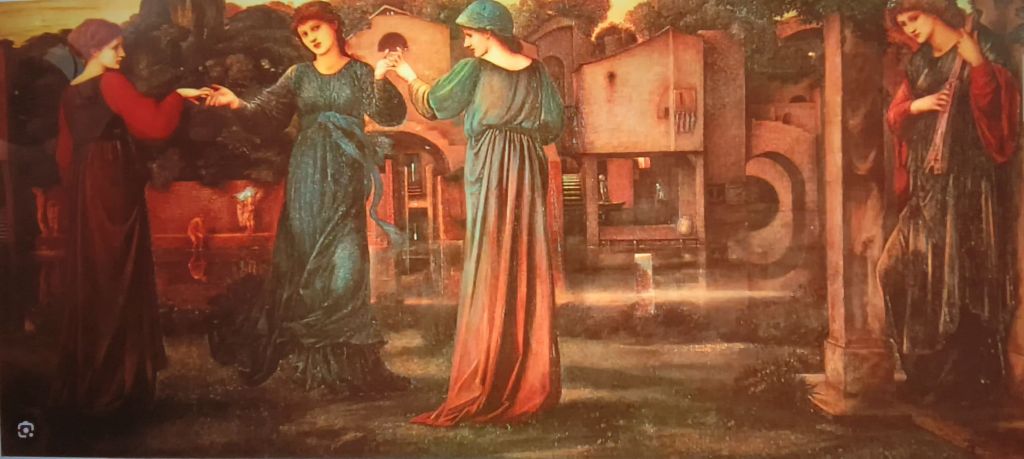
The painting ‘The Mill’ depicts four nude bathers on a further riverbank, where buildings and a mill-wheel are situated; on the foremost bank are three dancing maidens, a fourth figure lurks in an alcove clutching an object that may be a trumpet.
To interpret this scene in terms of reincarnation, the bathers are the shades of the dead standing beside the river Lethe, into which they have plunged and drank of its waters of forgetfulness, so that they might again experience a life on Earth – to enter once more on the eternal round – symbolized by the mill-wheel – of life-death-rebirth. The three dancing maidens to the fore of the painting are the three fates, Clotho the spinner who weaves the threads of a new life, Lachesis who measures the allotted span of that life and Atropos who determines how death shall cut the threads.
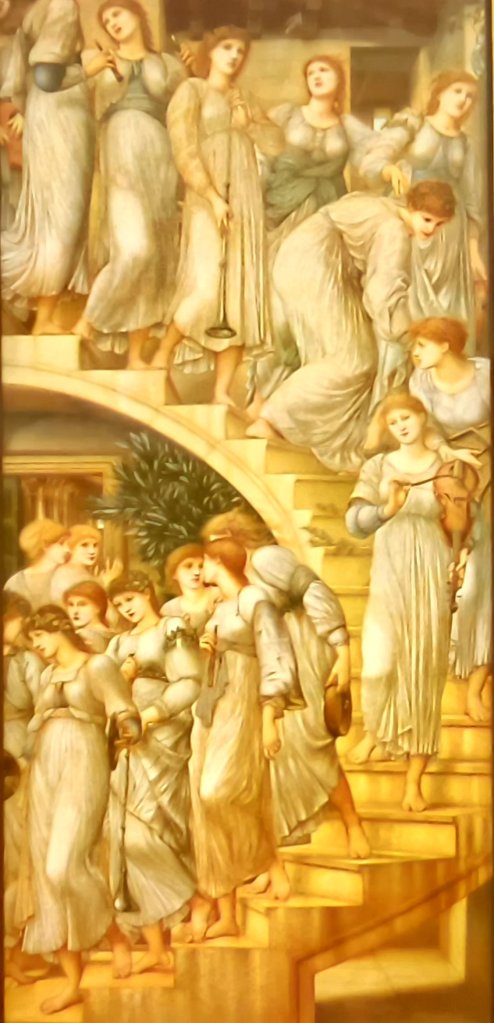
The Golden Stairs
Roger Drew in his 1996 PhD thesis ‘Symbolism and Sources in the painting and poetry of Gabriel Dante Rossetti’ which reflects upon the esoteric thought that shaped the subject matter of Rossetti’s works, considers ‘The Golden Stairs’depicting a long line of maidens, each holding a musical instrument, walking down a twisting stairway, to illustrate the Platonic descent of Beauty to rescue the soul; the spiralling stair modelled on William Blake’s (whose art exerted an influence upon Burne-Jones) ‘Jacob’s Ladder’ in which a spiral unearthly staircase upon which adults and children descend and ascend, rises up amongst the stars, behind the slumbering Jacob
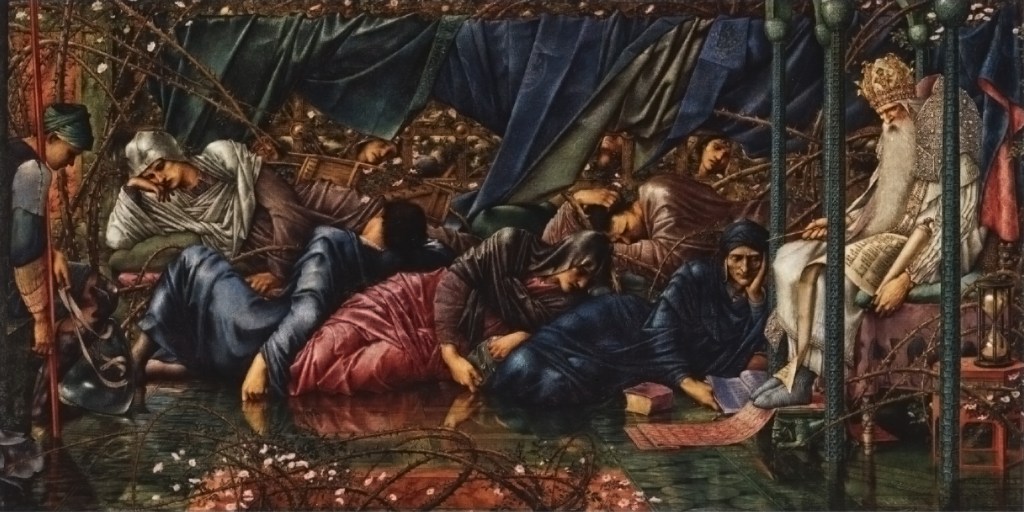
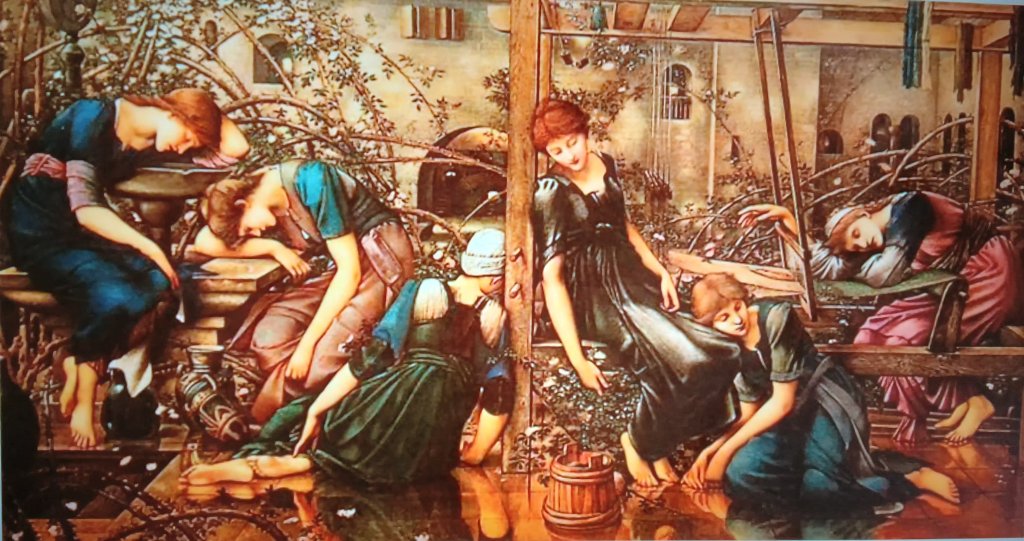
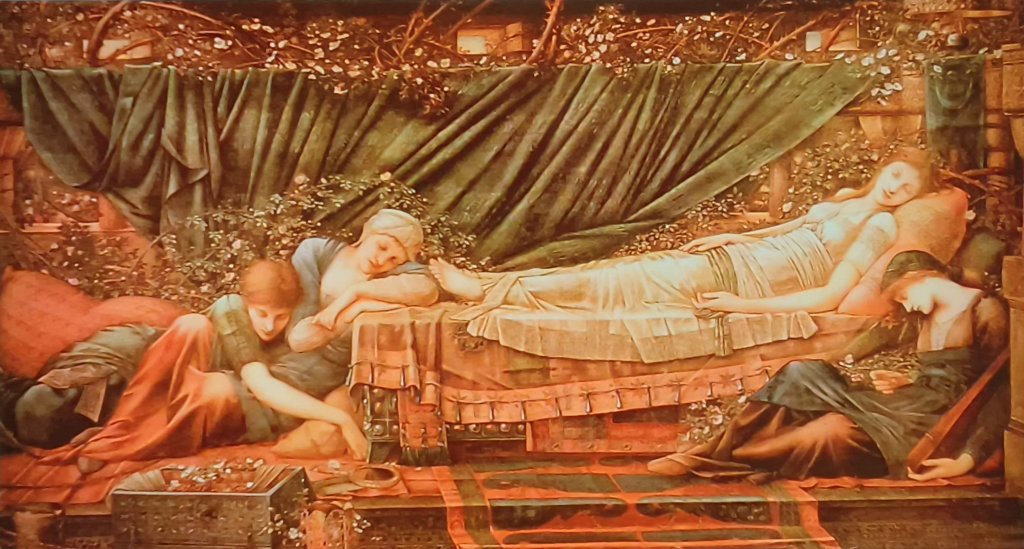
I now want to turn the same interpretative lens upon the four paintings composing ‘The Legend of Briar Rose’: ‘The Briar Wood’ ‘The Council Chamber’‘The Garden Court’‘The Rose Bower’ (accompanied by William Morris verses), which are based on the fairy tale Sleeping Beauty and inspired by the poem ‘The Day Dream’ by Tennyson; who himself had a great interest in the occult. Burne-Jones wrote to Cormell Price in 1853 that his heart-felt desire was to found a Brotherhood, with Tennyson (whom he referred to as ‘Sir Galahad’) the patron.
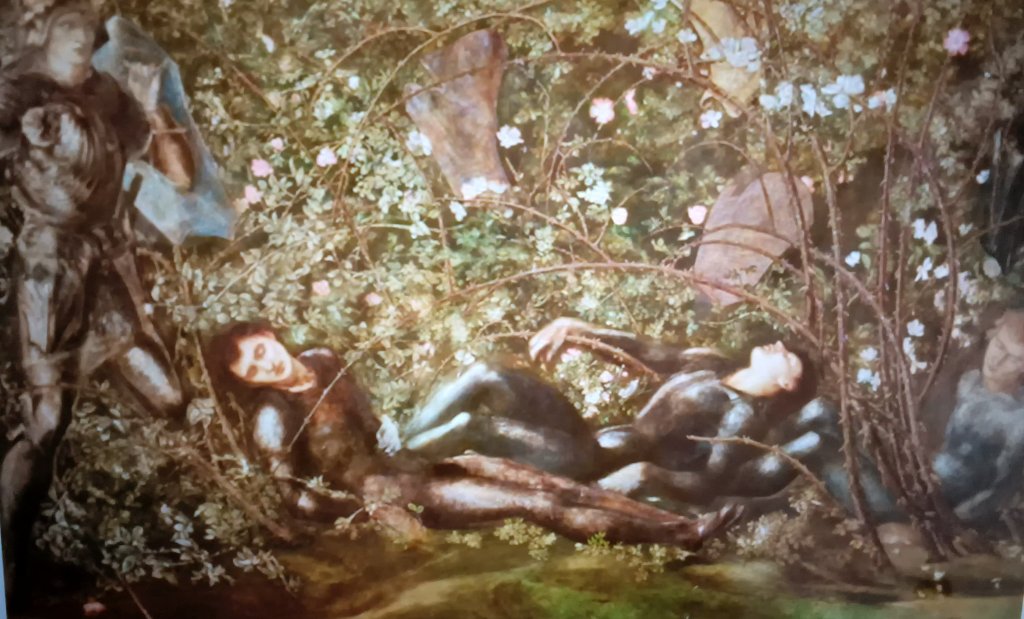
The Briar Wood
The Council Chamber
The Garden Court
The Rose Bower
First to outline the Sleeping Beauty fairy tale. Seven good fairies are invited to the christening of a princess, they are given rich gifts, and each in turn bestows upon the infant the qualities of beauty, wit, grace, dance, goodness and song; but before the seventh could pronounce her gift, she is interrupted by an old witch; whom everyone thought was dead and so she had not been invited to the feast. The deeply offended old witch places a curse upon the princess, she will prick her finger on the spindle of a spinning wheel and will die. The seventh fairy cannot undo the curse, but decrees the princess shall not die but sleep for a hundred years. When the curse is realized, the good fairy fearing the distress the princess will suffer upon awakening and finding everyone she loved and cared for dead, sends to sleep the entire inhabitants of the castle and then hides it from view by summoning a forest of trees around about it and brambles with their host of thorns. There it lies forgotten, until a prince spying its presence amongst the forbidding foliage, hacks his way into the castle and bestows a kiss on Sleeping Beauty’s lips waking her and everyone up.
In ‘The Briar Wood’ the prince has arrived and is confronted by sleeping knights in armour amongst an ever-encroaching mass of briar rose thorny branches; this is his only appearance for Burne-Jones does not concern himself with the awakening kiss. He concentrates on the castle’s timeless sleeping world and it is easy to think of the three sleeping women grouped around a loom in ‘The Garden Court’, surrounded by other sleeping servants, as representing the three fates, the working out of their handiwork in the lives around them suspended. The monarch, and his courtiers in the ‘The Council Chamber’ slumbers, oblivious to
The threat of war, the hope of peace,
The kingdoms peril and increase
While in her chamber ‘The Rose Bower’ Sleeping Beauty sleeps on, she is
. . . the hoarded love, the key
To all the treasure that shall be;
Love is the key, for this slumbering deadly world is the creation of lack of love, anti-love; it was the vanity, jealousy, pride of the old witch that had brought about this ruin. This lovelessness is symbolised in the paintings by the briar rose whose thorny branches have invaded every inch of this slumbering world; the etymology of the words ‘briar rose’ means ‘fragrant thorn’ more thorn than rose, a forbidding maze of chaotic branches unlike the rose bush with its straight stems and fragrant blossoms. Support for my reading of his use of the briar rose to symbolise the painful entanglement of bitter negative emotions, is his use of the scrambling shrub in his painting ‘Love among the Ruins’.
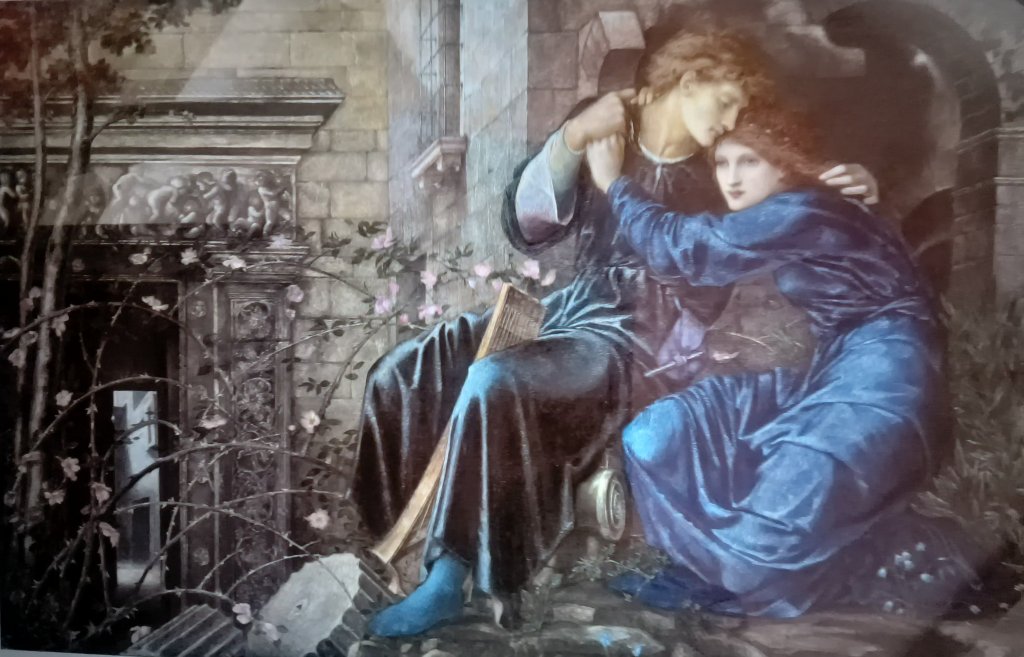
A man and woman sit clinging to each other, around them is littered fallen masonry, to their right is an ornate open doorway; but the way is barred by the tangled branches of a briar rose bush. This painting is widely regarded as illustrative of the emotional turmoil the married Burne-Jones had gone through during a four-year love affair with his model Maria Zambaco. When he tried to find a way to end the affair, matters finally came to a head on a January night in 1869, she wanted him to pledge himself to a suicide pact with her, he refused, and she tried to commit suicide by jumping into the Regent’s Canal; but he restrained her and was still struggling with her when the police arrived. Like Burne-Jones and Maria, the pair in the painting are trapped in the ruins of their dead love, but are still unable to escape the toxic emotional turmoil of its demise – represented by the spreading briar rose bush barring escape through the open doorway.
Burne-Jones’ depiction of the Sleeping Beauty world creates a miniature of human society and its strata – from the servants in the garden courtyard, to the sleeping knights in the briar rose thicket, to the king in his council chamber. It is this aspect of the paintings in which, I believe, lies their true import; as a metaphor for the society in which he lived and for which it is known he had little sympathy; he condemned the pollution caused by the Industrial Revolution and its misuse of the natural world, the morally questionable treatment of different races and cultures within the British Empire and its brand of unchecked capitalism; added to this, how he would perceive it, a spiritual blindness – creates a humanity sleeping through their doom.
My seeing this sub-text in the slumbering world of Briar Rose, is supported by stanza 7 of the ‘The Sleeping Palace’ a section of Tennyson’s ‘The Day Dream’, which inspired ‘The Legend of Briar Rose’;indicating the fairy tale is a vehicle for imparting a deeper message:
When will the hundred summers die,
And thought and time be born again,
And newer knowledge drawing nigh,
Bring truth that sways the soul of men?
One could say nothing has changed since he painted the ‘The Legend of Briar Rose’ – we are still ‘asleep’ guided by those with influence and power, unwilling to change a world that benefits them so well; who acting like chief lemmings are rushing us to our doom. Warnings about how we are abusing our planet are not new; Viktor Schauberger 1885-1958 was long an advocate for working with the natural world not against it. He remarked that it didn’t matter if people thought him mad, one more madman didn’t matter, but if he was right God help us.
‘The Legend of Briar Rose’is about the power of lovelessness, ‘The Pilgrim Triptych’ in contrast, which I turn to next, is about the search for the true nature of love – a search reflected in Burne-Jones’s own life in his addiction to passionately falling in love with a succession of beautiful women, coitus was never the object of these episodes which inspired much of his artistic endeavours; it was in essence a search for an ideal, a spiritual celestial love. He understood what drove his nature, considering himself to be essentially a monk tormented with carnal desires.
‘The Pilgrim Triptych’ is composed of three paintings ‘Love leading the Way’, ‘The Pilgrim at the Gate of Idleness’, ‘The Heart of the Rose’and is loosely based on Chaucer’s fourteenth century translation of Le Roman de la Rose ‘The Romance of the Rose’ by Guillaume de Lorris composed circa 1236.
In ‘Love Leading the Way’a man is identified as the pilgrim by a scallop shell adorning his hat; the shell is an emblem of pilgrimage, primarily associated with the tomb of Saint James of Compostela in Spain. The pilgrim is being aided to extricate himself from a bramble patch by an angelic figure, who similar to the account in ‘Romance of the Rose’ wears a chaplet of roses with a multitude of nightingales flying around his head and a number of birds about him on the ground. Burne-Jones has given him black wings and he holds as a staff a great arrow.
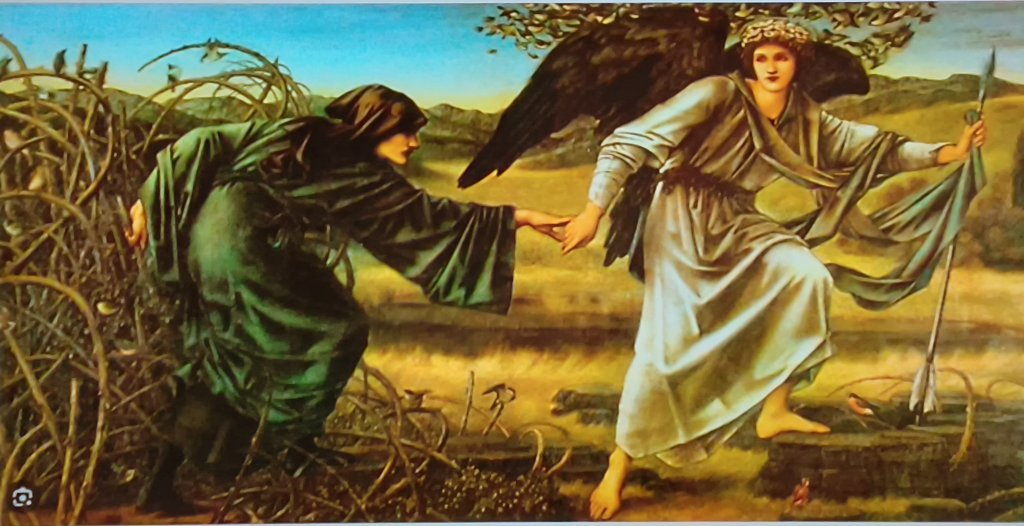
Love Leading the Way
In the second painting ‘The Pilgrim at the Gate of Idleness’the now absent angel has led the pilgrim to a castle-like dwelling, where a figure wearing a rose chaplet has emerged from the building an open door behind him, accessed by a stone slab over a filled water basin that runs the length of the wall, through which can be glimpsed a rose garden.
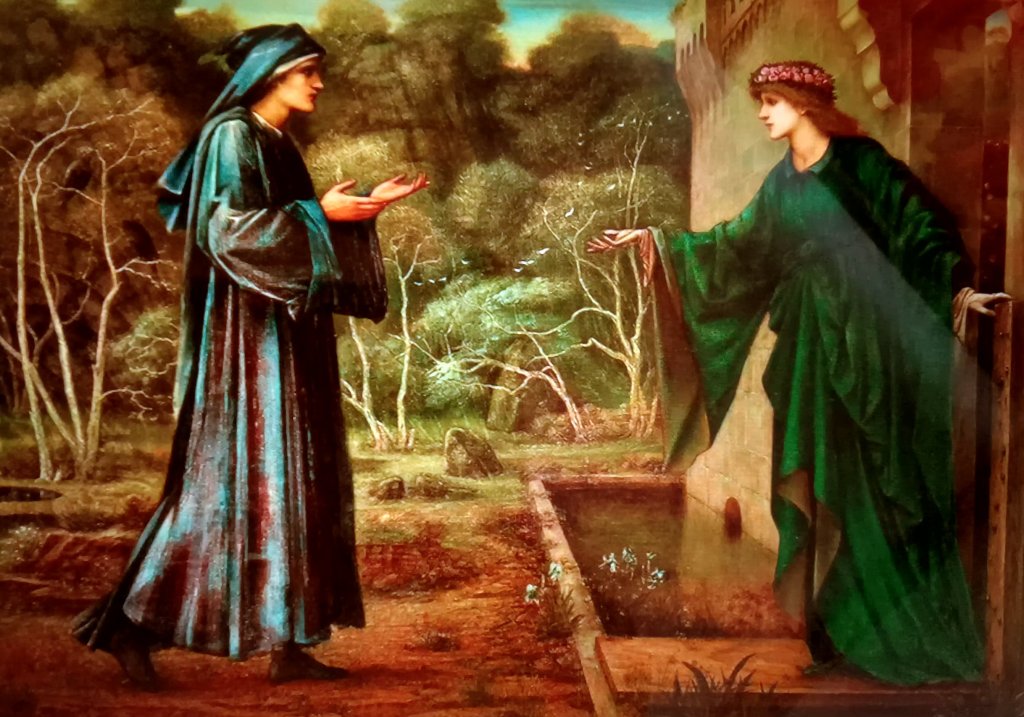
The Pilgrim at the Gate of Idleness
In the third painting ‘The Heart of the Rose’ the pilgrim has successfully gained entrance into the castle, followed by three nightingales, the angel stands beside him holding a black bow with white lilies growing to his right, as they gaze in unison upon a gracious maiden in a green gown seated in a rose bush.
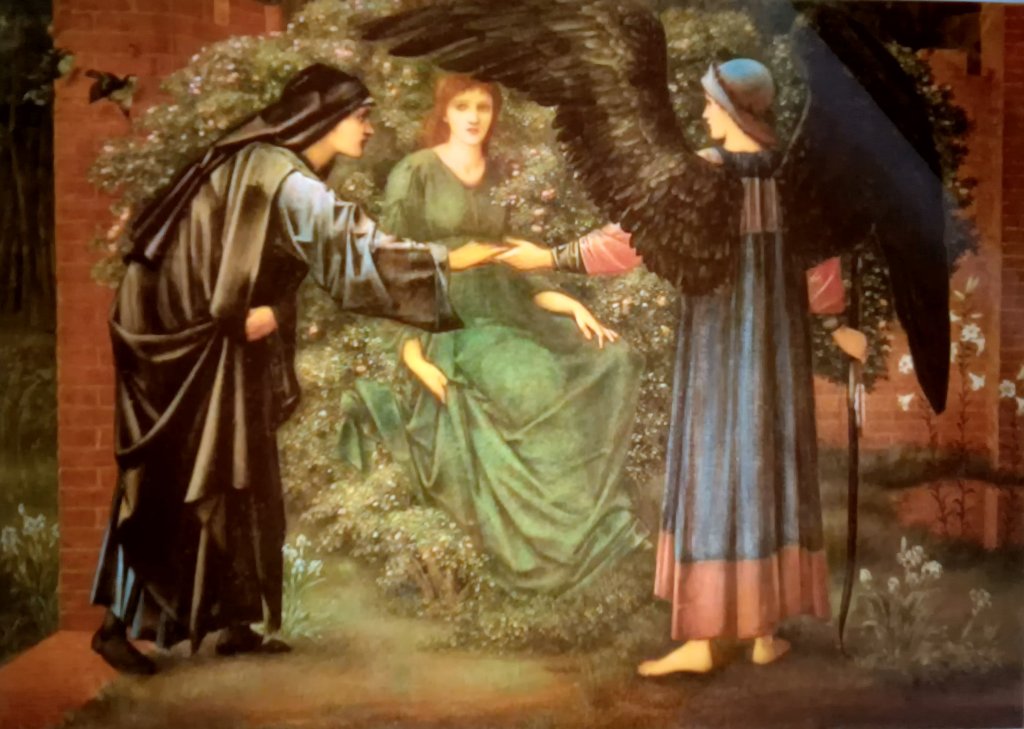
The Heart of the Rose
In ‘Love Leading the way’the angel is aiding the pilgrim to extricate himself from a bramble patch, this action in the light of the title of the painting identifies this supernatural being as a love emissary – leading the pilgrim out of a bramble patch, evocative of the briar rose representing a thorny maze of negative emotions, from which he is struggling to disentangle himself. This emissary of love is no cupid, who indiscriminately uses his inopportune arrows of love to randomly inflict joy or despair, for the only arrow he bears is used as a staff an emblem of a greater deeper love. His black wings the colour of night, decay and death, with similar symbolism attached to the nightingales (name deriving from Old English niht night and galan to sing) of night, nature, death and the hidden mysteries. This aspect of his and their nature portends that the love he serves requires a death of self, a spiritual death, a night time of the soul, a cleansing of baser emotions – as a Sufi sought to cleanse, to polish their heart so that it only reflects the divine greater Heart and Love; this same thinking is evident in ‘The Pilgrim Triptych’ for the penultimate painting and goal of the pilgrim is ‘The Heart of the Rose’ – the rose globally a symbol of love
In ‘The Pilgrim before the Gate of Idleness’ the emissary of love has brought the pilgrim before a castle, the red rose chaplet worn by an attendant emerging from within and the rose garden glimpsed through the open doorway behind him proclaims this place to be the Castle of Love; further substantiated by the nature of the final painting when the pilgrim gains admittance within. The title of the painting implies, the pilgrim has undergone a test of his resolve and not gained immediate access and fulfilment of his pilgrimage – evoking the stages of initiation before full admittance into the mysteries.
In ‘The Heart of the Rose’the three nightingales accompanying the pilgrim within and the presence of the angel, this time carrying a black bow (the power behind love’s arrows) assert again that entering here involves a death of self, a ‘death’ also symbolized by the stretch of water he traversed to enter, evoking a shade crossing a river of the Underworld; but the white lilies growing nearby, which symbolically represent a cleansed soul and rebirth, proclaims this ‘death’ is ultimately a rebirth: a rebirth in which his soul has been purified and he can glimpse and reflect the greater Heart, the divine Love of which we are an expression. This aspect of a cleansed soul and rebirth is emphasized in the two tapestry designs produced by Burne-Jones
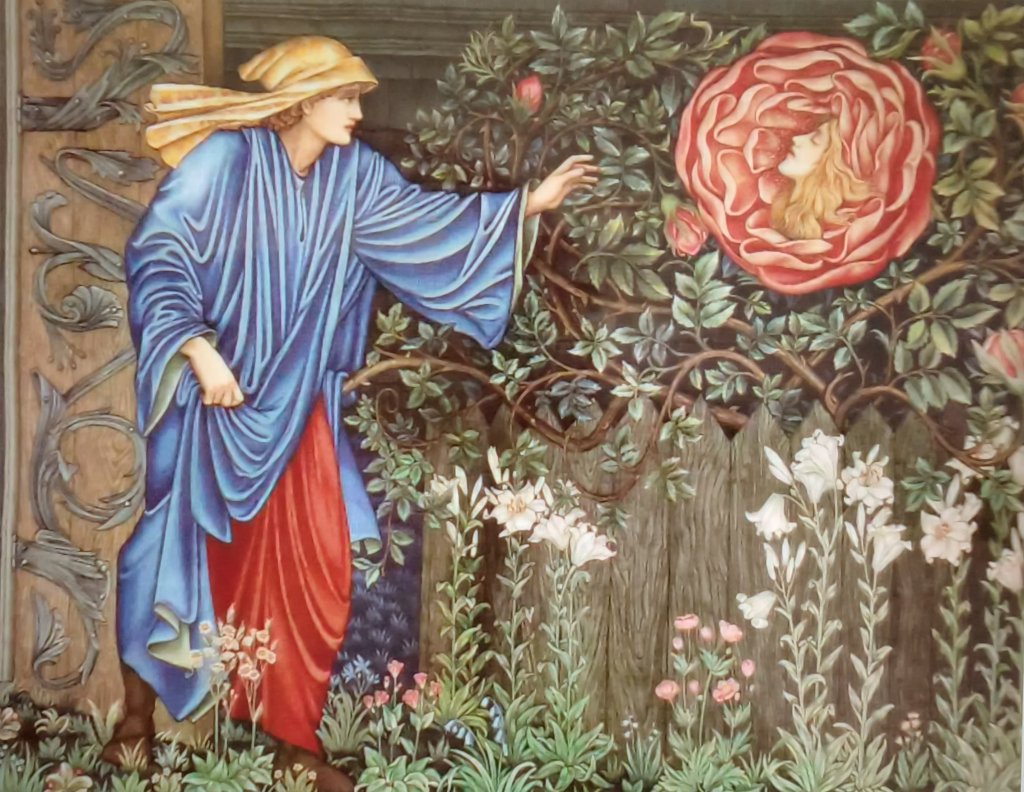
based on ‘The Heart of the Rose’in which the pilgrim stands before a row of white lilies growing before a fence, behind which a rose bush grows; the pilgrim is stretching out his hand towards an open blossom containing the face of a woman – but the lilies barring his way indicate that only those who have been transformed by the alchemy of spiritual death and rebirth can break down the barrier that separates the pilgrim from his union with the Love he desires. In the painting ‘The Heart of the Rose’the pilgrim has passed that barrier represented by a red-brick wall. The wall and fence are also symbols of time that cuts up the passage of our lives in seconds, minutes and hours – the pilgrim entering into the presence of the Heart of Love has entered a timeless, eternal dimension.
Burne-Jones portrays the cosmic Heart of Love of which human love is a reflection as a beautiful young woman, for it was in a number of women that he found intimations of this celestial perfect love.
 cDt
cDt 